

Cost of Professional Crypto Security Audits in 2026

Getting a professional crypto security audit isn’t optional anymore-it’s the bare minimum for any serious blockchain project. In 2026, skipping an audit is like building a house without locks on the doors. You might save money upfront, but one exploit can wipe out millions in assets and destroy your reputation overnight. The question isn’t whether you need one-it’s how much you should expect to pay, and what you actually get for that price.
What You’re Paying For
A crypto security audit isn’t just a scan with a tool. It’s a deep, human-led investigation into your smart contracts. Top firms combine automated tools that check for known vulnerabilities-like reentrancy bugs or overflow errors-with manual code reviews by engineers who’ve seen every exploit pattern in the book. They don’t just look at syntax. They test your tokenomics, your governance mechanics, your external contract integrations, and how your system behaves under stress.Think of it like a structural engineer inspecting a bridge. They don’t just check if the steel is rusted-they simulate earthquakes, heavy loads, and extreme weather. That’s what a good audit does for your code.
Cost Tiers: From Simple Tokens to Enterprise DeFi
Audit prices vary wildly based on complexity. Here’s what you’re likely to pay in early 2026:- Basic token contracts (ERC-20, SPL tokens): $1,000-$20,000. If your project is just a simple token with minting and transfer functions, no staking, no governance, no complex logic-you’re in this range. Some firms quote as low as $1,000, but those often skip deep logic checks.
- Intermediate projects (NFT collections, staking, basic governance): $15,000-$50,000. Once you add features like reward distribution, voting mechanisms, or multi-signature wallets, the audit gets harder. Auditors have to trace how changes in one contract affect others. This is where most mid-tier DeFi projects land.
- DeFi protocols (DEXs, lending platforms, yield aggregators): $40,000-$100,000. These systems move millions in real-time. A flaw in a liquidity pool calculation or a price oracle integration can lead to catastrophic losses. Auditors spend weeks here, modeling economic attacks and edge cases.
- Enterprise-grade systems (multi-chain bridges, DAO treasuries, cross-chain protocols): $100,000-$300,000+. These are the most complex. A bridge connecting Ethereum, Solana, and Polygon? That’s not one audit-it’s three audits stitched together, plus checks for consensus failures, relay attacks, and timestamp manipulation. Firms like Trail of Bits and ConsenSys Diligence handle these.
Why Some Audits Cost More
It’s not just about size. Several hidden factors drive the price up:- Language and chain: Solidity (Ethereum) audits are cheaper because there are more experts. Rust (Solana, Near) audits cost 20-40% more due to fewer specialists.
- Code quality: Well-documented, modular code cuts audit time. Messy, poorly commented code? That adds days-and thousands-to the bill.
- Timeline: Rushing an audit? Expect a 25-50% premium. Most firms need 2-4 weeks for basic audits. Complex ones take 8-16 weeks. If you want it in two weeks, you’re paying for overtime.
- Reputation: Top-tier firms like OpenZeppelin, Trail of Bits, and CertiK charge 30-50% more than newer players. Why? Because their track record matters. If your project gets hacked after a $5,000 audit, your investors will blame the audit firm. They’d rather pay more for one with a clean history.

The Hidden Costs Nobody Talks About
Here’s the truth: the quote you get is rarely the final bill. Most audits uncover vulnerabilities. That means you have to fix your code-and then get it re-audited.Industry experts say budget an extra 20-30% beyond the initial quote. Why? Because:
- Fixing a reentrancy bug might require rewriting three contracts.
- Changing your staking rewards formula could break your tokenomics model.
- After you patch it, the auditor has to come back and verify your changes.
One team I spoke to spent $18,000 on their first audit, then $12,000 on a re-audit after fixing 12 critical issues. They thought they were getting a $15,000 service. They ended up paying $30,000.
And if you skip the re-audit? You’re gambling. Many hacks in 2024-2025 happened on contracts that were “audited” but never re-checked after fixes.
What Happens If You Go Cheap
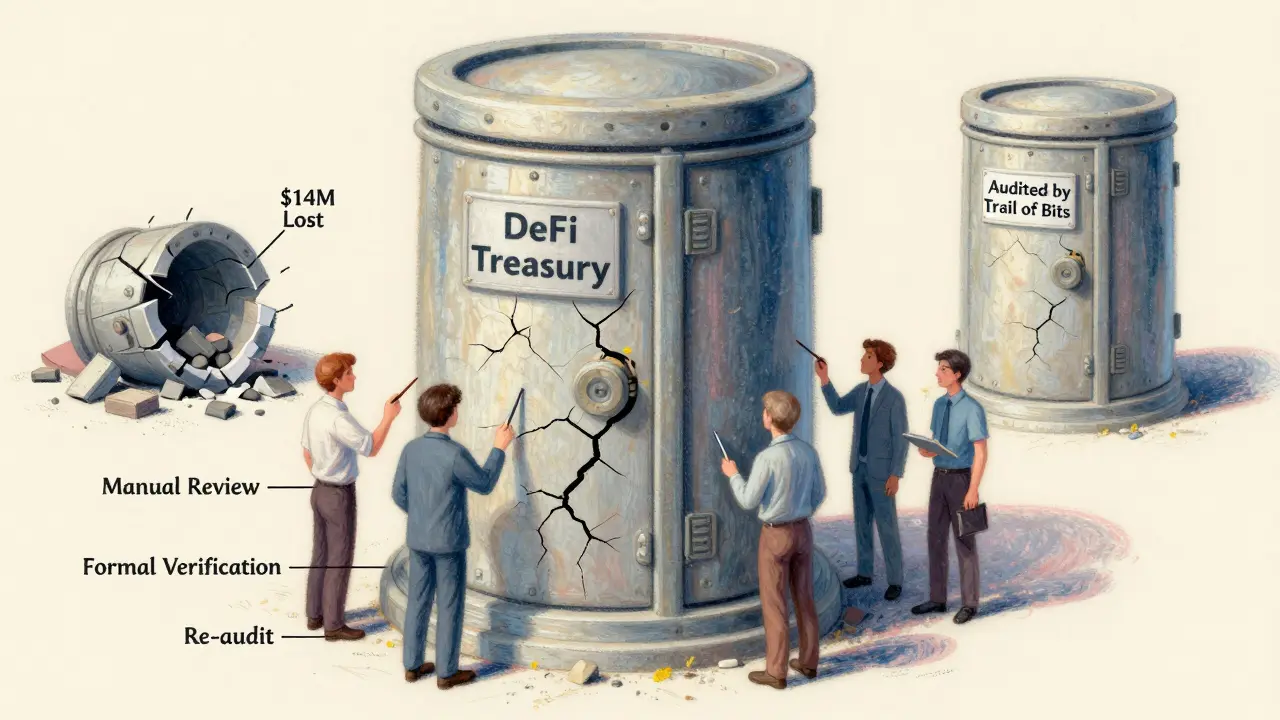
Reddit threads and Twitter threads are full of horror stories. A project raised $20 million, paid $5,000 for an audit, and got hacked six weeks after launch. The exploit cost them $14 million. The audit firm had used only automated tools. No human reviewed the logic. The report was 12 pages long-mostly generic warnings.Community feedback is clear: cheap audits are dangerous. They give you a false sense of security. You get a PDF that says “no critical issues found,” but miss a subtle flaw in how your contract handles withdrawal limits. That’s the kind of bug that lets someone drain your treasury slowly, over days, without triggering alarms.
Developers who’ve been burned say: “I’d rather pay $80,000 to an established firm than $10,000 to someone I found on Fiverr.”
How Much Should You Budget?
Most successful projects allocate 5-10% of their total development budget to security audits. For DeFi protocols with millions in TVL (total value locked), that number jumps to 10-15%.Here’s a simple rule: if your project handles more than $1 million in assets, don’t even consider an audit under $15,000. If you’re managing $50 million or more, expect to pay $75,000+.
And don’t forget: audits aren’t a one-time cost. Every major upgrade, new feature, or chain expansion needs another review. Think of it like software maintenance-except in crypto, the stakes are life-or-death.
What to Look for in an Audit Firm
Not all audits are equal. Here’s what separates the good from the bad:- Public reports: Reputable firms publish their audit results (even for failed audits). If they won’t show you past reports, walk away.
- Team credentials: Look for auditors who’ve spoken at DevCon, published research on blockchain vulnerabilities, or worked on protocols like Uniswap or Aave.
- Process transparency: Do they explain their methodology? Do they use static analysis + manual review + formal verification? If they just say “we use tools,” that’s a red flag.
- Post-audit support: Do they help you fix issues? Or just hand you a report and disappear?
Top firms don’t just find bugs-they help you understand them. They’ll explain why a vulnerability matters, how it can be exploited, and how to fix it without breaking your tokenomics.
Preparing for an Audit
You can lower your audit cost-without lowering your security-by preparing well:- Use OpenZeppelin’s hardened contracts as a base. They’re battle-tested.
- Document your logic. Write clear comments on what each function does and why.
- Test your code thoroughly before sending it out. Use Foundry or Hardhat to simulate attacks.
- Keep your code modular. Avoid spaghetti code with 10,000-line contracts.
Projects that come in prepared cut audit time by 30-40%. That’s thousands of dollars saved.
The Bigger Picture
The crypto audit industry has grown from $50 million in 2020 to over $400 million in 2026. Demand is outpacing supply. There aren’t enough skilled auditors to meet the need. That’s why prices keep rising.But here’s the real math: losing $10 million to a hack costs far more than a $100,000 audit. Reputation damage, lost investor trust, regulatory scrutiny, and legal fees add up fast. In 2025 alone, over $800 million was lost to exploits on unaudited or poorly audited contracts.
Security isn’t a line item on your budget. It’s the foundation of your project’s survival.
How long does a crypto security audit take?
Basic token audits take 2-4 weeks. Intermediate projects like NFT collections or staking systems take 4-8 weeks. Complex DeFi protocols or multi-chain bridges can take 8-16 weeks. Timelines often extend if critical vulnerabilities require major code changes and re-testing.
Can I skip the audit to save money?
Technically, yes-but it’s extremely risky. Over $800 million was lost in 2024-2025 to exploits on projects that skipped or skimped on audits. Even if your project seems small, a single vulnerability can drain your entire treasury. Audits aren’t optional-they’re insurance.
Are automated audits enough?
No. Automated tools catch only about 30-40% of vulnerabilities, mostly known ones like reentrancy or overflow errors. They miss logic flaws, economic attacks, and subtle bugs in tokenomics. A professional audit combines automation with manual review by experienced engineers who think like attackers.
Why are Solana audits more expensive than Ethereum ones?
Solana programs are written in Rust, and there are far fewer auditors with deep expertise in Rust and Solana’s unique architecture compared to Solidity and Ethereum. Lower supply + higher demand = higher prices. Solana audits typically cost 20-40% more than equivalent Ethereum audits.
Do I need more than one audit?
For high-value projects-especially DeFi protocols or cross-chain bridges-it’s strongly recommended. Many institutional investors now require audits from two or more independent firms. This reduces the risk of a single auditor missing a critical flaw. While it doubles the cost, it also dramatically increases security assurance.
What’s included in a typical audit report?
A full report includes a summary of findings, a severity rating for each issue (critical, high, medium, low), detailed technical explanations, proof-of-concept exploits (if applicable), and remediation recommendations. Top firms also provide follow-up consultations to help you implement fixes correctly.
Can I audit my own smart contracts?
You can test your code, but you shouldn’t call it an audit. Even experienced developers miss blind spots. Professional auditors have seen hundreds of exploits and know what to look for. It’s like a surgeon checking their own X-rays-possible, but not advisable. Outsourcing gives you objectivity and credibility with users and investors.
How do I know if an audit firm is trustworthy?
Check their public audit reports-do they publish them? Look at their team’s LinkedIn profiles-are they active in the blockchain security community? Have they audited well-known protocols? Avoid firms that don’t share past work or can’t name any clients. Reputation matters more than price.






Honestly? This is the most clear-headed breakdown I've seen in months. I've been burned before by cheap audits. Now I just say 'no audit, no launch.' 💯
i heard a guy paid 5k for an audit and got hacked 2 weeks later lol
This is why crypto is a scam. They want you to pay $200k to prove your code works. Meanwhile the whole system is built on sand.
If you're building anything with real value, treat security like oxygen. You don't skip it. You don't bargain for it. You just breathe it. This post nailed it.
The assertion that audits are non-negotiable is statistically unsound. There are documented cases where audits failed to prevent exploits, while un-audited projects thrived due to superior economic design. The industry is capitalizing on fear.
USA and Canada are getting ripped off. In India we get full audits for $8k and better service. These firms are just rent seekers
Anyone who thinks a $10k audit is enough deserves to get hacked. You're not a developer, you're a liability. 😒
I've been in this space since 2017. Every major hack came after an audit. The audits are fake. The firms are in cahoots with the devs. You think they want you to be safe? They want you to pay them again next month.
It's not about the money, it's about the energy. When you invest in security, you're aligning with cosmic integrity. The blockchain is a mirror - what you put into it reflects back. 💫✨
I love how this post doesn't just list prices - it explains WHY the cost exists. So many people think audits are a tax, but they're actually a shield. Thank you for this.
Let's be real - 80% of these audits are just automated scans with a PDF cover page. The 'manual review' is a 30-minute skim. The whole industry is a pyramid scheme built on FUD.
Rust audits cost more? That's because American firms charge more for everything. Canadian devs do better work for less. The market is broken.
In Nigeria we have brilliant young auditors who work for $5k and know more than some US firms. The problem is not skill, it's access to networks. Give them a chance
If security is the foundation, then why do we build on top of systems that are themselves unsecured? The audit is a symptom, not the cure. The real question is: why do we trust code that cannot be proven?
I used to believe in audits. Then I saw the report from a $120k audit that said 'no critical issues' - and the project got drained of $40M in 48 hours. The whole thing is theater.
Look, I've spent 18 months in this industry and I've learned one thing: if you're not paying $100k+, you're not getting an audit, you're getting a receipt. The firms that charge less are either incompetent or complicit. Don't be fooled by pretty reports. Ask for the raw findings. Ask for the PoC scripts. If they won't show you, you're being played.
The notion that one should allocate 5–10% of one's development budget to security is not merely prudent; it is a fiduciary imperative. To do otherwise constitutes negligence.
I started with a $5k audit and lost $200k. Then I went with Trail of Bits for $85k. Took 10 weeks. Found 23 issues. Fixed them. Launched. No hacks. Worth every penny. Don't be cheap. Your users are counting on you.
big up to the devs who prep their code right - clean comments, modular contracts, tested with foundry. you save so much cash and stress. audit time drops like magic
I just don't get why people get mad about audit prices. If your app handles millions, and you're crying over $50k, maybe you shouldn't be in crypto. That's like complaining about buying a seatbelt.
I know a guy who got audited by a firm that later got indicted for fraud. The audit report was generated by a bot. The auditors were in a different country, speaking a different language. We're not securing code - we're playing Russian roulette with a loaded gun.
I used to think audits were overkill. Then my friend's project got drained because of a tiny off-by-one error in the withdrawal function. Nobody saw it. The audit firm missed it. That’s why you need humans who’ve seen it all. Not tools.
The fact that we even have to debate this is a tragedy. Audits aren't a cost - they're a covenant with your community. If you break that covenant, you deserve to fail. The money is the least of your worries.
And if you're the author - thank you. This is the kind of post that saves projects. I'm sharing this with every startup I know. The re-audit cost? Totally real. Budget for it. Don't be that guy.