
Thailand SEC Crypto Regulations for Exchanges: Rules, Bans & Licensing Guide
Did you know that in early 2025, popular global crypto platforms like Bybit and OKX were suddenly blocked from serving users in Thailand? If you are a trader or an exchange operator looking at the Southeast Asian market, this shift is not just noise-it is a fundamental change in how cryptocurrency exchanges must operate to survive.
The Thailand Securities and Exchange Commission (SEC) has tightened its grip on the digital asset space. The goal isn't to kill innovation; it is to stop scammers from exploiting loopholes. With new emergency decrees effective April 13, 2025, the rules for who can trade, what they can trade, and how platforms must behave have become crystal clear-and strictly enforced. This guide breaks down exactly what these restrictions mean for you, whether you are trying to trade Bitcoin or launch a new platform.
The Core Legal Framework: Digital Asset Business Act
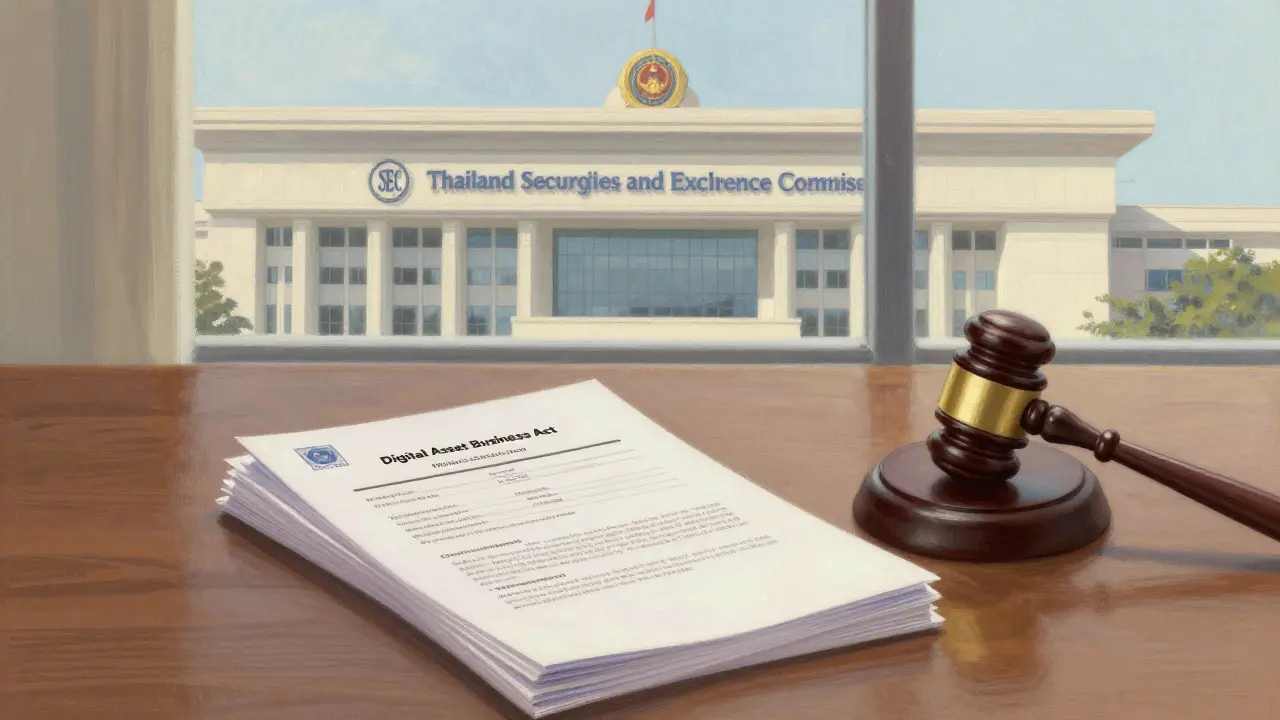
To understand the current landscape, we need to look at the law driving it all. The foundation is the Digital Asset Business Act (DABA) originally enacted as the Royal Decree on Digital Asset Businesses B.E. 2561/2018. However, the game changed significantly with amendments passed via the Emergency Decree on Digital Asset Businesses (No. 2) B.E. 2568 (2025). These changes were driven by the Thai Ministry of Finance, with oversight from the Office of the SEC under Secretary-General Pornanong Budsaratragoon.
The primary purpose of this framework is threefold: preventing money laundering, curbing online fraud, and protecting Thai investors from unregulated platforms. Before these updates, many foreign operators served Thai customers without local oversight. Now, any entity deemed to be providing services to persons in Thailand must obtain proper licensing from the Thai SEC. Failure to comply results in severe penalties, including heavy fines and prison terms.
As of February 2025, only nine entities had secured approval as licensed digital asset portals. You can verify their status through the official SEC licensing database. This exclusivity means that if your favorite exchange isn't on that list, it likely shouldn't be operating in Thailand right now.
How the SEC Defines "Serving Thai Users"
One of the most critical aspects of the 2025 amendments is the extraterritorial reach. Many foreign exchanges argued they didn't operate in Thailand because their headquarters were elsewhere. The SEC shut down this loophole by defining seven specific characteristics that determine when a foreign platform is considered to be serving Thai users. If a platform meets even one of these criteria, it requires a license:
- Language: The digital platform is displayed in whole or in part in the Thai language.
- Domain Name: Using a domain extension like ".th" or ".ไทย" or other Thailand-related names.
- Currency: Accepting payments in Thai baht (THB) or through Thai deposit/electronic money accounts.
- Governing Law: Specifying Thai law as the governing law or Thai courts for dispute resolution.
- Marketing: Paying search engines to facilitate access specifically for Thai users.
- Local Presence: Establishing offices or personnel to support Thai users.
- Other Criteria: Any other characteristics prescribed by SEC Notification.
This definition effectively caught major players like Bybit and OKX, leading to their shutdown in the Thai market following the April 2025 regulatory changes. It forces platforms to choose: get licensed locally or block Thai IP addresses entirely.
Operational Restrictions for Licensed Exchanges
Getting a license doesn't mean you can do whatever you want. Licensed digital asset business operators face strict operational restrictions designed to keep the market stable and secure. Here is what is currently prohibited:
- Privacy Coins: Services for privacy-focused cryptocurrencies are banned due to anti-money laundering concerns.
- Payment Promotion: Promoting digital assets as payment for goods and services is prohibited. Crypto is treated as an investment asset, not currency.
- Lending with Promised Returns: Offering deposit-taking or lending services with guaranteed returns is forbidden to protect retail investors from unsustainable yield schemes.
- Meme and Fan Tokens: Trading of meme tokens, fan tokens, and non-fungible tokens (NFTs) on local exchanges is explicitly prohibited.
The SEC issued specific notifications prohibiting licensed operators from advertising excessively, providing certain wallet services, or facilitating transfers for payment purposes. Compliance is enforced through regular audits. For example, Bitkub Thailand's largest licensed exchange reported a six-month implementation period to fully adapt its systems to meet these specifications.
Comparison: Thailand vs. Global Regulatory Models
How does Thailand's approach stack up against other major jurisdictions? Understanding this helps contextualize why the rules are so strict here compared to elsewhere.
| Feature | Thailand (SEC) | Singapore (MAS) | European Union (MiCA) |
|---|---|---|---|
| Foreign Exchange Participation | Restricted; must license locally | More open to foreign participation | Passporting allowed across EU |
| Extraterritorial Reach | Strong (7-point test) | Moderate | High (Single Market) |
| Stablecoin Clarity | Limited clarity | Developing guidelines | Clear e-money token rules |
| Blocking Mechanism | Instant blocking by MDES | Court orders often required | National enforcement varies |
Thailand's model is notably stricter than Singapore's Monetary Authority of Singapore (MAS) framework but less restrictive than China's complete ban. A unique differentiator is the expedited blocking mechanism, which allows the Ministry of Digital Economy and Society (MDES) to block unlicensed platforms instantly without needing court orders. This speed was evident in the rapid removal of several offshore apps in mid-2025.
Impact on Traders and Market Dynamics
So, what does this mean for the average user? The impact has been mixed. On one hand, security has improved dramatically. According to the Royal Thai Police Cybercrime Investigation Division, there was a 37% decrease in crypto-related fraud reports in Q2 2025 compared to Q1 2025. Users on Pantip.com, Thailand's largest discussion forum, praised the "more secure trading environment" after foreign exchanges left.
On the other hand, liquidity and choice have suffered. Complaints focus on reduced liquidity and wider spreads on local exchanges compared to giants like Bybit. As of June 2025, only 35 tokens were approved for trading on local exchanges, versus the 350+ available on former foreign platforms. Transaction fees also averaged 0.25% on local sites, compared to 0.1% on international ones.
Furthermore, withdrawal limits can be restrictive. For instance, Bitkub imposes a daily withdrawal limit of ฿500,000 (approximately $13,700), which some serious traders find constraining. Consequently, estimates suggest that 35% of Thai crypto activity has migrated offshore since April 2025, with users increasingly accessing foreign platforms through VPN services-a practice that carries legal risk under the new cybercrime decrees.
Licensing Process for New Entrants
If you are an exchange looking to enter the Thai market, the path is expensive and rigorous. Foreign exchanges seeking Thai licensing must submit documentation to the SEC within 30 days of operations targeting Thai users. The financial barriers include:
- Application Fee: ฿1,000,000 ($27,400).
- Annual License Fee: ฿500,000 ($13,700).
- Minimum Operational Capital: ฿50 million ($1.37 million).
Required documentation includes proof of Anti-Money Laundering/Counter-Financing of Terrorism (AML/CFT) compliance systems meeting Financial Action Task Force (FATF) standards, source code audits from SEC-approved firms, and evidence of capital reserves. The average approval timeline is 90-120 days. Major challenges involve adapting user interfaces to comply with Thai language requirements and implementing real-time transaction monitoring systems that meet SEC specifications.
Recent developments show that even global giants are adapting. Binance announced the expansion of its Thai hub operations in June 2025, signaling confidence in the long-term viability of the regulated market. Additionally, the SEC issued clarifications regarding staking services on June 1, 2025, providing more guidance for compliant offerings.
Future Outlook: DeFi and CBDC Integration
The regulatory roadmap extends beyond today's restrictions. Planned amendments to the Digital Asset Business Act in Q4 2025 aim to address decentralized finance (DeFi) platforms, which currently exist in a gray area. Furthermore, a pilot project for central bank digital currency (CBDC) integration with licensed exchanges is expected in Q2 2026. This could revolutionize settlement speeds and costs for Thai traders.
The Thai ETF market is also preparing to expand beyond Bitcoin and Ethereum, with altcoin ETF products planned for 2026. This expansion could unlock up to $3 billion in new investment capital. Industry analysts project a 22% compound annual growth rate for Thailand's regulated crypto market through 2028, supported by government commitment to blockchain innovation, including a ฿2.1 billion allocation for blockchain development projects through 2027.
Is it illegal to use foreign crypto exchanges in Thailand?
Yes, if the exchange is deemed to be serving Thai users based on the SEC's seven-point test (e.g., accepting THB, using Thai language), it must be licensed. Using unlicensed platforms can expose users to risks, and the government has mechanisms to block access. While individual users aren't typically prosecuted, their funds may be less protected, and access can be cut off abruptly.
Which crypto exchanges are currently licensed in Thailand?
As of early 2025, nine entities were approved. The most prominent is Bitkub. Others include Zipmex (under restructuring/supervision), SATANG Platform, and others listed on the official SEC licensing database. Always check the SEC website for the most current list as licenses can be revoked or granted.
Can I trade NFTs and Meme coins in Thailand?
Currently, no. Licensed exchanges in Thailand are explicitly prohibited from listing meme tokens, fan tokens, and non-fungible tokens (NFTs). These assets are considered high-risk or speculative without underlying utility, and the SEC aims to protect retail investors from such volatility.
What happens if a foreign exchange ignores the ban?
The Ministry of Digital Economy and Society (MDES) can instantly block the platform's domain and app store listings without a court order. Additionally, the company faces heavy fines and potential prison terms for executives if they are found to be actively targeting Thai users without a license.
Are there plans to regulate DeFi in Thailand?
Yes. The SEC has indicated that planned amendments to the Digital Asset Business Act in Q4 2025 will specifically address decentralized finance (DeFi) platforms. Currently, DeFi exists in a regulatory gray area, but expect clearer rules on liquidity providers and smart contract audits soon.