

What Happens If You Withdraw Crypto to Fiat in China: Bank Reactions and Risks

You might think that holding cryptocurrency is just a personal financial choice. In mainland China, however, trying to convert those digital assets into Chinese Yuan (CNY) or other fiat currencies through traditional banking channels is a high-stakes gamble with your entire financial life. The rules are not just strict; they are actively enforced by sophisticated surveillance systems designed to catch even the smallest slip-up.
If you attempt to withdraw crypto proceeds to a bank account in China, you aren't just breaking a rule-you are triggering a multi-layered response from the People's Bank of China (PBoC), local commercial banks, and anti-money laundering agencies. This isn't about vague warnings. It’s about immediate account freezes, mandatory reporting, and potential long-term bans on using formal financial services. Here is exactly what happens behind the scenes when you try to bridge the gap between crypto and fiat in one of the world’s most regulated financial environments.
The Legal Reality: Why Banks Must Say No
To understand why Chinese banks react so aggressively, you first need to look at the legal foundation. Since September 2021, a joint statement by the PBoC and nine other government agencies has classified all cryptocurrency trading activities as "illegal financial activities." This document, known as Circular No. 237, explicitly forbids financial institutions from providing any services related to crypto transactions. This includes account opening, payment settlement, and fund transfers.
While it is technically not illegal for an individual to *hold* crypto in China, converting it to fiat through a bank is strictly prohibited. The law treats this not as a simple currency exchange but as a violation of monetary sovereignty. As Pan Gongsheng, Governor of the PBoC, stated in May 2025, stablecoins and crypto assets pose a significant threat to global financial stability. For a bank employee, facilitating such a transaction isn't just a mistake-it can lead to criminal liability and the revocation of their business license. This creates a zero-tolerance environment where compliance teams are incentivized to block any suspicious activity immediately.
How Banks Detect Crypto Transactions
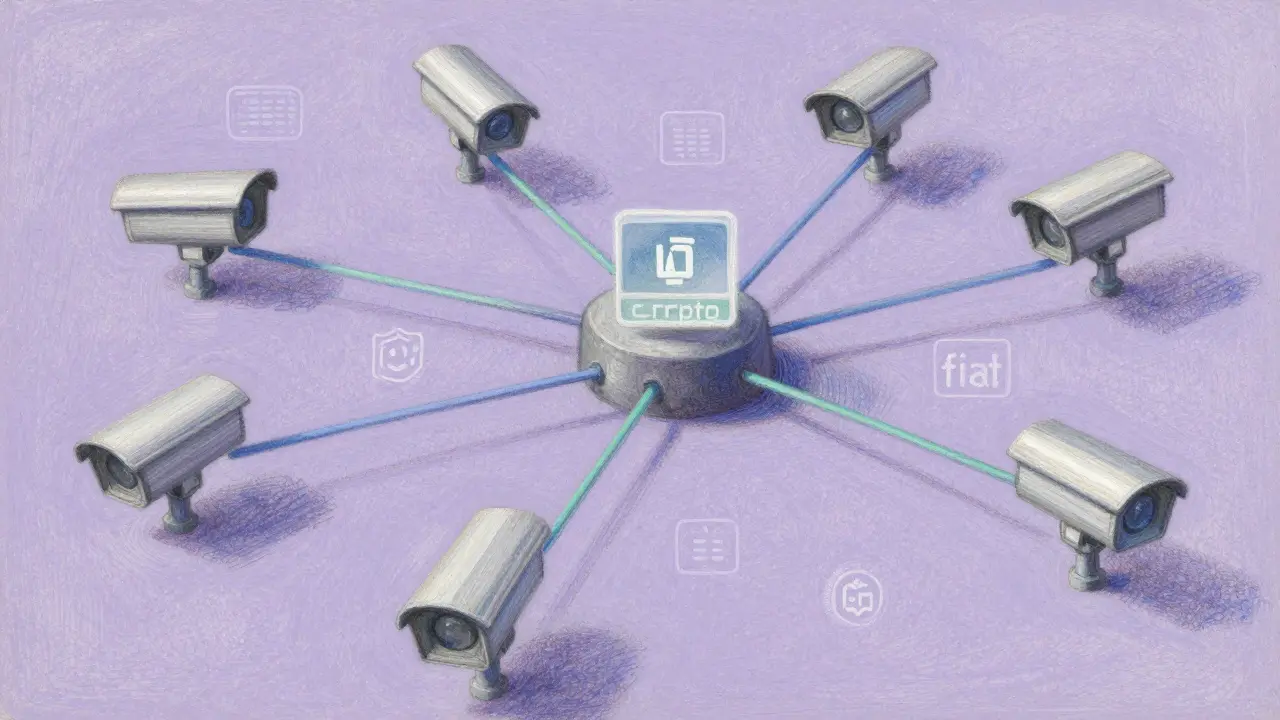
You might wonder how a bank knows if a transfer is linked to crypto, especially if you don't mention it. The answer lies in advanced algorithmic monitoring. Chinese banks employ sophisticated transaction pattern analysis tools trained to detect characteristics commonly associated with crypto-to-fiat conversions. These systems don't just look for keywords; they analyze behavior.
The detection algorithms flag several specific red flags:
- Rapid sequential transfers: Moving money quickly between multiple accounts to obscure the source.
- Unusual aggregation patterns: Many small deposits that add up to a large sum shortly before a withdrawal.
- Known wallet associations: Transactions linked to IP addresses or entities associated with banned exchanges like Binance, Huobi, or OKEx.
- Blacklisted addresses: Interactions with any of the 14,273 crypto-related addresses currently on China's official blacklist.
In fact, data from July 2025 shows that 68% of detected cases involved transactions with IP addresses linked to known crypto exchanges. Another 23% were flagged due to rapid movement of funds between accounts. The remaining cases often involve connections to offshore entities serving Chinese residents. Once these patterns are identified, the system doesn't wait for human review to act-it triggers an automatic hold.
The Immediate Consequence: Account Freezes
When a bank's monitoring system detects suspicious activity, the reaction is swift. According to Circular No. 319 issued by the PBoC in June 2022, banks must freeze relevant accounts immediately upon detecting suspicious crypto-related activity. This freeze typically lasts for an initial 72 hours while investigators conduct their preliminary review.
However, 72 hours is rarely the end of the story. Data from China's six largest commercial banks indicates that 89% of frozen accounts remain restricted for more than 30 days. During this period, you cannot access your funds, make new transfers, or use debit cards linked to the account. The bank is required to report the incident to both the China Anti-Money Laundering Monitoring and Analysis Center (CAMLMAC) and local branches of the PBoC within 24 hours.
This process is not just administrative. It is part of a broader enforcement strategy. In the first half of 2025 alone, Chinese authorities dismantled 127 cross-border cryptocurrency transaction networks, freezing approximately ¥2.1 billion ($290 million) in assets. A notable case in April 2025 saw the Agricultural Bank of China freeze 217 accounts in Guangdong Province after identifying patterns consistent with crypto withdrawals. These actions demonstrate that banks are not passive observers; they are active participants in enforcing the ban.
Penalties for Non-Compliance
The stakes for both individuals and banks are incredibly high. For financial institutions, the penalties for facilitating crypto-to-fiat conversions include immediate revocation of business licenses, fines equal to 1-5 times the transaction amount, and potential criminal charges for senior management. Dr. Li Wei, a Senior Researcher at the Chinese Academy of Financial Inclusion, notes that these severe penalties ensure that banks prioritize compliance over customer service in these matters.
For individuals, the consequences extend beyond a frozen account. You may face enhanced due diligence requirements for future transactions, limits on foreign currency conversions (capped at $50,000 annually under State Administration of Foreign Exchange rules), and even inclusion in credit blacklists that restrict access to loans and mortgages. The goal is to create a financial environment where attempting to bypass the crypto ban becomes economically unviable.
The Rise of Informal Channels and Their Risks
Faced with these strict banking controls, many Chinese citizens turn to informal money laundering networks (CMLNs) to move funds. FinCEN estimates that Chinese citizens transacted approximately $8.2 billion through these informal channels in 2024, up from $5.7 billion in 2023. These networks often involve cash deposits, peer-to-peer trades, or third-party intermediaries.
However, relying on informal channels does not protect you from bank scrutiny. Banks are specifically trained to identify unusual cash deposit patterns, particularly those exceeding ¥200,000 ($27,500), which trigger enhanced due diligence. Moreover, participating in CMLNs carries significant legal risks, including potential charges for illegal business operations or money laundering. The regulatory net is tightening, with banks expected to implement AI-powered blockchain analysis tools by Q2 2026 that can trace crypto flows across multiple blockchains with 92% accuracy.

Hong Kong vs. Mainland China: A Regulatory Divide
It is crucial to distinguish between mainland China and Hong Kong. While mainland China maintains a comprehensive ban, Hong Kong has taken a different path. In August 2025, the Hong Kong Monetary Authority launched the Stablecoins Ordinance, creating a licensed regime for stablecoin issuers. However, mainland banks are strictly prohibited from participating in Hong Kong's regulated crypto market. Any attempt to use Hong Kong-based services to facilitate crypto-to-fiat conversions for mainland residents will likely result in additional scrutiny from the State Administration of Foreign Exchange, especially for transfers exceeding HK$50,000 ($6,400).
| Feature | Mainland China | Hong Kong |
|---|---|---|
| Crypto Trading Status | Banned (Illegal Financial Activity) | Regulated/Licensed |
| Bank Involvement | Strictly Prohibited | Permitted under License |
| Stablecoins | Banned | Licensed under Stablecoins Ordinance |
| Enforcement Focus | Account Freezes & Fines | Licensing Compliance |
Future Outlook: Will the Rules Change?
Despite ongoing debates about digital assets, there is little indication that mainland China will relax its crypto ban in the near future. S&P Global projects that strict regulations will persist through 2027. Potential relaxation might only occur after the digital yuan (e-CNY) achieves 30% penetration in retail payments, a milestone not expected before 2028. Until then, banks will continue to invest heavily in compliance technologies, with an average of 15-20% of their compliance budgets dedicated to crypto monitoring since 2022.
The focus is shifting toward enhancing detection capabilities rather than easing restrictions. With AI-powered tools becoming standard, the ability to hide crypto-derived funds in traditional banking systems will become increasingly difficult. For anyone considering crypto-to-fiat conversions in China, the message is clear: the system is designed to stop you, and it gets better at doing so every year.
Is it illegal to own cryptocurrency in China?
No, it is not explicitly illegal for individuals to hold cryptocurrency in mainland China. However, trading, mining, and converting crypto to fiat through formal banking channels are strictly prohibited and classified as illegal financial activities.
How long does a bank account freeze last after a crypto suspicion?
The initial freeze lasts for 72 hours for investigation. However, data shows that 89% of accounts remain restricted for more than 30 days. In complex cases involving cross-border networks, restrictions can last much longer or become permanent.
Can I use Hong Kong banks to withdraw crypto to fiat?
Hong Kong has a licensed regime for stablecoins and crypto services, but mainland Chinese banks are prohibited from participating in this market. Transferring funds from Hong Kong to mainland accounts for crypto purposes triggers strict scrutiny from the State Administration of Foreign Exchange, especially for amounts over HK$50,000.
What happens if my bank finds out I used crypto?
Your account will likely be frozen immediately. The bank must report the activity to CAMLMAC and the PBoC within 24 hours. You may face enhanced due diligence, limits on future transactions, and potential inclusion in credit blacklists, restricting access to loans and other financial services.
Are informal money transfer networks safe?
No. While some people use informal networks to bypass bans, these carry significant legal risks. Participating can lead to charges for illegal business operations or money laundering. Additionally, banks monitor for unusual cash deposit patterns associated with these networks, making detection likely.