
Anatomy of a Blockchain Block: Structure, Hashes, and Security Explained

Imagine a digital ledger that never forgets, never lies, and cannot be edited without everyone noticing. That is the promise of blockchain technology. But how does it actually work under the hood? It all comes down to one fundamental building block: the blockchain block. If you have ever wondered why Bitcoin transactions are so secure or how decentralized networks maintain trust without a central bank, the answer lies in the precise anatomy of these data containers.
We often hear buzzwords like "immutable" and "decentralized," but those terms mean nothing if you don't understand the mechanical structure that enforces them. A block is not just a random pile of transaction receipts; it is a carefully engineered cryptographic unit. By breaking down the components of a single block, we can see exactly how security, chronology, and integrity are baked into the system's DNA.
The Two Main Parts: Header and Body
Every block in a blockchain network consists of two primary sections: the block header and the block body. Think of the header as the envelope metadata-it contains the address, date, and tracking number-while the body is the actual letter inside containing the details.
The block body is where the action happens. This section holds the raw transaction data. In the context of Bitcoin, for example, this includes the sender's wallet address, the recipient's wallet address, and the exact amount of cryptocurrency transferred. Other blockchains might store smart contract code execution results or supply chain logistics data here. The body is essentially a list of verified events that occurred during a specific window of time.
The block header, however, is the brain of the operation. It is much smaller than the body but far more critical for security. It contains several key fields:
- Version: Indicates which version of the protocol was used to create the block (e.g., version 1, 2, etc.). This allows the network to upgrade rules over time while maintaining backward compatibility.
- Previous Block Hash: A unique identifier pointing to the block immediately before it. This is the glue that holds the chain together.
- Merkle Root: A single hash that represents all the transactions in the block body.
- Timestamp: The exact time the block was created, usually measured in seconds since January 1, 1970 (Unix time).
- Bits (Difficulty Target): A compressed representation of the difficulty level required to mine the block.
- Nonce: A 32-bit number that miners change repeatedly to solve the cryptographic puzzle.
Understanding this split is crucial because the header is what gets hashed to create the block's unique identity, while the body provides the value. Without the header's strict formatting, the body would just be an unsecured spreadsheet.
The Cryptographic Fingerprint: Understanding Hashes
If you want to grasp blockchain security, you must understand the cryptographic hash function. Most major blockchains, including Bitcoin and Ethereum (in its proof-of-work era), use the SHA-256 algorithm (Secure Hash Algorithm 256-bit).
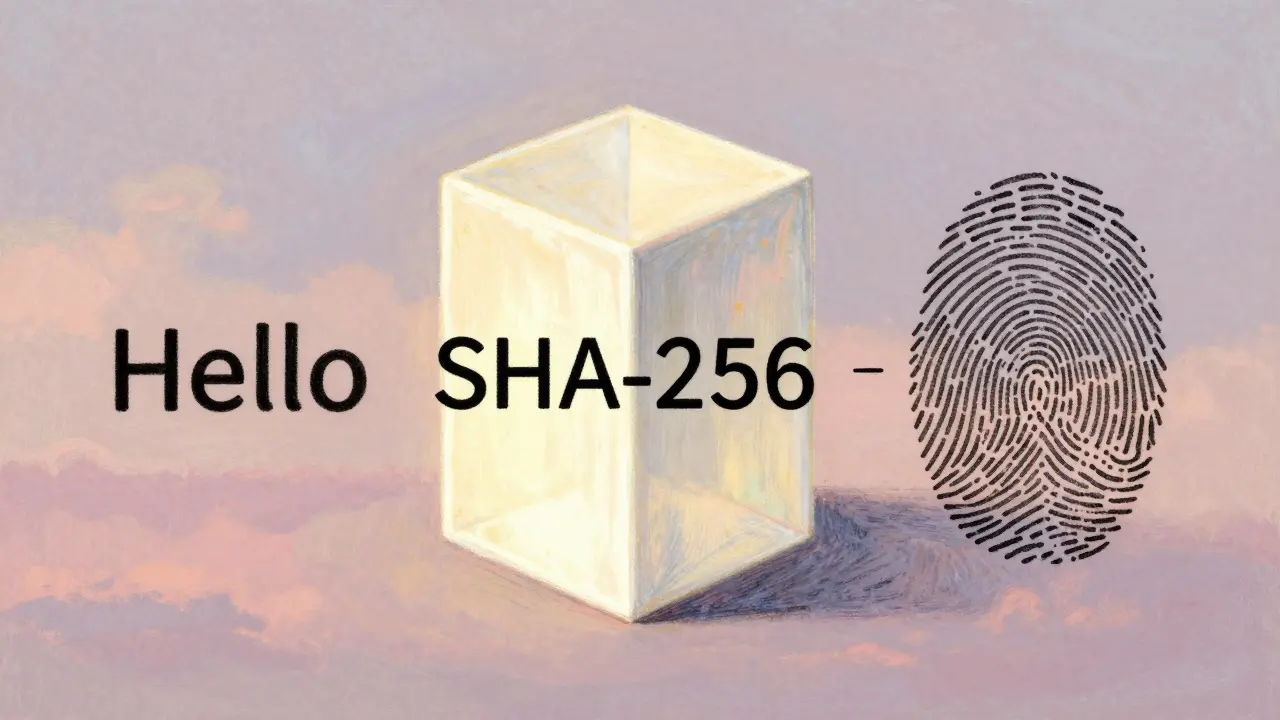
A hash function takes any amount of input data-whether it's a single word or an entire library of books-and outputs a fixed-length string of characters. For SHA-256, this output is always 256 bits long, typically displayed as a 64-character hexadecimal string. Here is the magic part: even if you change one tiny detail in the input, such as changing "Hello" to "hello," the resulting hash changes completely.
| Input Data | SHA-256 Hash Output |
|---|---|
| Hello | 185f8db32271fe25f561a6fc938b2e264306ec304eda518007d1764826381969 |
| hello | 2cf24dba5fb0a30e26e83b2ac5b9e29e1b161e5c1fa7425e73043362938b9824 |
| Hello! | d9014c4624844aa5bac314773d6b689ad467fa4e1d1a50a1b8a99d5a95f72ff5 |
This property is known as the "avalanche effect." In a blockchain, each block has a unique hash derived from its header. This hash serves as the block's digital fingerprint. Because the hash is deterministic (the same input always produces the same output) yet unpredictable (you cannot guess the output from the input), it creates a verifiable seal of authenticity.
When you look at a block explorer, you will see a long string of numbers and letters labeled "Hash." That is the block's ID. If anyone tries to alter the transaction data inside the block, the hash changes instantly. Since every subsequent block references the previous block's hash, changing one block breaks the link to the next, rendering the tampering obvious to the entire network.
The Chain Link: Previous Block Hash
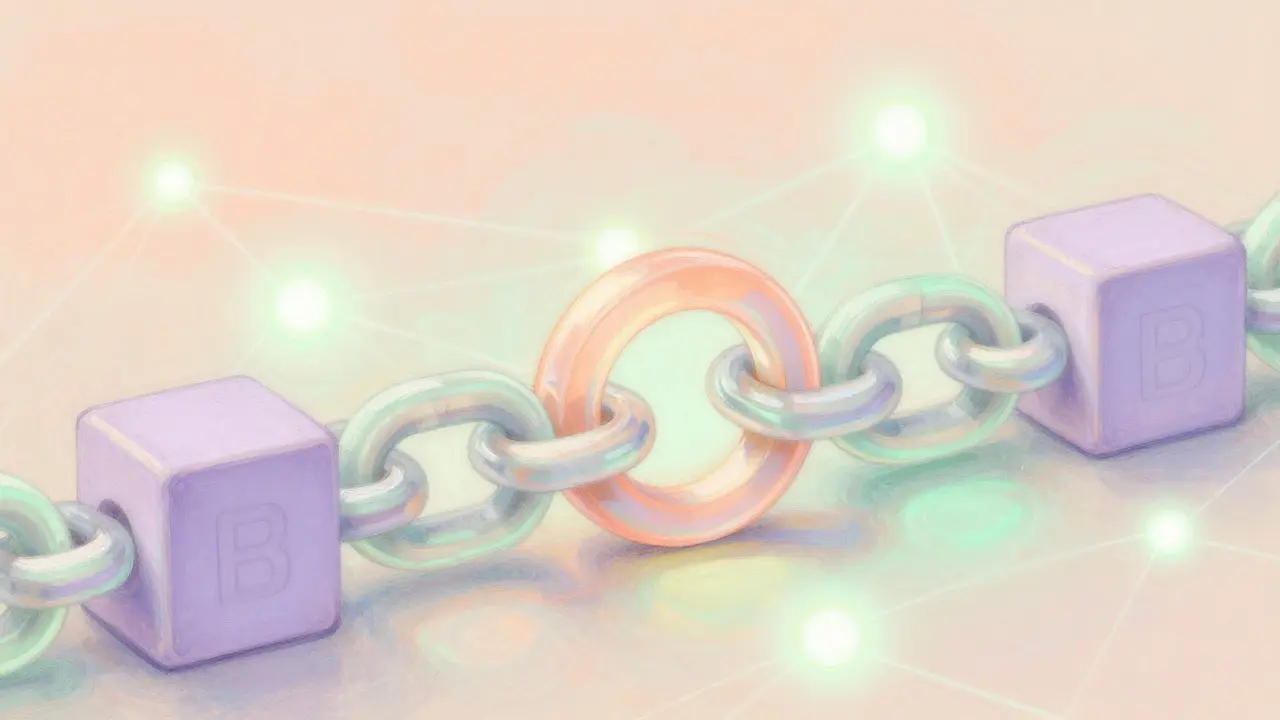
The most revolutionary aspect of blockchain architecture is the previous block hash field located in the header. This simple reference is what transforms a list of blocks into a chain.
Imagine a paper chain made of interlocking loops. If you cut one loop, the entire chain falls apart. In a blockchain, the current block contains the hash of the previous block. Let's say Block 100 has a hash of `abc123`. Block 101 is created, and in its header, it records `abc123` as its "Previous Block Hash." Now, Block 101 is cryptographically locked to Block 100.
Why does this matter for security? Suppose a hacker wants to alter a transaction in Block 100. They change the amount sent from 1 BTC to 0.1 BTC. This change alters the data in Block 100, which generates a new hash, let's call it `xyz789`. However, Block 101 still points to the old hash `abc123`. The network nodes immediately see the mismatch: Block 101 says the previous block should be `abc123`, but the actual Block 100 now hashes to `xyz789`. The chain is broken, and the attack fails.
To successfully hack the chain, the attacker would need to recalculate the hash for Block 100, then recalculate the hash for Block 101 (since its previous hash changed), then Block 102, and so on, all the way to the latest block. This requires immense computational power, making historical tampering practically impossible on robust networks like Bitcoin.
Efficiency at Scale: The Merkle Root
Blocks can contain thousands of transactions. How does the network verify that a specific transaction is included in a block without downloading and checking every single entry? Enter the Merkle Root.
Invented by Ralph Merkle, this data structure uses a binary tree of hashes. Here is how it works:
- Each individual transaction in the block is hashed.
- These transaction hashes are paired up and hashed together to create parent nodes.
- This process repeats until only one hash remains at the top of the tree.
- This final hash is the Merkle Root, which is stored in the block header.
The beauty of the Merkle Tree is efficiency. If you want to prove that your transaction is in a block, you don't need to show the whole block. You only need to provide a small subset of hashes (called a Merkle Proof) that leads from your transaction to the Merkle Root. If the math checks out against the root in the header, the network knows your transaction is valid and included.
This mechanism is vital for lightweight wallets (SPV clients) that run on smartphones. These devices cannot store the entire blockchain history, but they can download just the block headers and use Merkle Proofs to verify their own transactions securely. Without the Merkle Root, mobile crypto usage would be impractical due to bandwidth and storage constraints.
The Mining Puzzle: Nonce and Difficulty
In Proof-of-Work (PoW) blockchains like Bitcoin, adding a block isn't automatic. Miners must solve a complex mathematical puzzle to earn the right to add the next block. This is where the nonce and difficulty target come into play.
The nonce is a 32-bit number that starts at zero. Miners combine the nonce with the rest of the block header and run it through the SHA-256 algorithm. The goal is to produce a hash that is lower than a specific target number set by the network. This target is represented by the "bits" field in the header.
Since hash functions are random-looking, the only way to find a valid hash is through brute force. Miners increment the nonce (0, 1, 2, 3...) millions of times per second, hoping to hit a hash that meets the difficulty requirement. Once found, the block is broadcast to the network. Other nodes verify the hash quickly (verification is easy; solving is hard) and accept the block.
The difficulty adjusts approximately every two weeks (every 2,016 blocks in Bitcoin) to ensure that new blocks are added roughly every 10 minutes, regardless of how much computing power joins the network. This self-regulating mechanism maintains the stability of the blockchain's issuance rate.
Decentralization and Consensus
A block is useless unless the network agrees it is valid. This agreement is called consensus. In a decentralized network, there is no CEO or central server to approve transactions. Instead, thousands of independent computers, known as nodes, maintain copies of the blockchain.
When a new block is proposed, nodes check several things:
- Is the block header format correct?
- Does the previous block hash match the tip of their local chain?
- Are all transactions within the block valid (e.g., no double-spending)?
- Does the Merkle Root accurately represent the transactions?
- Does the hash meet the current difficulty target?
If any of these checks fail, the node rejects the block. Only when the majority of nodes accept the block does it become part of the permanent ledger. This distributed verification eliminates the need for trust in a third party. You don't need to trust the miner; you just need to trust the math and the consensus rules enforced by the software.
Why Block Anatomy Matters for Users
You might be thinking, "I just want to send money; why do I need to know about nonces and Merkle Roots?" Understanding the anatomy of a block helps you appreciate the security guarantees you rely on daily. It explains why:
- Transactions are irreversible: Once a block is buried under several others, the computational cost to rewrite history exceeds any potential gain from fraud.
- Data is transparent: Anyone can inspect the block body and verify transactions independently.
- The system is resilient: There is no single point of failure. Even if half the nodes go offline, the remaining ones preserve the truth.
As blockchain technology evolves beyond simple currency transfers into areas like decentralized finance (DeFi), supply chain tracking, and digital identity, the fundamental structure of the block remains the anchor of trust. Whether you are a developer building smart contracts or an investor holding assets, knowing how the block is constructed empowers you to make informed decisions about the technologies shaping the future of the internet.
What is the difference between a block header and a block body?
The block header contains metadata essential for linking blocks and securing the chain, such as the previous block hash, timestamp, Merkle root, and nonce. The block body contains the actual payload, which is the list of transactions or data being recorded in that specific block.
How does the Merkle Root improve blockchain efficiency?
The Merkle Root allows for efficient verification of transactions without needing to download the entire block. By using a Merkle Proof, users can confirm that a specific transaction is included in a block with minimal data transfer, which is crucial for lightweight wallets and network scalability.
Why is the previous block hash important for security?
The previous block hash links each block to its predecessor, creating an unbreakable chain. If any data in a past block is altered, its hash changes, causing a mismatch with the next block's reference. This makes tampering immediately detectable and computationally expensive to fix.
What role does the nonce play in mining?
In Proof-of-Work systems, the nonce is a variable number that miners change repeatedly to generate different hash outputs. The goal is to find a nonce that produces a block hash meeting the network's difficulty target, thereby earning the right to add the block to the chain.
Can a blockchain block be modified after it is added?
Practically, no. While technically possible to rewrite history, doing so would require recalculating the hashes of all subsequent blocks and gaining control of more than 50% of the network's computational power (a 51% attack). This is considered economically and computationally infeasible for large, established blockchains.