
CoinWind (COW) Airdrop Guide: Details, Risks, and How to Participate

Have you seen the buzz about the CoinWind (COW) is a cryptocurrency project that has generated attention through promotional airdrop campaigns, particularly on platforms like CoinMarketCap. It operates in the broader ecosystem of digital asset distributions where users complete social tasks to receive tokens. The project's primary visibility comes from these marketing-driven events rather than deep technical innovation or widespread adoption.? If you’re looking for free crypto, it’s easy to get caught up in the hype. But before you spend hours retweeting and joining Telegram groups, you need to know exactly what you’re signing up for. Is this a legitimate opportunity, or just another low-value token designed to pump social metrics?
The reality of the CoinWind COW airdrop is mixed. On one hand, it follows a standard, transparent process that anyone can follow. On the other hand, the token itself shows very weak market performance, and there is significant confusion with a much larger, similarly named project. This guide breaks down everything you need to know: how the airdrop works, what the token is actually worth, and why you should be careful not to mix it up with its bigger cousin.
How the CoinWind COW Airdrop Works
Airdrops are essentially marketing giveaways. Projects send out free tokens to build a community and increase visibility. The CoinWind campaign hosted by CoinMarketCap is the world's largest cryptocurrency data platform, which hosts promotional campaigns for various digital assets. CoinMarketCap provides the infrastructure for projects to run these contests, handling the verification of tasks and the distribution of rewards. followed a classic structure. They set aside a prize pool of 30,000 COW tokens. These were split among 1,000 winners, meaning each person who qualified could receive up to 30 COW tokens.
To qualify, participants had to jump through several hoops. These tasks are designed to boost the project’s online presence. Here is what was typically required:
- Maintain an active account on CoinMarketCap.
- Add CoinWind (COW) to your personal watchlist on the platform.
- Follow the official CoinWind Twitter account (@coinwind_com).
- Join their Telegram group and news channel.
- Retweet a specific pinned message from their Twitter profile.
The campaign ran for a specific window-usually about two weeks. For example, past iterations ran from mid-July to early August. If you missed the deadline, you couldn’t participate. The key takeaway here is that the barrier to entry is low, but the reward is also modest. You aren’t risking money, but you are spending time and exposing yourself to more spam in your social feeds.
Understanding the Token: Value and Market Reality
So, you did the tasks. You got the 30 COW tokens. Now what? This is where things get tricky. The value of the CoinWind token is extremely low. As of recent data, COW trades at around $0.0028 per token. Let’s do the math: 30 tokens multiplied by $0.0028 equals roughly $0.08. That’s eight cents.
But the price isn’t the only red flag. Look at the trading volume. Reports show $0 in 24-hour trading volume and a market capitalization that hovers near zero. A fully diluted valuation of just $283 suggests that almost no one is actively buying or selling this token. In the crypto world, liquidity is king. If there’s no volume, you can’t easily sell your tokens even if the price goes up. You might find yourself holding a digital receipt that you can’t cash out.
This lack of activity often indicates one of two things: either the project is in its very early stages with little interest, or the data reporting is incomplete. Either way, it signals high risk. Don’t expect this airdrop to make you rich overnight. Treat it as a curiosity, not an investment.
\n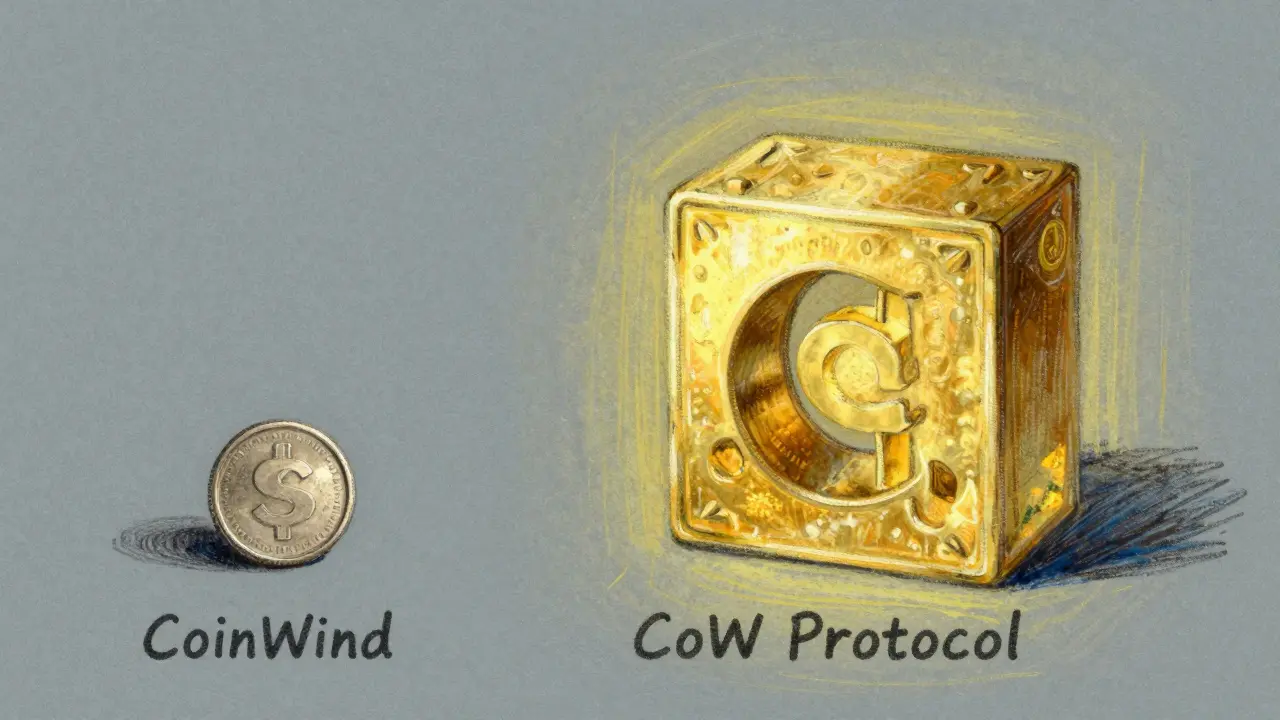
The Big Confusion: CoinWind vs. CoW Protocol
Here is the most critical part of this guide. Do not confuse CoinWind (COW) with CoW Protocol is a decentralized exchange protocol that uses batch auctions to protect traders from MEV (Maximal Extractable Value) and optimize trade execution. Unlike many smaller projects, CoW Protocol has secured significant funding from major industry players like 0x Labs and 1kx, totaling over $23 million. It focuses on advanced trading mechanics rather than simple social media promotions.. They share the same ticker symbol, "COW," which leads to massive confusion among new investors.
| Feature | CoinWind (COW) | CoW Protocol (COW) |
|---|---|---|
| Primary Focus | Social media engagement & airdrops | Decentralized trading & MEV protection |
| Market Cap | Near $0 (extremely low) | ~$98.5 million |
| Funding | Unspecified / Minimal | $23 million+ from top VCs |
| Technology | Unclear / Limited documentation | Batch auctions, smart order routing |
| Risk Level | High (low liquidity, unknown utility) | Moderate (established project, active development) |
If you see headlines about "COW" going up or down, check carefully. Most serious news refers to CoW Protocol. Investing in CoinWind based on CoW Protocol’s success would be a costly mistake. Always verify the contract address and the project name before interacting with any wallet.
Why Participate? The Pros and Cons
Should you bother with the CoinWind airdrop? It depends on your goals. If you are a seasoned crypto collector who likes to hoard small amounts of various tokens for potential future flips, then sure. It costs you nothing but time. However, if you are looking for substantial financial gain, this likely isn’t the right place.
Consider the opportunity cost. Spending an hour following accounts and retweeting could be spent learning about more established DeFi protocols or studying fundamental analysis. The crypto space moves fast. While CoinWind sits dormant with zero volume, other projects are building real utility. Use this airdrop as a learning experience in due diligence rather than a lottery ticket.
Also, be aware of the privacy implications. Joining Telegram groups and following obscure accounts can lead to increased spam and phishing attempts. Scammers often target airdrop participants because they know these people are eager for free tokens. Never connect your main wallet to unverified sites associated with small airdrops.
Red Flags and Risk Management
When evaluating any airdrop, especially one with limited information, look for these warning signs:
- Lack of Whitepaper: Does the project have clear documentation explaining its technology and roadmap? CoinWind lacks comprehensive technical specs.
- Unknown Team: Who is behind the project? Anonymous teams carry higher risk.
- Zero Volume: If no one is trading, how will you exit your position?
- Name Similarity: Be wary of projects that mimic the names of successful ones.
Protect yourself by using a separate "burner" wallet for airdrops. Never use your primary wallet where you store significant funds. If something goes wrong, you don’t want to lose your entire portfolio. Additionally, keep your expectations realistic. Most micro-cap airdrops end up being worthless. Only participate if you can afford to ignore the outcome entirely.
Next Steps for Crypto Enthusiasts
If you’ve already participated in the CoinWind airdrop, monitor the token’s status on reputable trackers like CoinMarketCap or CoinGecko. Check if trading pairs open up on decentralized exchanges. If volume remains zero for months, it’s safe to assume the token has no immediate future value.
For those looking for better opportunities, consider exploring airdrops from established DeFi protocols or Layer-2 networks. These projects often have clearer roadmaps, active communities, and tokens with actual utility. Look for projects that require you to use their product-like swapping tokens or lending assets-rather than just clicking buttons on social media. Those tend to have more sustainable value post-launch.
Stay curious, stay skeptical, and always do your own research. The crypto world is full of hidden gems, but it’s also littered with traps. Knowing the difference is the real skill.
Is the CoinWind COW airdrop still active?
The specific CoinMarketCap campaign mentioned ran during a limited window in mid-to-late summer. Airdrops are time-sensitive. Check the official CoinWind Twitter or CoinMarketCap page for current announcements. If the dates have passed, you cannot retroactively claim tokens.
What is the difference between CoinWind and CoW Protocol?
They are completely different projects. CoinWind is a smaller project focused on social media airdrops with low market cap. CoW Protocol is a major decentralized exchange protocol with millions in funding and a focus on MEV protection. They share the ticker "COW" but have no operational relationship.
How much are CoinWind COW tokens worth?
As of recent data, COW trades at approximately $0.0028. With an airdrop reward of 30 tokens, the total value is less than $0.10. Note that with zero trading volume, selling these tokens may be impossible.
Is it safe to participate in CoinWind airdrops?
Participating in social media tasks is generally safe, but be cautious. Never connect your main wallet to unverified links. Use a burner wallet for any blockchain interactions. The main risk is not losing money, but wasting time and exposing yourself to spam or phishing attempts.
Where can I buy or sell CoinWind COW tokens?
Due to extremely low liquidity and zero reported trading volume, there may be no active markets for COW. Check decentralized exchanges like Uniswap or PancakeSwap using the correct contract address, but be prepared for high slippage or inability to execute trades.