

What is Moonlana (MOLA) crypto coin? A clear breakdown of the Solana meme coin
There’s no shortage of new crypto coins popping up every week. Most fade away in days. A few, like Dogecoin or Shiba Inu, became household names. Then there’s Moonlana - or MOLA is a community-driven meme cryptocurrency built on the Solana blockchain with no official team, no whitepaper, and minimal trading activity. If you’ve seen it mentioned online, you’re probably wondering: is this just another flash in the pan, or is there something real behind it?
What exactly is Moonlana (MOLA)?
Moonlana isn’t a project with a team, a roadmap, or even a clear launch date. It doesn’t have a founding team you can Google. It doesn’t have a GitHub repo. It doesn’t even have a proper website. Instead, it’s a token - an SPL token on the Solana blockchain - that exists because a small group of people decided to create it and list it on a few exchanges. Its entire value comes from speculation, not utility.
It’s labeled a meme coin, which means it’s built more on hype and community than technical innovation. But even by meme coin standards, MOLA is unusually quiet. You won’t find active Discord servers. No big Twitter threads. No Reddit communities with thousands of users. Compare that to Bonk, another Solana meme coin, which has tens of thousands of followers and real partnerships. MOLA? Barely any trace.
How does MOLA work?
Technically, MOLA is just a digital token on the Solana network. That means it uses Solana’s fast, low-cost infrastructure. Transactions cost about $0.00025 - barely anything. You can store it in any Solana wallet: Phantom, Solflare, or even on KuCoin if you don’t want to manage your own keys.
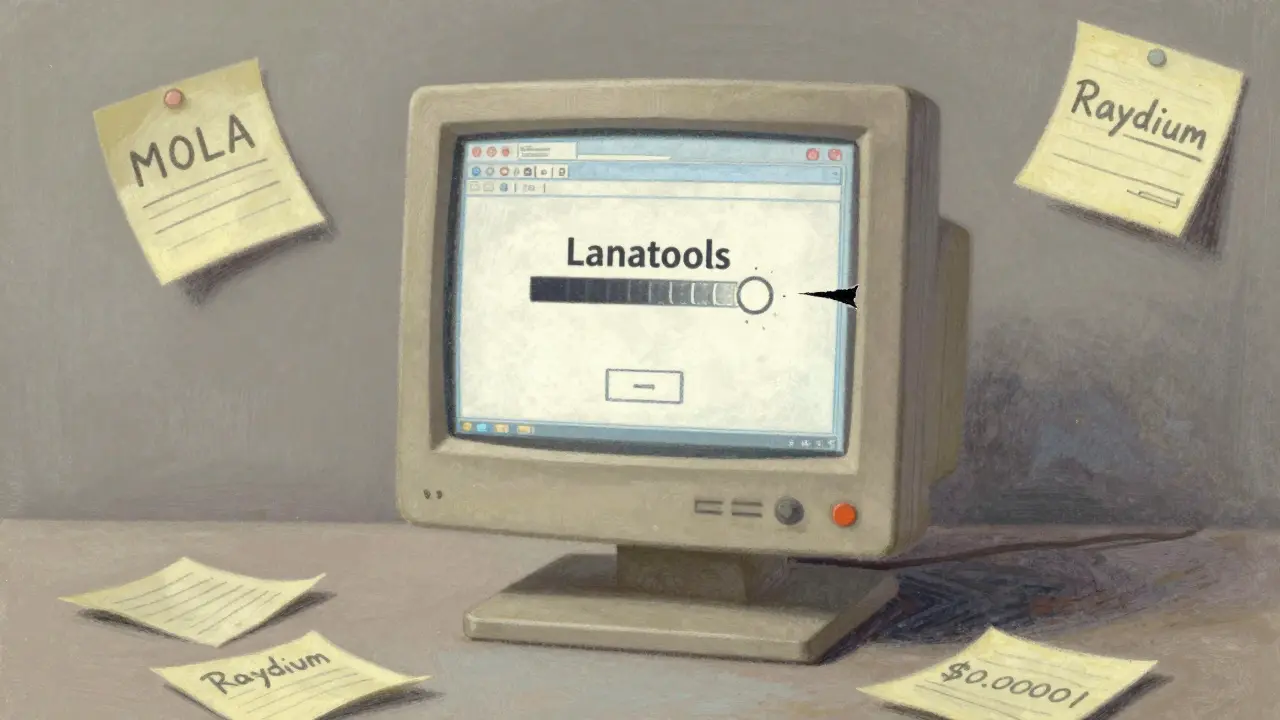
The project claims to have built a platform called Lanatools, which offers a dashboard to track Solana tokens, manage NFTs, and trade on a decentralized exchange called Lanadex. Sounds useful? Maybe. But here’s the catch: there’s no public proof this platform actually works. No screenshots, no user testimonials, no demo. The website linked from exchange listings is basic, outdated, and doesn’t load properly on some devices. If you’re trying to use it, you’re on your own.
Supply and market data: The numbers don’t lie
MOLA has a total supply of 4.2 billion tokens. Nearly all of them - 4.19 billion - are already in circulation. That’s 99.76% of the max supply. In crypto terms, that’s a red flag. When almost all tokens are out there, there’s no reserve left to control price or fund development. It’s a one-way street: once the early buyers sell, there’s nothing left to support the price.
Price data? It’s all over the place. CoinGecko says MOLA is trading around $0.0000105. LiveCoinWatch says $0.000057. CoinCodex says $0.0000147. Why the difference? Because almost nobody is trading it. The 24-hour volume on Raydium - the only exchange that lists MOLA/USDC - is under $1,000. Compare that to Shiba Inu, which trades over $500 million daily. MOLA’s market cap hovers around $30 million at best. That’s less than a small startup’s valuation.
Its all-time high was $0.0075. Today? It’s down over 99%. That’s not a correction. That’s a collapse.
Technical analysis: Is it going up?
Some sites claim MOLA is “on the rise.” CoinCodex predicts it could hit $0.000048 by mid-2025 - a 228% jump. But here’s what they don’t say: that prediction is based on zero real-world data. It’s a guess. A hope.
Looking at actual technical indicators, MOLA is stuck. The 50-day moving average is at $0.0000145. The 200-day is at $0.0000268. The current price is below both. That’s a classic bearish signal. The RSI is at 50.67 - neutral, but leaning down. Bollinger Bands show the price is near the lower edge. No breakout. No momentum.
And then there’s the Fear & Greed Index. It says “Greed.” But when only 10 people are buying a token in a day, that index doesn’t mean anything. It’s like saying a desert is “hot” because one person is sweating.
Why MOLA is different from other meme coins
Most meme coins have one thing going for them: community. Dogecoin has millions of fans. Shiba Inu has influencers. Bonk has a Discord with 100,000+ members. MOLA? You’ll struggle to find a single public conversation about it.
It also lacks exchange support. Only Raydium lists it. That’s it. No KuCoin trading pair? No Binance? No Coinbase? That’s not just bad luck - it’s a death sentence. Exchanges don’t list coins with zero volume. They list them because people are trading them. MOLA isn’t being traded. It’s being ignored.
Even Solana’s own meme coin ecosystem has moved on. Bonk, Doge Killer, and others have integrated with wallets, DeFi protocols, and NFT platforms. MOLA? Nothing. No partnerships. No integrations. No updates since late 2024.
Is MOLA a scam?
It’s not a scam in the traditional sense. There’s no evidence of a rug pull - no team vanished with funds. The token contract is open. The supply is fixed. No one’s hiding anything.
But it’s not a project either. It’s a ghost. A token with no purpose, no team, no community, and no future plan. The SEC has been cracking down on tokens that masquerade as memes while offering zero utility. MOLA fits that description perfectly. It’s not illegal - but it’s not sustainable.
Should you buy MOLA?
If you’re looking for a long-term investment? No. If you’re looking for a quick flip? Maybe - but you’re gambling.
Here’s the reality: MOLA’s price moves on whispers. One person buys 10 million tokens. The price jumps 20%. Then they sell. Price crashes. Rinse. Repeat. There’s no fundamental reason for it to go up. No product. No user growth. No adoption.
Even if you believe in Solana as a blockchain, MOLA adds nothing. It doesn’t improve the network. It doesn’t attract users. It doesn’t solve a problem. It’s just a token with a funny name.
What’s the future of MOLA?
The odds are against it. Industry analysts like Messari’s Ryan Selkis say micro-cap meme coins with no active development or community have “near-zero probability of sustained value retention.” That’s MOLA in a sentence.
Without a team, without a roadmap, without a community, and without exchange support, MOLA is a coin waiting to disappear. It might bounce a few more times. It might hit $0.00002 for a day. But unless something changes - and there’s zero sign of that - it will fade into obscurity like hundreds of others before it.
Is Moonlana (MOLA) a real cryptocurrency?
Yes, MOLA is a real token on the Solana blockchain. But it’s not a project. It has no team, no development, and no official documentation. It exists as a token with minimal trading activity and no clear purpose beyond speculation.
Can I buy MOLA on Coinbase or Binance?
No. As of early 2026, MOLA is only listed on Raydium, a decentralized exchange on Solana. It is not available on any major centralized exchanges like Coinbase, Binance, or KuCoin for direct trading. You’ll need a Solana wallet and USDC to trade it on Raydium.
What’s the total supply of MOLA?
The total supply of MOLA is 4.2 billion tokens. Nearly all of them - 4.19 billion - are already in circulation. That means there’s no reserve left to stabilize the price or fund future development.
Is MOLA a good investment?
As a long-term investment? No. As a short-term gamble? Only if you’re okay with losing everything. MOLA has no utility, no community, and no roadmap. Its price is driven by thin trading volume and random spikes. Most analysts consider it a high-risk, low-reward asset with little chance of recovery.
Why is MOLA’s price so unstable?
Because there’s almost no liquidity. With only $1,000 in daily trading volume, a single large buy or sell can swing the price by 30% or more. This makes it extremely volatile and dangerous for anyone not actively monitoring the market. It’s not a coin - it’s a slot machine.
Can I store MOLA in a hardware wallet?
Yes. Since MOLA is an SPL token on Solana, you can store it in any Solana-compatible wallet - including hardware wallets like Ledger or Trezor (with Solana app support), or software wallets like Phantom and Solflare. Just make sure you’re using the correct token contract address.
Final thoughts
Moonlana (MOLA) isn’t a cryptocurrency you invest in. It’s a cryptocurrency you observe - from a distance. It’s a reminder of how chaotic and speculative this market can be. There are thousands of tokens like it. Most vanish. A few get lucky. MOLA? It hasn’t shown any sign of luck.
If you’re curious, you can buy a few tokens for $1. See what happens. But don’t expect anything more than a short-lived thrill. There’s no future here. Just noise, volatility, and a fading echo of a meme that never caught on.




MOLA? More like MOLA-slow. This thing is a ghost coin with a side of delusion.
I read this whole thing and all I feel is sadness. Not for the investors - for the poor soul who thought "Lanatools" was a real product. Someone typed that into a website builder and called it a day. 😔
This isn't crypto. This is digital litter. You don't need a whitepaper to be a scam - you just need zero effort. MOLA is the crypto version of a parking lot sign that says 'Free Parking'. It's not true. It's just empty.
so like... MOLA is basically a crypto version of those "free energy" youtube videos? 🤔 lmao i just bought 100k for $0.50 bc why not 😎
I don't get why people still talk about this. It's like arguing about whether a broken toaster can still make toast. It's technically a toaster. But it's not doing anything. Just... leave it in the drawer.
I think we need to stop pretending these meme coins are investments and start calling them what they are emotional distractions. People don't buy MOLA because they believe in it. They buy it because they're bored. Or lonely. Or both. It's not finance. It's therapy with a blockchain.
It is important to recognize that the absence of a formal team does not inherently equate to illegitimacy. However, the complete lack of development activity, community engagement, or utility-driven infrastructure renders this asset functionally inert. One cannot build value on speculation alone when there is no foundation upon which to speculate.
bro i checked the raydium pool and there were like 3 trades in the last 12 hours. one of them was me. i bought 10M MOLA just to say i did. now i feel like i'm holding a digital ghost. it's kinda poetic lmao
MOLA is the crypto equivalent of a neon sign in an abandoned mall. It still glows. People still notice it. But no one’s shopping. No one’s even walking by anymore. It just... hums. Lonely. Bright. Pointless. I love it.
America doesn't need more crypto scams. We got real problems. Inflation. Debt. Kids on TikTok. And now this? Some guy in India named "Lanatools" thinks he's building the future? Nah. This is just digital confetti. Burn it.
I appreciate the thorough breakdown. It's rare to see someone lay out the facts without yelling. MOLA is a quiet ghost. And quiet ghosts don't scare people. They just make you wonder why they're still there.
i just wanna say i bought 100k MOLA last week and now i feel like part of a secret club 🫶 we’re the last believers in something that doesn’t exist. that’s kinda beautiful? 🌙✨
i think mola is kinda like a dream you had once and forgot about but still kinda remember? like you know it was real but you cant explain it? i bought some and now i just stare at my wallet like its a pet
YALL ARE OVER THINKING THIS. MOLA ISN’T A COIN IT’S A MEME. A LITTLE BIT OF CHAOS. A DIGITAL STICKER. I BOUGHT IT BECAUSE IT’S FUNNY. NOT BECAUSE I WANT TO BE RICH. YOU’RE ALL TAKING THIS TOO SERIOUSLY 😤💸
if you think mola is dead, you’re not looking hard enough. i saw a tweet yesterday from someone in serbia who said they used it to pay for coffee. not verified. not real. but kinda makes you smile? 🌟
this is all a psyop. the fed is using mola to track crypto users. the 4.2b supply? it's not supply. it's surveillance. the 'lanatools' dashboard? it's a backdoor. they're watching us. don't touch it. delete your wallet. now.
i love how mola just sits there like a quiet little moon. no drama. no hype. no influencers. just... existing. like a rock in the ocean. maybe that's the point. maybe peace is the ultimate meme 🌙
i dont get why people say its dead. i just checked the chart and it went up 5% last hour. maybe its coming back? i bought more. i believe
OH MY GOD YOU GUYS. I JUST FOUND OUT MOLA IS ACTUALLY BACKED BY A SECRET SOLANA DEVELOPER TEAM. THEY’RE HIDING BECAUSE THEY’RE AFRAID OF THE SEC. THE WEBSITE ISN’T WORKING BECAUSE THEY’RE MOVING TO A NEW BLOCKCHAIN. I SAW A LEAK ON A 4CHAN THREAD. WE’RE ALL LOSERS FOR NOT BUYING MORE.
It is commendable to observe the resilience of decentralized communities, even in the absence of formal structure. While MOLA lacks traditional indicators of success, its persistence suggests a deeper cultural resonance. Perhaps its value lies not in price, but in symbolic defiance.
i bought mola because i thought it was a typo for 'moola'. turns out it's not. i feel stupid. but also... kinda proud? like i'm holding a glitch in the matrix. it's not a coin. it's a mistake. and mistakes are beautiful.
This is not a coin. This is a mistake. A typo. A glitch. A forgotten line of code. And yet... it still trades. Still exists. Still has a price. That's not crypto. That's magic. Or madness. Probably both.
Honestly, if you’re not rich from MOLA, you’re not trying hard enough. Everyone else is making bank. You just don’t know it. That’s the whole point of crypto - the truth is hidden. The real team is laughing at you right now. You’re the last one in the room. Wake up.
i think mola is kind of like a candle in a blackout. it doesnt light up the room. but if you stare at it long enough... you kinda forget the dark?