

Crypto Trading Regulations: US vs EU Comparison Guide
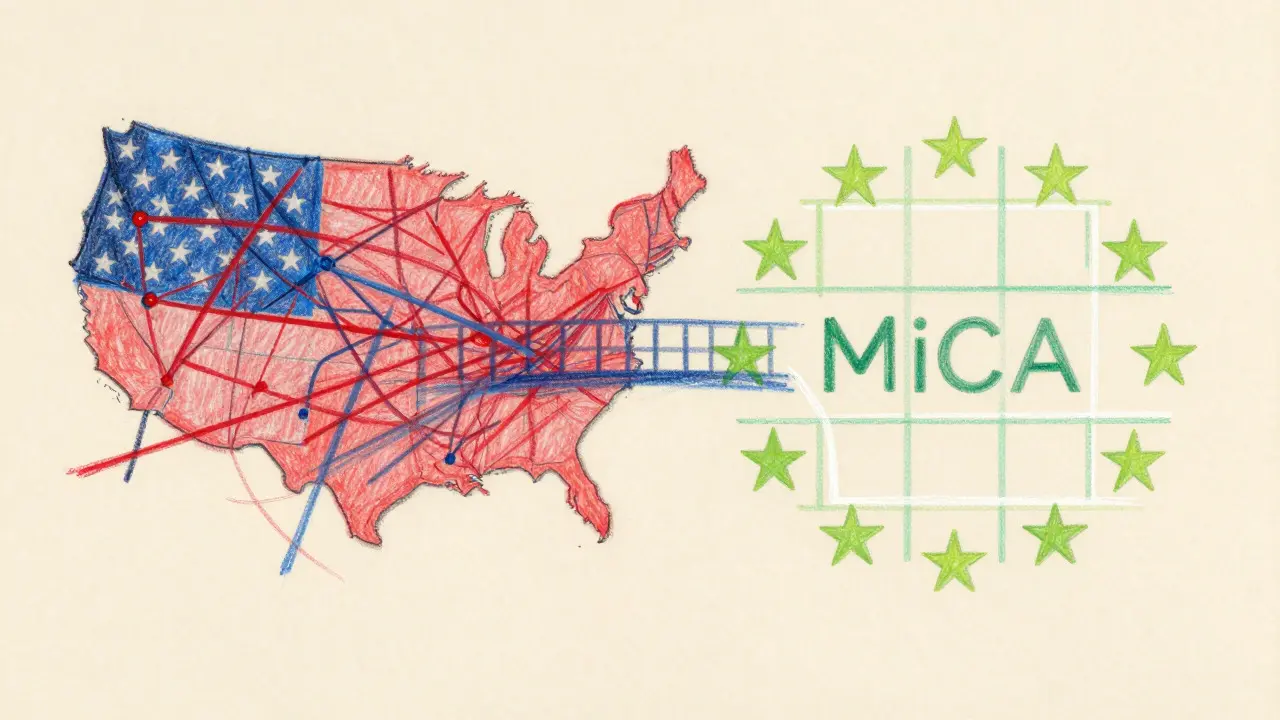
Imagine trying to trade Bitcoin while navigating two completely different rulebooks. In one corner, you have the European Union with its strict, all-encompassing law. In the other, the United States is still figuring out which agency has jurisdiction over your specific token. This isn't just bureaucratic noise; it directly impacts where you can trade, how much you pay in compliance fees, and whether your favorite exchange even allows you to open an account.
The core problem for traders and businesses alike is that there is no single global standard for crypto trading regulations. Instead, we are dealing with a fragmented landscape where the approach varies wildly depending on which side of the Atlantic you are on. Understanding these differences is no longer optional-it is essential for anyone serious about long-term participation in digital assets.
Quick Summary / Key Takeaways
- EU Approach: The Markets in Crypto-Assets (MiCA) regulation provides a unified, comprehensive framework fully applicable since December 2024, offering clear licensing paths but imposing strict environmental and banking standards.
- US Approach: A fragmented system involving the SEC, CFTC, and state-level laws creates uncertainty, relying heavily on case-by-case judicial rulings rather than a single federal statute.
- Stablecoins: The US GENIUS Act (2025) offers new clarity for stablecoins, contrasting with the EU's existing classification under MiCA as Electronic Money Tokens or Asset-Referenced Tokens.
- Compliance Burden: Both regions enforce strict Anti-Money Laundering (AML) rules, but the operational details differ significantly regarding data collection thresholds and reporting structures.
The US Patchwork: Agencies, Courts, and State Laws
If you look at the United States regulatory environment, you won't find one big law governing everything. Instead, you will find a complex web of overlapping jurisdictions. The primary players here are the Securities and Exchange Commission (SEC) and the Commodity Futures Trading Commission (CFTC).
The fundamental conflict lies in asset classification. If the SEC decides a crypto asset is a security, it falls under their purview. If the CFTC deems it a commodity, they take the lead. This lack of a definitive federal definition has led to years of legal battles. For example, in the landmark case SEC v. Ripple Labs, Judge Torres ruled that only institutional sales of XRP were securities, leaving retail sales largely unregulated by the SEC. Conversely, in SEC v. Terraform Labs, Judge Rakoff held that the UST stablecoin was a security. These conflicting rulings mean that the legal status of many tokens remains in a gray area until a final court decision is made.
Adding to this federal confusion is state-level regulation. Each of the 50 states can impose its own rules. Louisiana’s Virtual Currency Business Act, for instance, requires specific licensing for virtual currency businesses, with exemptions for those already regulated by federal acts like the Securities Exchange Act. This means a crypto exchange operating across multiple US states must navigate up to 50 different sets of local requirements on top of federal oversight. It is a high-compliance-cost environment that favors large, well-capitalized firms capable of managing this complexity.
The EU Standard: MiCA and Unified Oversight
In stark contrast, the European Union adopted the Markets in Crypto-Assets Regulation (MiCA), which became fully applicable in December 2024. Unlike the US model, MiCA is a comprehensive, pre-emptive framework. It covers almost every aspect of the crypto lifecycle, from issuance to trading and custody.
MiCA categorizes crypto-assets into three main groups:
- Electronic Money Tokens (EMTs): Digital representations of fiat currency, like stablecoins pegged to the Euro or Dollar.
- Asset-Referenced Tokens (ARTs): Stablecoins designed to maintain a stable value by reference to a basket of assets.
- Other Crypto-Assets: Everything else, including utility tokens and blue-chip assets like Bitcoin and Ethereum.
The key advantage of MiCA is clarity. There is no debate about whether Bitcoin is a security or a commodity; it is simply regulated as a crypto-asset under MiCA. However, this clarity comes with a price. Issuing EMTs or ARTs requires a license from a traditional bank or e-money institution. This gives established financial institutions a significant competitive edge, as they can offer a full suite of services without needing to build separate crypto-specific infrastructure from scratch. For smaller startups, obtaining these licenses is a massive hurdle compared to the more flexible (though uncertain) US environment.

Comparing Regulatory Philosophies: Pre-emptive vs. Reactive
The difference between the US and EU approaches isn't just about paperwork; it reflects deeper philosophical differences in how governments view innovation versus risk.
| Feature | United States | European Union (MiCA) |
|---|---|---|
| Primary Framework | Fragmented (SEC, CFTC, State Laws) | Unified (MiCA Regulation) |
| Asset Classification | Case-by-case (Security vs. Commodity) | Preset Categories (EMT, ART, Other) |
| Licensing Requirement | Varies by agency/state; often exempt if not a security | Mandatory license for issuers and service providers |
| Stablecoin Specifics | GENIUS Act (2025) provides federal clarity | Covered under MiCA as EMT/ART since Dec 2024 |
| Environmental Focus | Minimal specific regulatory mandate | High focus; mining may fall under EU Taxonomy |
| Compliance Cost | High due to legal uncertainty and multi-state issues | High due to strict licensing and reporting standards |
The Rise of Stablecoin Legislation: GENIUS Act vs. MiCA
One area where both regions have recently converged is stablecoins. In July 2025, the US passed the GENIUS Act, a bipartisan law providing a federal framework for payment stablecoins. This act aims to bring order to a market previously dominated by private companies issuing their own tokens with varying levels of reserve backing.
Under the GENIUS Act, stablecoin issuers must hold reserves in cash or short-term Treasury bills. This aligns closely with the EU's requirements for EMTs under MiCA, which also demand full reserve backing. The similarity suggests that despite their different structural approaches, both regulators agree on one thing: stablecoins used for payments need to be as safe as holding cash.
However, the impact differs. In the US, the GENIUS Act resolves a major source of uncertainty for banks wanting to enter the crypto space. They now know exactly what rules apply to stablecoins. In the EU, MiCA had already established these rules, so the GENIUS Act doesn't change the daily operations for EU-based firms. But it does raise questions about "regulatory arbitrage." Could US stablecoins become so dominant that they bypass EU monetary sovereignty? The European Commission is watching this closely, debating whether MiCA needs updates to ensure European stablecoins remain competitive against their American counterparts.

Anti-Money Laundering and the Travel Rule
Regardless of whether you are in New York or Frankfurt, you cannot escape Anti-Money Laundering (AML) checks. Both the US and EU enforce the Travel Rule, derived from Financial Action Task Force (FATF) standards. This rule requires crypto exchanges to collect and share information about the sender and receiver of a transaction.
In the US, the Bank Secrecy Act mandates that Virtual Asset Service Providers (VASPs) collect personally identifiable information for transactions of $3,000 or more. This includes names, addresses, wallet addresses, and transaction hashes. The Financial Crimes Enforcement Network (FinCEN) oversees these requirements. Non-compliance can lead to heavy fines and enforcement actions, a trend that accelerated in 2025 as regulators ramped up scrutiny.
The EU applies similar principles but integrates them into the broader MiCA framework. While the data points required are similar, the enforcement mechanisms differ. In the EU, the penalty for non-compliance is tied to the turnover of the firm, potentially making fines much larger for major players. Additionally, the EU is considering bringing crypto-mining under its sustainability taxonomy, meaning miners might need to prove their energy usage meets certain environmental standards-a requirement not currently present in US federal law.
What This Means for Traders and Businesses
So, what does all this mean for you? If you are a retail trader, the immediate impact is limited. You will still need to verify your identity (KYC) and pay taxes. However, the choice of exchange matters. An exchange based in the EU must comply with MiCA, ensuring a certain level of fund segregation and transparency. An exchange based in the US might operate with slightly different internal controls, depending on which state licenses it holds.
For businesses, the stakes are higher. If you are building a crypto product, you must decide where to launch first. Launching in the EU gives you a clear roadmap but requires expensive licensing. Launching in the US allows for faster iteration but exposes you to legal risks if the SEC changes its stance on your asset class. Many global firms are adopting a dual-track strategy, obtaining licenses in both regions to minimize risk and maximize market access.
Looking ahead, we might see some convergence. The success of the GENIUS Act in the US could pressure other countries to adopt similar stablecoin frameworks. Meanwhile, the EU's experience with MiCA will likely inform future regulations in Asia and beyond. But for now, the divide remains sharp. Navigating it requires staying informed about the latest developments in both jurisdictions, as the rules are still evolving rapidly.
Is Bitcoin regulated differently in the US and EU?
Yes. In the EU, Bitcoin is clearly classified as a crypto-asset under MiCA, with specific rules for exchanges and custodians. In the US, Bitcoin is generally treated as a commodity by the CFTC, but the SEC retains authority over any derivative products or funds linked to Bitcoin. This creates a clearer path for spot Bitcoin ETFs in the US, while the EU focuses on direct trading and custody licenses.
Which region has stricter KYC requirements?
Both are very strict, but the EU tends to have higher penalties for non-compliance. The US focuses on the $3,000 threshold for the Travel Rule under the Bank Secrecy Act. The EU applies similar data collection rules but ties fines to company revenue, making the financial risk of ignoring KYC rules much higher for large firms.
Does the GENIUS Act make US stablecoins better than EU ones?
Not necessarily. Both require full reserve backing. The GENIUS Act provides a federal safety net for US issuers, reducing legal uncertainty. MiCA provides a standardized license for EU issuers. The "better" option depends on your preference for federal flexibility versus regional standardization. Currently, US stablecoins dominate the market due to earlier adoption, but EU stablecoins are gaining traction as MiCA becomes entrenched.
Can I trade crypto freely across borders?
Technically yes, via decentralized exchanges (DEXs). However, centralized exchanges often restrict users based on location due to regulatory constraints. If you use a US-based exchange, you might face restrictions when traveling to the EU, and vice versa. Always check the terms of service of your specific platform regarding cross-border trading limits.
Will the US and EU eventually have the same rules?
Unlikely in the near term. The US prefers a market-led, agency-specific approach, while the EU favors comprehensive legislation. Convergence is more likely in specific areas like stablecoins and AML, where international cooperation is mandatory. For general crypto-asset trading, the structural differences will persist for years.





Oh, look at you all, playing in the sandboxes of bureaucracy while the real money is made in the shadows. It is truly a moral failing of our generation that we allow governments to dictate how we handle our own digital property. The EU thinks they are so clever with their 'unified' MiCA framework, but it is just a polite way of saying they want to strangle innovation in its crib. And the US? Oh, the glorious chaos of the SEC vs CFTC dance. It is not fragmentation; it is freedom fighting for its life against the iron fist of regulation. If you cannot navigate 50 state laws and two federal agencies, perhaps you do not deserve to hold Bitcoin. Let the regulators have their paperwork; the market will always find a way to outsmart them, as it always has.
Meh. The compliance overhead is going to be a massive drag on liquidity anyway. We're looking at significant friction in the order book depth due to these new KYC thresholds. The delta between the GENIUS Act and MiCA is negligible for retail, but the institutional flow will definitely skew towards the US until the EU sorts out their banking integration issues. Just another layer of tax on yield.
You clearly have not read the whitepaper on regulatory arbitrage, which is a shame because it explains exactly why this divergence exists. The US model is not 'chaos'; it is an adaptive ecosystem where the strongest survive. The EU is building a cage and calling it a garden. I have seen too many startups die from 'compliance fatigue' in Brussels. They think if they write enough rules, the risk disappears. Nonsense. Risk moves. It does not vanish. The only thing that vanishes is your ability to iterate quickly. So yes, the US is messy, but it is alive. The EU is clean, but it is sterile. Choose your poison accordingly, or better yet, choose no side and trade on-chain where neither can touch you directly. That is the true alpha here.
Good point about the iteration speed. I’ve worked with teams in both regions and the difference in velocity is stark. In the US, you can launch a pilot in weeks. In the EU, you’re waiting for legal sign-off on every minor feature change. But the stability in the EU does help with long-term partnerships. Banks there trust the clarity of MiCA more than they trust the shifting sands of SEC enforcement actions. It’s a trade-off, really. Speed vs. Certainty.
yeah sure speed is great until the sec comes knocking. i live in ireland so i feel the pain of mica daily. it is boring but predictable. in the us my cousin lost half his portfolio because one judge said his token was a security. here we just pay the fees and move on. maybe being bored is better than being broke. who knows. probably the americans are right though. nothing like a lawsuit to teach you a lesson
Oh, please. Stop pretending that 'boredom' is a valid strategy for global dominance! The EU is slowly strangling its own fintech sector with red tape while the US is actually letting the market breathe! Look at the stablecoin space! The GENIUS Act is a masterpiece of bipartisan pragmatism, whereas MiCA is just another example of European overreach! Why would anyone want to deal with banks holding the keys to your stablecoins when you could have a clear federal framework in the US? It is simply absurd that people defend this bureaucratic nightmare!
Ugh, the drama is exhausting. I just want to know if my DeFi positions are safe from the next wave of enforcement. It feels like every time I think I understand the landscape, someone changes the rules mid-game. The 'Travel Rule' implementation alone has been a headache for any serious trader trying to move funds across borders without getting flagged by some algorithm. It’s not about ideology anymore, it’s about survival. Can we please just agree that the current state of affairs is a mess before we start picking sides?
Let's cut through the noise. The real story here isn't about 'freedom' vs 'safety,' it's about capital allocation efficiency. The US fragmented approach creates a high-cost environment for compliance, which effectively raises the barrier to entry for smaller players. This leads to a consolidation of market power among large, well-capitalized firms. In the EU, the licensing requirement does the same thing, but through a different mechanism. Both systems are creating oligopolies. The only question is whether you prefer your oligopoly to be driven by legal uncertainty (US) or by administrative hurdles (EU). Neither is good for the average user. The spread between bid and ask prices on compliant exchanges is already widening due to these costs. Watch the liquidity pools dry up. That's the real metric to watch, not the press releases.
I completely agree with the point about liquidity drying up! It is such a subtle but critical factor that often gets overlooked in these debates. From a British perspective (though we are post-Brexit now, so we are watching from the sidelines), the contrast is stark. The UK is trying to find its own middle ground, which is interesting to observe. However, the US/EU divide is certainly the most significant. I hope we see more convergence soon, as the lack of standardization makes cross-border trading so cumbersome for everyone involved. It really needs to be streamlined for the sake of the industry!
This is such a vital discussion! I love seeing everyone weigh in on the nuances of the GENIUS Act versus MiCA. One thing I’d add is the impact on developer experience. When you have a unified framework like MiCA, developers know exactly what APIs they need to build for compliance. In the US, it’s more of a guessing game, which slows down product development cycles. But let’s not forget that innovation often thrives in uncertainty! What are your thoughts on how these regulations might affect decentralized finance specifically? Are we seeing any shifts in how DEXs operate to avoid these jurisdictional pitfalls?
From India, the view is very different. We have our own struggles with crypto taxation and FDI limits. Watching the US and EU fight over jurisdiction seems almost quaint compared to the challenges we face. But the GENIUS Act is a step in the right direction for global standardization. If the US can get its house in order, it sets a precedent for emerging markets. We need clear rules, not ambiguity. Ambiguity kills investment. Clarity brings capital. Simple as that.
Sarcastic aside, I think the 'ambiguity kills investment' line is a bit reductive. Sometimes ambiguity allows for creative solutions that rigid rules stifle. But I’ll admit, for institutional investors, clarity is king. My main concern is whether the EU’s environmental mandates will make mining unprofitable there. If miners move to places with looser energy rules, does that undermine the 'green' narrative? Or is it just a natural migration of capital to where costs are lower? Food for thought.
well the green narrative is already dead in the water. i mean who cares if the miners use coal or solar. its all about the hash rate. the eu wants to make it expensive to mine so they can control the supply. classic central bank behavior. they dont like that bitcoin is outside their control. so they slap taxes and environmental rules on it. its not about saving the planet. its about power. always has been. wake up people. the regulators are not your friends. they are your competitors.
Haha, 'regulators are your competitors' is a bold take! I’m not sure I fully agree, but there is truth in it. They are definitely gatekeepers. I think the key is finding the balance. Too much regulation stifles growth, but too little invites scams and fraud. We saw that with the Terra/Luna collapse. Maybe a hybrid approach is best? Use the US flexibility for innovation and the EU structure for safety? Just a thought. What do you all think? Is a hybrid model possible in practice?
A hybrid model sounds nice in theory, but in practice, it’s a logistical nightmare! 🤯 Imagine having to maintain two separate compliance stacks. One for the US SEC/CFTC rules and one for the EU MiCA requirements. The cost alone would be prohibitive for most mid-sized firms. I think we’ll see more companies choosing one home base and operating globally from there, rather than trying to be dual-compliant everywhere. It’s a tough call, but I think the US will attract more of the innovative players, while the EU becomes the hub for established financial institutions entering crypto. 💡🚀
One must consider the long-term implications of such bifurcation. Historically, fragmented regulatory regimes lead to inefficiencies and increased transaction costs. The US system, while dynamic, suffers from a lack of predictability that deters foreign direct investment. Conversely, the EU system, while predictable, may stifle the very innovation it seeks to regulate. The ideal scenario would be a harmonized international standard, akin to Basel III for banking. Until then, we remain in a suboptimal equilibrium. It is a pity that politics prevents a more rational approach to this technological paradigm shift.
Suboptimal equilibrium? Please. The US is winning this race hands down! The EU is dragging its feet while American tech giants are building the future. And don’t get me started on the conspiracy angle-do you really think the EU is acting in good faith? They’re trying to protect the euro zone from dollar dominance by making crypto less attractive. It’s a geopolitical play, plain and simple. The GENIUS Act is about keeping the dollar strong in the digital age. Wake up and smell the coffee! ☕️🇺🇸
The geopolitical angle is often underappreciated. Yes, currency sovereignty is a major driver. If US stablecoins dominate, the dollar remains the reserve currency of choice even in the digital realm. If EU stablecoins gain traction, it strengthens the euro’s position. It’s not just about trading; it’s about monetary policy. For countries like India, this means we have to decide which camp to align with strategically. A difficult choice, but necessary.
I think we’re all missing the forest for the trees here. At the end of the day, it’s about consumer protection. Whether it’s the US or the EU, the goal should be to keep people safe from scams and ensure fair markets. The methods differ, but the intent is similar. Let’s try to focus on the positive aspects of both systems. The US brings innovation, the EU brings stability. Together, they push the industry forward. No need for so much negativity, right? 😊
(:) I totally agree! It’s easy to get caught up in the details and forget the big picture. I’ve been following this space for years, and while the regulations are changing rapidly, the core value proposition of crypto hasn’t changed. Decentralization, transparency, and accessibility. As long as those values remain intact, the regulations will just be the container they come in. I’m optimistic that we’ll find a balance that works for everyone. Thanks for sharing your insights! 🙏
Oh, the optimism is *palatable*! But let’s not delude ourselves. Regulations are never neutral. They always favor the incumbent. In the US, that’s the Wall Street banks. In the EU, that’s the Frankfurt bankers. The small guy, the retail trader, the startup founder-they are just pawns in this grand chess game. :( But hey, at least we have the luxury of complaining about it online! Who else is tired of reading legal jargon? Raise your hand! 🙋♀️
It is indeed a complex web of interests. However, I believe that public pressure can shape these outcomes. The more informed the retail investor, the harder it is for incumbents to capture the regulatory process. Education is the key. We need to empower people to understand not just the technical aspects of blockchain, but also the political economy behind it. Only then can we ensure that the system serves the many, not just the few. 🌟
Beautifully put. Education is the ultimate equalizer. I’ve seen how a single well-explained thread can change someone’s perspective on regulatory risk. It’s not about fear-mongering; it’s about empowerment. Let’s keep the conversation going. The next chapter of this story is being written right now, and we all have a voice in it. 📖✨