

Confidential Transactions Explained: How Blockchain Hides Amounts

Imagine handing someone a sealed envelope. You know exactly what’s inside-maybe $50, maybe $500-but everyone else watching just sees a piece of paper being passed across the table. That is the core promise of confidential transactions. In traditional blockchains like Bitcoin or Ethereum, every transaction amount is public. Anyone can look up your wallet and see exactly how much you sent to whom. This transparency is great for security but terrible for financial privacy.
Confidential Transactions (CT) change that dynamic. They allow a network to verify that a transaction is valid-that inputs equal outputs plus fees-without ever revealing the actual numbers involved. It sounds like magic, but it’s actually rigorous cryptography. If you are trying to understand how privacy works on the blockchain without sacrificing trust, this is the mechanism you need to know about.
The Core Problem: Transparency vs. Privacy
Blockchains were built to be open ledgers. The idea was that if everyone could see every transaction, no one could cheat. But this creates a side effect called 'transaction graph analysis.' Even if you use new addresses for every payment, sophisticated tools can link those addresses together by analyzing timing, amounts, and patterns. If you send exactly 1 BTC to three different people at the same time, analysts can guess that all three came from the same source.
Confidential Transactions solve the 'amount' part of this puzzle. By hiding the value, they break the most obvious link in the chain. Greg Maxwell, a Bitcoin Core developer, first proposed this concept in 2013. His goal wasn't to hide who was sending money, but to ensure that the sheer volume of data didn't expose personal financial habits. Today, technologies like Monero’s RingCT and Liquid Network’s confidential assets rely on these principles to protect user data.
How Confidential Transactions Work Under the Hood
You don’t need a PhD in mathematics to grasp the logic, though the math behind it is intense. Think of CT as a set of cryptographic locks that work together.
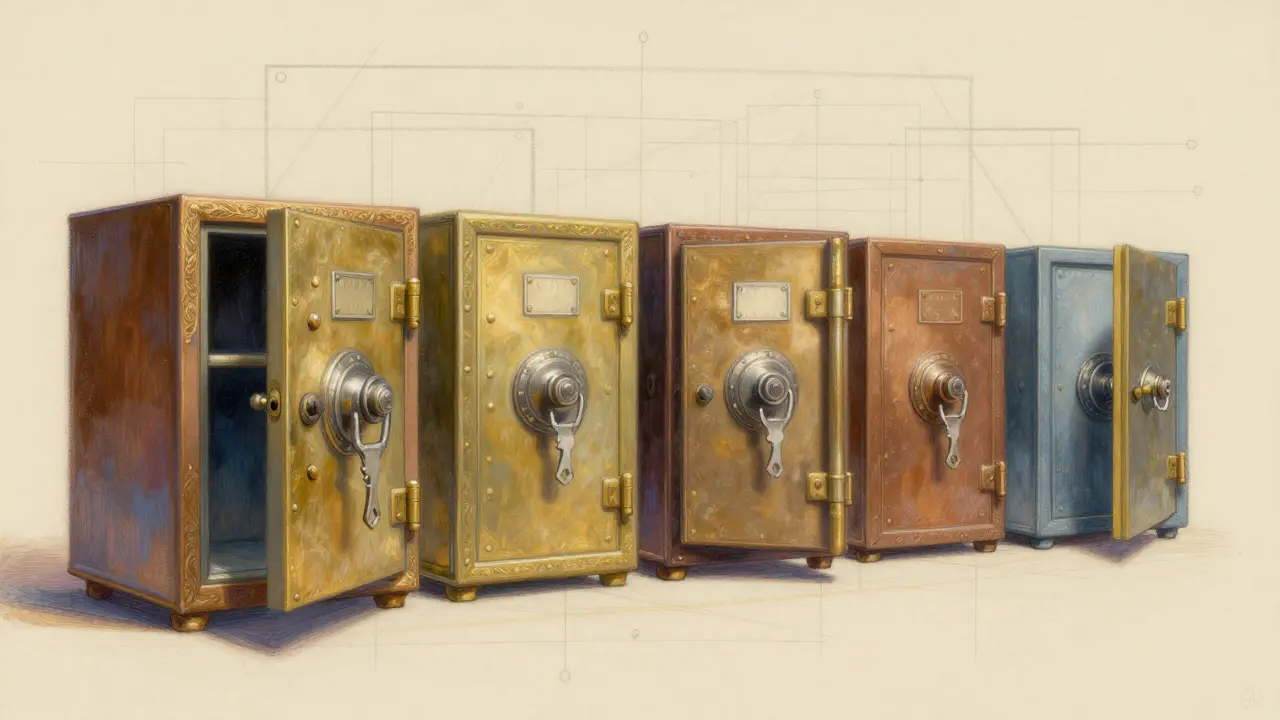
Pedersen Commitments are the foundation. Imagine putting a number into a safe. You give the safe to the network. The network can check that the combination of safes coming in equals the combination of safes going out, but they cannot open any single safe to see the number inside. This ensures that no new money is created out of thin air, maintaining the fixed supply rule of cryptocurrencies.
However, Pedersen Commitments alone have a flaw: they allow for negative numbers. You could theoretically 'create' money by committing to -10 coins and spending +20, netting +10. To fix this, CT uses Range Proofs, specifically a type called Bulletproofs. These proofs cryptographically guarantee that the hidden number is positive and within a reasonable limit (like 0 to 2^64 satoshis). Before Bulletproofs, these proofs were huge-taking up kilobytes of space. Now, thanks to optimizations introduced around 2017, a range proof is tiny, often under 700 bytes.
Finally, to hide who is sending and receiving, systems like Monero add Ring Signatures. This mixes your transaction with several others (decoys) so observers can’t tell which input actually signed the transaction. When you combine hidden amounts with mixed signatures, you get RingCT, which makes tracing funds virtually impossible for outside observers.
Real-World Implementations: Monero vs. Liquid
Not all confidential transactions are built the same way. The two most prominent examples today serve very different audiences.
| Feature | Monero (RingCT) | Liquid Network |
|---|---|---|
| Primary Goal | Full public anonymity | Institutional settlement privacy |
| Anonymity Set | 16 inputs (as of Akita upgrade) | Federated members only |
| Transaction Speed | ~2 minutes confirmation | d>~1 second confirmation |
| Regulatory Status | Banned on some US exchanges | Accepted by major institutions |
| Privacy Scope | Sender, Receiver, Amount | Amount only (participants known) |
Monero is the gold standard for retail privacy. Since its RingCT upgrade in 2017, every transaction hides the sender, receiver, and amount. The recent 'Akita' upgrade increased the anonymity set to 16 participants, making statistical attacks nearly useless. However, this comes at a cost: slower speeds and higher scrutiny from regulators.
Liquid Network, launched by Blockstream in 2018, takes a different approach. It is a sidechain used primarily by exchanges like Bitfinex and OKCoin. On Liquid, the participants are known (it’s a permissioned network), but the transaction amounts are confidential. This allows institutions to settle trades worth billions daily without revealing their positions to competitors. It offers speed and privacy where it matters most for business, without the full anonymity of Monero.
The Trade-Offs: Why Isn't Everything Confidential?
If CT is so good, why doesn't Bitcoin use it by default? There are real costs to privacy.
First, there is bloat. A standard Bitcoin transaction might be 250 bytes. A confidential transaction on Liquid averages 290 bytes, and early CT implementations were much larger due to bulky range proofs. While Bulletproofs have shrunk this gap, storing more data per transaction means nodes need more hard drive space and bandwidth. For a global network like Bitcoin, efficiency is critical.
Second, there is the regulatory hurdle. Governments want to prevent money laundering. The U.S. Treasury has explicitly stated that privacy-enhancing technologies must maintain enough transparency for Anti-Money Laundering (AML) compliance. This tension led Binance to delist Monero in the U.S. market in 2022. Users who demand absolute privacy often find themselves locked out of mainstream financial services.
Third, complexity is a barrier. Developing CT requires deep knowledge of elliptic curve cryptography and zero-knowledge proofs. A 2023 survey found that blockchain engineers needed 6-8 weeks to properly implement CT protocols. Mistakes can be catastrophic; a vulnerability in Monero’s range proof implementation in 2017 briefly allowed attackers to create fake coins, though it was patched quickly.

Who Needs Confidential Transactions?
You probably don’t need CT for buying coffee. But for specific use cases, they are essential.
- Business Competitiveness: If you run a supply chain business, competitors shouldn't be able to analyze your blockchain payments to guess your inventory levels or supplier costs. CT hides these operational details.
- Personal Financial Security: Public wealth attracts crime. Keeping your balance private reduces the risk of targeted theft or harassment.
- Institutional Settlement: Banks and exchanges need to move large sums without signaling their market moves to high-frequency traders. Liquid Network’s CT enables this discreetly.
For everyday users, the trend is moving toward 'optional privacy.' Projects like Zcash offer shielded pools, and future Bitcoin upgrades via Taproot Assets may bring lightweight CT capabilities to the main chain. The goal isn't to hide everything, but to give users the choice to keep their financial life private when they need it.
Future Outlook: Hybrid Models and Compliance
The technology is evolving rapidly. We are seeing a shift from 'all-or-nothing' privacy to selective disclosure. The Monetary Authority of Singapore collaborated with Liquid Network in 2023 to test protocols that allow users to reveal transaction details to auditors while keeping them hidden from the public. This 'compliance-friendly' privacy could be the key to wider adoption.
Additionally, quantum-resistant variants of CT are in development by the Elements Project team. As computing power grows, ensuring that today’s encrypted transactions remain secure tomorrow is a priority. By 2027, Gartner predicts that 65% of institutional blockchain deployments will use some form of confidential transaction technology.
Confidential Transactions aren't just a niche feature for privacy enthusiasts anymore. They are becoming a standard tool for balancing the openness of blockchain with the human right to financial privacy. Whether through Monero’s robust anonymity or Liquid’s institutional efficiency, the ability to transact without broadcasting your entire financial history is here to stay.
What is the difference between Confidential Transactions and Zcash's zk-SNARKs?
Both hide transaction details, but they do it differently. Confidential Transactions (CT) primarily hide the *amount* using Pedersen Commitments and Range Proofs, often combined with Ring Signatures for sender/receiver anonymity (like in Monero). Zcash uses zk-SNARKs (Zero-Knowledge Succinct Non-Interactive Arguments of Knowledge), which hide the sender, receiver, *and* amount simultaneously in a more compact proof. zk-SNARKs require a trusted setup ceremony initially, whereas CT does not. CT is generally faster to verify (0.8 seconds vs 3.2 seconds for zk-SNARKs on similar hardware) but may result in larger transaction sizes depending on the implementation.
Can I use Confidential Transactions on Bitcoin?
Not directly on the main Bitcoin chain yet. Bitcoin currently uses transparent transactions. However, you can use Confidential Transactions on sidechains connected to Bitcoin, such as the Liquid Network. Additionally, proposals like 'Taproot Assets' aim to integrate CT features into Bitcoin's ecosystem in the future, potentially allowing for confidential asset transfers alongside regular BTC.
Are Confidential Transactions legal?
The legality depends on your jurisdiction and how you use them. The technology itself is not illegal. However, regulations vary. In the U.S., for example, exchanges are required to comply with AML/KYC laws, which has led some platforms to delist fully anonymous coins like Monero. Institutional networks like Liquid operate within regulatory frameworks by using permissioned access. Always consult local laws regarding privacy-focused cryptocurrencies.
Do Confidential Transactions increase transaction fees?
Yes, typically. Because CT adds cryptographic proofs (like Bulletproofs) to the transaction data, the transaction size increases. Larger transactions consume more block space, which usually results in higher fees during periods of network congestion. For example, Monero transactions are generally larger than Bitcoin transactions, leading to higher average fees, though fee markets differ between networks.
What are Bulletproofs and why are they important?
Bulletproofs are a type of range proof used in Confidential Transactions. They prove that a hidden number is within a specific range (e.g., positive and not overflowing) without revealing the number itself. Before Bulletproofs, range proofs were large and slow. Bulletproofs reduced the proof size from roughly 10KB to less than 1KB, making CT scalable and efficient enough for practical use in networks like Monero and Liquid.