

Future of Under-Collateralized DeFi Loans: How DeFi Will Break Free from Overcollateralization
Right now, if you want to borrow $10,000 in DeFi, you need to lock up at least $12,500 worth of crypto as collateral. That’s not a loan-it’s a hostage situation. You have to already own a pile of crypto just to get access to more. And that’s the problem. DeFi was supposed to be open to everyone. But if you don’t have crypto to begin with, you’re locked out. That’s why under-collateralized DeFi loans aren’t just a nice upgrade-they’re the next big leap for decentralized finance.
Why Overcollateralization Is Holding DeFi Back
Most DeFi lending platforms today, like Aave and Compound, force borrowers to put up way more than they borrow. Why? Because there’s no way to know if you’ll pay back the loan. No credit score. No bank statement. No job verification. So the system says, ‘If you don’t have proof, we’ll just make you lock up extra.’ It’s a workaround, not a solution.
That’s fine if you’re a crypto investor who already owns $50,000 in ETH and just wants to borrow USDC to buy more without selling. But what if you’re someone who needs $5,000 to pay medical bills, fix your car, or start a small business? You don’t have $6,250 in crypto to lock up. You don’t even have $1,000. You just need access to capital. And right now, DeFi doesn’t serve you.
The numbers don’t lie. In Q1 2022, the U.S. unsecured personal loan market was worth $178 billion. That’s more than the entire value locked in all DeFi protocols combined. And that’s just one slice of the pie. Credit cards, student loans, payday loans-those are all undercollateralized. Yet DeFi is stuck in a corner, serving only people who already have wealth. It’s the opposite of financial inclusion.
The $178 Billion Opportunity Nobody’s Talking About
Think about that number again: $178 billion. That’s how much Americans borrowed in unsecured personal loans in just one quarter. Now imagine if even 10% of that market moved into DeFi. That’s $17.8 billion. And that’s just one country. Globally, the opportunity is trillions.
Right now, DeFi lending has about $25 billion locked in total. That’s impressive-but it’s still tiny compared to what’s possible. The reason? Overcollateralization. It’s a barrier. People aren’t saying, ‘I want to borrow crypto, but I need to lock up 25% more.’ They’re saying, ‘I need money. How do I get it?’
Traditional finance figured this out decades ago. Banks don’t require you to hand over your house to get a $5,000 personal loan. They use credit history, income, and repayment behavior. DeFi has none of that. And that’s why it’s stuck. But what if it could? What if DeFi could verify your ability to repay without knowing your name, your address, or your bank account?
How Undercollateralized DeFi Loans Could Work
Here’s the big question: How do you lend without collateral? The answer isn’t magic. It’s data. And not just any data-on-chain data. Your wallet history. How often you send and receive crypto. How long you’ve held assets. Whether you’ve repaid loans before. Whether you interact with DeFi apps regularly. All of that can be turned into a trust score.
Imagine this: You’ve been using DeFi for two years. You’ve borrowed and repaid three small loans. You’ve staked tokens. You’ve swapped assets on Uniswap. You’ve never missed a payment. Your wallet has a solid track record. A smart contract could look at that and say, ‘This user is low risk.’ Then, instead of needing $12,500 in collateral for a $10,000 loan, you only need $2,000-or even nothing.
That’s the idea behind on-chain reputation systems. No KYC. No government ID. Just behavior. It’s not perfect, but it’s better than nothing. And it’s already being tested. Projects like NFT-based credit scores and wallet history aggregators are starting to show real results.
Another angle? DECO technology. It lets smart contracts verify off-chain data-like bank statements or pay stubs-without exposing the actual data. So you could prove you earn $4,000 a month without giving your employer’s name or your account number. The system just says, ‘Verified income.’ And that’s enough to approve a loan.
Real Risks and Real Challenges
Of course, there’s a downside. If you remove collateral, what happens when someone defaults? In traditional finance, they sue you. In DeFi? There’s no court system. No police. No repossession agents.
That’s why insurance and reputation are going to be key. Imagine a system where your loan is backed by a decentralized insurance pool. You pay a small fee. If you default, the pool covers the loss. But if you repay on time, you get part of that fee back. It’s like a credit score with financial rewards.
Another idea? Penalty tokens. If you default, your reputation score drops. You can’t borrow again for six months. Your access to other DeFi apps gets restricted. You’re flagged. Not punished with jail, but with exclusion. And in DeFi, that’s a real deterrent.
But here’s the hard truth: We’re still in the early days. No undercollateralized DeFi loan has gone mainstream. No protocol has proven it can handle defaults at scale. The tech is promising, but it’s untested. And that’s why most lenders still stick to overcollateralization. It’s safe. Predictable. But it’s also limiting.
Who’s Already Building This?
Several teams are racing to solve this. One project, called FinNexus, is testing a reputation-based lending model using on-chain activity to determine creditworthiness. Another, Maple Finance, has started offering institutional undercollateralized loans-though only to verified entities with audited balance sheets. Not quite decentralized yet, but a step.
Then there’s Arcadeum, which combines NFTs with credit scores. If you hold certain NFTs from trusted collections, your borrowing limit increases. It’s weird, but it works. People care about their digital identity. And that’s a new kind of collateral.
Even Aave is experimenting. Their new ‘Credit Delegation’ feature lets users lend their creditworthiness to others. So if you have a strong repayment history, you can let someone else borrow using your reputation. It’s not full undercollateralization, but it’s a bridge.
What’s Next? The Hybrid Future
The future of DeFi lending won’t be all-or-nothing. It’ll be a mix. Some loans will still need collateral. Others won’t. It’ll depend on your history, your behavior, your risk level.
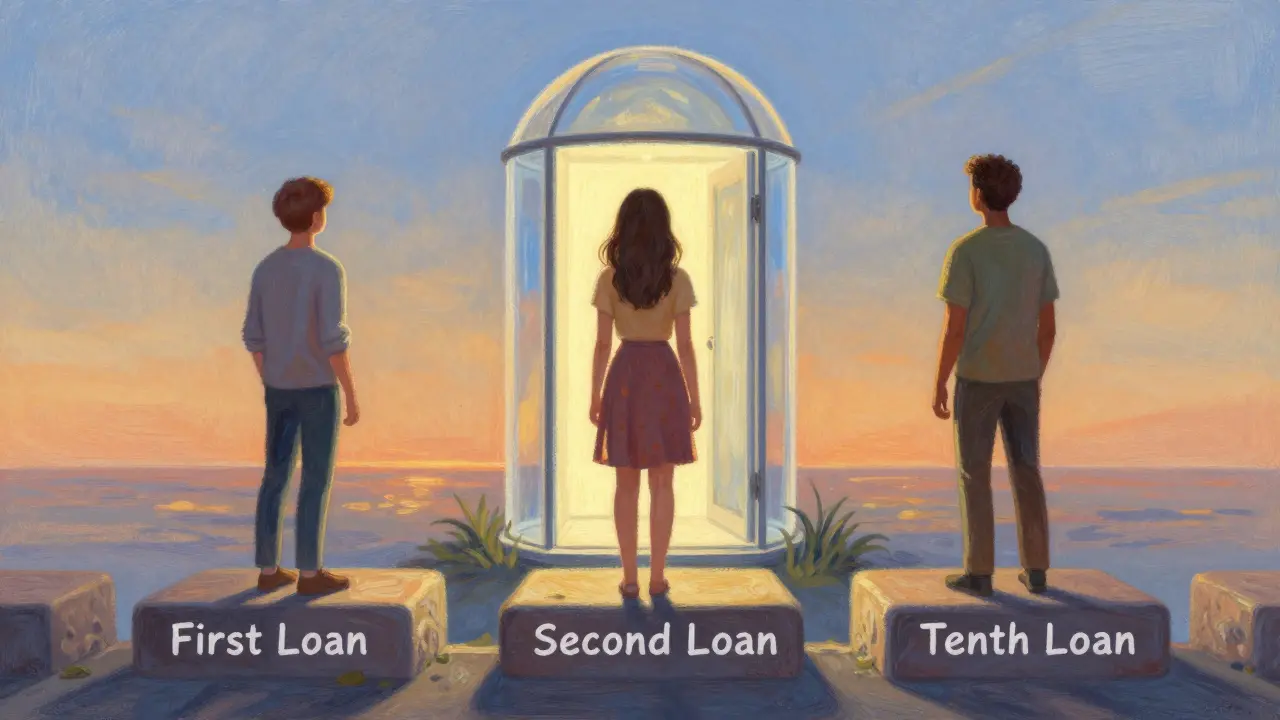
Think of it like this: Your first loan in DeFi? You need 150% collateral. Your third? Maybe 100%. Your tenth? Maybe 0%. The system learns you. And you earn trust over time. That’s how real financial inclusion works-not by handing out loans to everyone, but by giving people a path to earn access.
And that’s the real win. Not just more loans. Better loans. Fairer loans. Loans that don’t require you to be rich to get started.
Why This Matters More Than You Think
DeFi was supposed to be the financial system for the next billion people. Not just for the ones who already own crypto. Not just for the investors. But for the small business owner in Lagos. The freelancer in Manila. The student in Mexico City.
Right now, they can’t get in. But if undercollateralized lending works-if it’s safe, scalable, and fair-they can. And that’s not just a technical upgrade. It’s a revolution.
The old DeFi model is like a bank that only loans money to people who already have a million in the bank. The new one? A bank that gives you a chance to prove you’re trustworthy-even if you have nothing.
That’s the future. And it’s closer than you think.
Can you really get a DeFi loan without any collateral?
Yes-but not yet at scale. A few experimental protocols are testing zero-collateral loans using on-chain reputation, wallet history, and off-chain data verification via technologies like DECO. These are still in early stages and mostly limited to small loan amounts. No mainstream DeFi platform offers true undercollateralized loans today, but the technology is advancing fast.
How do lenders make money if there’s no collateral?
Lenders still earn interest, but they also use risk-based pricing. Higher-risk borrowers pay higher rates. Some protocols also require borrowers to lock up a small amount of token as a ‘risk deposit’-not to cover the full loan, but to create skin in the game. Insurance pools and reputation penalties help reduce defaults, making the system sustainable.
What’s the difference between undercollateralized and uncollateralized loans?
Undercollateralized means you put up less than the full loan value-say, 30% instead of 150%. Uncollateralized means you put up nothing at all. Most future DeFi systems will start with undercollateralized models before moving toward fully uncollateralized ones. The first step is reducing, not eliminating, collateral.
Is undercollateralized DeFi safe?
It’s riskier than overcollateralized loans, but not necessarily unsafe. The key is layered risk management: reputation scoring, insurance pools, behavioral penalties, and dynamic interest rates. These systems are designed to absorb defaults without collapsing. Early tests show default rates can be kept under 5%-comparable to traditional unsecured lending.
Will regulators allow undercollateralized DeFi loans?
It’s uncertain. Regulators are wary of uncollateralized lending because it resembles payday loans or credit cards. But if DeFi can prove it uses transparent, auditable, and self-governing risk controls-without human intermediaries-it may gain approval. Some jurisdictions are already testing sandbox environments for these new models.
What happens if I default on an undercollateralized DeFi loan?
There’s no repossession. Instead, your on-chain reputation drops. You lose access to borrowing privileges across multiple DeFi apps. Your wallet may be flagged in credit scoring systems. In some cases, a portion of your staked tokens or governance tokens is slashed. The penalty isn’t legal-it’s economic and social within the DeFi ecosystem.
Can I build credit history in DeFi?
Yes. Some platforms now track your repayment history, loan frequency, and interaction with lending protocols. Your wallet becomes a credit profile. If you repay consistently, your borrowing limit increases over time. It’s like a FICO score, but built on blockchain behavior, not bank reports.
Is undercollateralized DeFi only for crypto users?
Not necessarily. Future systems could integrate with real-world identity via zero-knowledge proofs or DECO, allowing users to prove income or employment without revealing personal data. This could open DeFi lending to anyone with a smartphone and internet access-even those with no crypto holdings.






This is literally the most overhyped thing I've seen all year. Undercollateralized loans? Bro, you're talking about turning DeFi into a payday loan app. And don't even get me started on 'on-chain reputation'-like my wallet history is gonna convince a bank I'm trustworthy? LOL. We're not even close to this working at scale. Someone's gonna get wiped out, and it'll be ugly.
i think this is kinda genius but also kinda risky? like, what if someone just creates 10 wallets and drains them? there's gotta be a way to stop sybil attacks. also, how do we know if someone's really repaying? what if they just move funds around? this feels like it needs more testing before going live.
India has been doing microcredit for decades. We don't need your fancy blockchain to give loans. We use community trust. Your system is just digital colonialism wrapped in crypto buzzwords. Why not learn from us instead of trying to reinvent the wheel?
I like this idea a lot. It feels like DeFi is finally starting to get real. The whole overcollateralized thing always felt like a crutch. If we can build trust through behavior instead of locking up assets, that’s huge. I’m curious to see how the insurance pools play out though.
omg yes!! this is what i’ve been waiting for!! i’ve been using deifi for 2 years and i’ve never missed a payment. why should i need to lock up 12k to borrow 10k?? i just want to buy a new laptop. this is sooo fair!! can’t wait for this to launch!!
You're all naive. This isn't innovation-it's a recipe for collapse. No collateral means no accountability. People will default. And when they do, the whole system will panic. You think reputation scoring is going to stop a guy who just wants free money? Wake up. This is how crypto crashes.
The fundamental flaw in this argument lies in its ontological assumption that financial inclusion can be achieved through algorithmic trust. The notion that on-chain behavior can replace institutional creditworthiness is not merely optimistic-it is epistemologically unsound. Human economic behavior is not reducible to transactional metadata.
I think this is the most important thing happening in DeFi right now. We’ve been stuck in this loop of ‘you need money to get money.’ This breaks that cycle. Imagine a single mom in Detroit who can’t get a bank loan but has been swapping ETH for years-this gives her a real shot. It’s not perfect, but it’s progress. And progress is better than perfection.
Solid breakdown. The part about penalty tokens is genius. If you default, you lose access. No jail, no lawsuit, just you can’t borrow anymore. That’s enough pressure. And the insurance pools? Smart. It’s like a mutual aid system. DeFi could actually become useful for regular people.
I’ve been watching this space for years and this is the first time I’ve seen something that actually feels scalable. The key is combining multiple layers: reputation, insurance, dynamic rates. One alone won’t work. But together? You get something that’s both secure and inclusive. And honestly, if we can get this right, it could change how the world thinks about credit forever.
The cultural implications of this shift are profound. In many societies, credit is tied to social standing, not just economic output. To replace that with algorithmic reputation is to redefine trust itself. This is not merely a financial innovation-it is a sociotechnical transformation.
This is dumb. You want to lend without collateral? Then why not just give people free money? At least with collateral you get something back. Now you're just handing out crypto like candy. Someone's gonna get rich. Everyone else gets screwed.
So let me get this straight. You’re saying the solution to not having enough crypto is to... trust people more? Wow. I never thought of that. Next you’ll tell me we should stop using passwords and just hug our computers.
You're all missing the real point. On-chain reputation is useless without cross-chain data aggregation. You need to integrate with EVM, Solana, and Polygon behavior. Otherwise, you're optimizing for a siloed system. And DECO? It's still in alpha. You're building on sand. Real innovation requires multi-layered, cross-protocol verification-not some half-baked wallet history metric.
This is the future. Imagine a kid in Nairobi who’s been sending small ETH payments for months to pay for data. He’s never had a bank account. But his wallet shows he’s consistent, reliable, and active. Now he gets a $500 loan to start a mobile repair business. That’s not just finance-that’s freedom. We’re not just changing loans. We’re changing lives.
I’m so excited about this. My cousin in Guatemala just got her first loan through a test version of this. She used it to buy a new sewing machine. Now she’s making money. No paperwork. No bank. Just her wallet and her history. This isn’t tech. This is magic.