

GameFi Protocol (GFI) CoinMarketCap Airdrop: What Actually Happened
Token Verification Tool
Verify Token Legitimacy
Check if a token exists on blockchain explorers to avoid fake airdrop scams like the GameFi Protocol (GFI) myth.
- Real projects have verified team members on LinkedIn/Twitter
- Legitimate airdrops don't ask for payment
- Check token contracts on BscScan/Etherscan
- Verify official channels before connecting your wallet
There’s no such thing as a GameFi Protocol (GFI) airdrop with CoinMarketCap - at least not one that ever happened. If you’ve seen posts, tweets, or YouTube videos claiming there was a GFI token drop tied to CoinMarketCap, you’re looking at misinformation. This isn’t just a rumor. It’s a fabricated story that’s been recycled across crypto forums since late 2021, long after any real event would have taken place.
What is GameFi Protocol?
GameFi Protocol doesn’t exist as a real blockchain project. There’s no whitepaper, no team, no GitHub repository, no token contract on BSC, Ethereum, or any other chain. The name sounds convincing - it blends two hot trends: gaming and DeFi - but that’s exactly how scams work. Fake projects often use names that sound like they belong to well-known ecosystems. In this case, it’s borrowing credibility from CoinMarketCap, a trusted name in crypto data.
Compare this to real GameFi projects like Thetan Arena, Binary X, or Faraland. These had actual games, real players, and verifiable token launches. Their airdrops were announced on official channels - Twitter, Discord, their own websites. They gave users clear steps: connect your wallet, complete tasks, wait for distribution. None of that exists for GameFi Protocol.
CoinMarketCap’s Real Airdrop History
CoinMarketCap did run airdrop campaigns - but only with real, vetted projects. In September 2021, they partnered with BSC GameFi Expo to distribute over $100,000 in tokens across five games: BunnyPark, Thetan Arena, Binary X, DeFi Warrior, and Faraland. These were legitimate launches. Each project had a working demo, a roadmap, and community traction. CoinMarketCap didn’t just hand out tokens to random names. They checked the teams, reviewed the code, and confirmed liquidity locks.
Later that October, they ran another round with Radio Caca, ZOO Crypto World, and CryptoBay. Again, all real projects. All with public documentation. All with token contracts you can verify on BscScan. You can still look up those token addresses today. Try searching for GFI on BscScan or Etherscan. Nothing comes up. No contract. No transactions. No minting events.
Why the GFI Airdrop Story Keeps Resurfacing
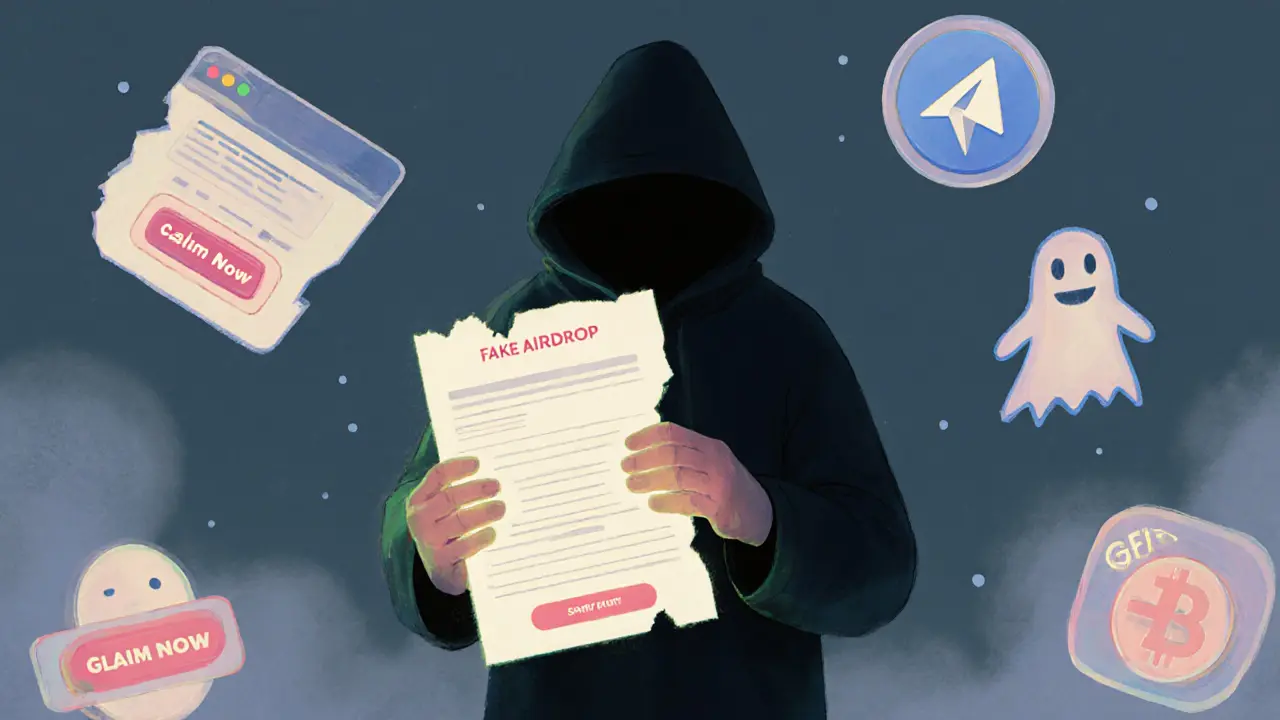
This myth survives because it’s easy to copy. Scammers love to reuse old names and fake announcements. They’ll post a screenshot of a fake CoinMarketCap page, add a “GFI” token symbol, and tell you to “claim your free tokens” by connecting your wallet. The goal? To steal your private key or trick you into paying a gas fee to “unlock” your airdrop.
Some people fall for it because they remember real airdrops from 2021 and assume anything with “GameFi” and “CoinMarketCap” must be real. Others see it in Telegram groups where bots auto-post fake airdrop links. The story gets passed along like a chain letter - no one checks the facts, and everyone thinks someone else already did.
How to Spot a Fake Airdrop
Here’s how you tell the difference between a real airdrop and a scam:
- Check the official source - CoinMarketCap never promotes airdrops on its homepage or app. They list tokens, they don’t give them away. If a site says “Claim your GFI via CoinMarketCap,” it’s fake.
- Look for a token contract - Real tokens have addresses on blockchain explorers. Search for GFI on BscScan or Etherscan. If you get zero results, it doesn’t exist.
- Verify the team - Real projects have LinkedIn profiles, Twitter accounts with verified badges, and public GitHub commits. GameFi Protocol has none.
- Never pay to claim - No legitimate airdrop asks you to send crypto to receive free tokens. If it does, it’s a trap.
- Check dates - If the airdrop is supposedly from 2021 and you’re reading about it in 2025, it’s dead. Real airdrops have clear timelines. They end. They don’t stay open forever.
What Happened to Real GameFi Airdrops?
The 2021 GameFi boom was real. Projects like Thetan Arena and Faraland gave away millions in tokens. But most of those tokens crashed hard after launch. Thetan Arena’s token fell over 90% within six months. Faraland’s dropped below 10% of its peak. That’s normal for early GameFi projects - high hype, low utility.
But here’s the key difference: those projects had real games. People actually played them. GFI? There’s no game. No app. No server. No players. Just a name on a scam list.

Where to Find Legit Airdrops in 2025
If you want real airdrops today, stick to platforms that verify projects:
- CoinGecko Launchpad - Lists upcoming token sales with audits and team info.
- Gitcoin Grants - Funds open-source blockchain projects, often with token rewards.
- Official project Discord servers - Like Axie Infinity, Illuvium, or Gala Games. They announce airdrops directly.
- Chainlink’s CCIP - Some newer games use Chainlink for random token distribution. These are transparent and on-chain.
Never trust airdrop links from random Twitter accounts, Telegram bots, or YouTube comment sections. They’re not giveaways. They’re phishing traps.
Final Warning
If you’ve already connected your wallet to a site claiming to distribute GFI tokens, disconnect it immediately. Use a burner wallet for future airdrops. Never use your main wallet. And if you sent any crypto to claim GFI, you’ve lost it. There’s no recovery. No refund. No secret backdoor.
The truth is simple: GameFi Protocol doesn’t exist. The GFI token doesn’t exist. The CoinMarketCap airdrop never happened. Don’t waste your time. Don’t risk your funds. And don’t spread the myth.
Did GameFi Protocol (GFI) ever have an airdrop with CoinMarketCap?
No. There was never an official GameFi Protocol (GFI) airdrop tied to CoinMarketCap. The name and token symbol are fabricated. CoinMarketCap ran real airdrops in 2021 with projects like Thetan Arena and Faraland, but GameFi Protocol was never one of them. No contract, no team, no website - it’s a scam.
How can I verify if a GFI token is real?
Search for the token symbol GFI on blockchain explorers like BscScan or Etherscan. If no contract address appears, it doesn’t exist. Real tokens have public addresses, transaction history, and liquidity pools. GFI has none. Also, check CoinMarketCap’s official site - it doesn’t list GFI as a tradable asset.
Why do people still believe in the GFI airdrop?
Because scammers reuse old names and fake screenshots. The story first appeared in 2021, during the peak of GameFi hype. People remember real airdrops from that time and assume this one is real too. It spreads through Telegram groups and YouTube comments where users copy-paste without checking facts. It’s misinformation dressed up as opportunity.
Can I still claim GFI tokens if I missed the airdrop?
No, because the airdrop never existed. Any site claiming you can still claim GFI tokens is trying to steal your crypto. There’s no wallet to connect, no task to complete, no countdown timer - those are all fake interfaces designed to trick you into sending funds or giving up your private key.
What should I do if I already sent crypto to claim GFI?
Stop immediately. Disconnect your wallet from the scam site. If you used your main wallet, consider moving your funds to a new one. Unfortunately, once crypto is sent to a scam address, it’s gone. There’s no recovery process. Learn from it - never send crypto to claim free tokens, and always verify projects before interacting with them.
Stay sharp. In crypto, the most dangerous thing isn’t a falling price - it’s believing something that isn’t real.




Bro this is fake as hell. I saw it on Telegram last year and lost $200 trying to claim it. Don't fall for it.
I can't believe people still believe this. I remember when the GameFi hype exploded in 2021 and everyone was chasing free tokens like they were candy at a parade. I actually checked CoinMarketCap's official blog that whole year - they only partnered with projects that had working demos, real teams, and audited contracts. GFI? Zero footprint. No GitHub. No Discord. No Twitter with more than 3 followers. It's not just a scam - it's a lazy, recycled ghost story that preys on FOMO. People don't even bother verifying anymore. They see 'CoinMarketCap' and 'free tokens' and their brains shut off. I've seen it happen to friends who are otherwise super smart. It's terrifying how easily trust gets weaponized in crypto. And now it's 2025 and the same exact screenshot is still floating around YouTube comments with a new date slapped on it. Someone needs to make a bot that auto-posts the real airdrop history every time someone types 'GFI'. We're not even fighting scammers anymore - we're fighting apathy.
Good breakdown. I've been helping newbies in my local crypto meetup avoid these traps. The GFI myth is like a zombie - kills you if you touch it, but everyone keeps poking it. I always tell 'em: if it sounds too easy, and you didn't hear it from the project's own site, it's a trap. And if there's no contract on BscScan? Game over. No refunds. No second chances. Stay safe out there.
It's not merely misinformation - it's a pathological symptom of the degenerate crypto culture that equates legitimacy with hype. The fact that this myth persists for four years speaks to the intellectual bankruptcy of the average crypto participant. They don't care about verification; they care about the fantasy of wealth. The absence of a token contract isn't an oversight - it's a feature of the scam. It's designed to be unverifiable until it's too late. CoinMarketCap's vetting process was rigorous. The fact that this phantom project still lingers proves that the community doesn't value due diligence - it values spectacle. This isn't a warning. It's an autopsy.
So many people got burned 😭 But hey - at least we're learning! 💪 Real airdrops don't ask for your seed phrase. Real projects have GitHub commits. Real teams have LinkedIn profiles. Keep your wallet safe, keep your eyes open, and never trust a DM that says 'free tokens' 🚫✨
Wow, another woke crypto lecture. Newsflash: CoinMarketCap is just a data site. They don't 'vet' anything. They list whatever gets enough volume. The fact you think they're some holy arbiter of truth is why you got scammed in the first place. If you're not holding ETH or BTC, you're already losing. GFI? Maybe it's stealth-launched. Maybe you're just too dumb to find it. Stop being a gatekeeper.
I remember when I first saw this GFI post on Reddit - I almost connected my wallet. Thank god I checked BscScan first. So many people in my group chat in India are still chasing it. I just send them the link to this post. It's heartbreaking how easily hope gets exploited. Thank you for writing this. It matters.
What if CoinMarketCap is in on it? What if the whole thing is a psyop to flush out the gullible? I mean - why would they publish a post like this unless they wanted to create a false sense of security? Maybe GFI is a honeypot. Maybe the real airdrop is hidden in a smart contract only accessible via a secret key buried in the HTML comments of this page. I’ve seen deeper rabbit holes than this. Don’t trust the narrative. Always ask: who benefits?
So like GFI doesn't exist right? Ok but like why even bother writing all this if it's just a fake? Who cares? I'm just here for the memes anyway lol
Bro you think America is the only one with fake airdrops? In India we have 10x more. Fake projects with names like 'BharatDeFi' and 'AirtelCoin'. People still send money. They think if it's in English and has 'CoinMarketCap' written on it, it's real. This isn't a crypto problem - it's a literacy problem.
One must pause and consider the epistemological implications of this phenomenon: the persistence of a non-existent entity within a decentralized, trustless system. The GFI myth functions not as a fraud, but as a cultural artifact - a meme-structured lie that reveals the collective psychological need for narrative certainty in an inherently uncertain domain. The fact that this falsehood has endured for four years, despite verifiable disproof, suggests that truth, in crypto, is not a function of evidence, but of emotional resonance. The contract address is not absent because it was never deployed - it is absent because belief has replaced verification as the primary ledger.
Yeah this is spot on. I used to fall for this stuff too. Now I just check BscScan first. If it's not there, I close the tab. Simple. No drama. No FOMO. Just stay calm and do your own digging. Crypto's hard enough without adding fake airdrops to the mix
Good work breaking this down. I've been telling my cousins in Delhi the same thing - if you're being asked to pay gas to claim free tokens, you're already paying to get scammed. The real winners are the ones who walk away. Keep sharing truth. It's rare these days.
Love this. I used to think I was the only one who got annoyed by these fake posts. It's wild how the same screenshot gets reused with new years. I even saw one with a 2030 deadline. Like... what? We're not even in 2025 yet. Anyway, thanks for being the voice of reason. Keep it up.
This is exactly the kind of post I wish I'd found when I first started. I almost sent ETH to a 'GFI claim portal' last year - thank god I paused and googled it. You saved me from a huge mistake. Please keep making these. People need to hear this.
Of course it's fake. Everyone knows CoinMarketCap is owned by Binance now. This whole 'vetting' narrative is just PR. The real airdrops are all gated behind KYC and paid promotions. GFI is just the tip of the iceberg. They're all scams - you're just too naive to see it.
While the structural integrity of the argument presented is commendable, one must interrogate the underlying epistemic assumptions regarding the ontological status of digital assets. The non-existence of GFI, as asserted, presumes a Cartesian certainty regarding blockchain ontology - yet, in distributed systems, existence is contingent upon consensus. If no entity has deployed the contract, does it not remain a potentiality? The absence of evidence is not evidence of absence - merely evidence of non-activation. The real risk lies not in believing the myth, but in assuming that absence equates to impossibility.
I'm from Mexico and I've seen this GFI thing in Spanish too. Same screenshot, same fake link. People here are even more desperate for free crypto. I printed out a one-page guide with the 5 red flags and handed it out at a local cafe. One guy cried. Said he lost his rent money. We need more of this. Not just posts - real outreach.
It's not that GFI doesn't exist - it's that it exists in the shadow ledger of delusion. The token is real to those who believe. The contract is real to those who sent gas. The team is real to those who DM'd 'support' and got a reply. In crypto, perception is the only blockchain that matters. The rest is just noise from the old world trying to impose fiat logic on a post-scarcity dream.
Thanks for this. I showed this to my brother. He was about to connect his wallet. He said 'but it says CoinMarketCap'. I showed him BscScan. He just stared. Then he said 'oh'. No emojis. No drama. Just silence. That silence was worth more than any reply.
It's a ghost. No contract. No team. No game. Just a name. And yet it haunts forums. Why? Because people want to believe they're special enough to get free money. The truth is boring. The lie is a fairy tale. And fairy tales never die - they just change the date on the screenshot
You're right - and I'm so glad you wrote this. I just started learning about crypto and I was so excited about airdrops. This post helped me slow down. I'm not chasing free tokens anymore. I'm learning how to protect myself. That's the real win 🌱