
Optimistic vs ZK-Rollups: Which Ethereum Layer 2 Scaling Solution Wins in 2026?

Ethereum is fast. It’s secure. But it’s also painfully slow when you need to send a small amount of ETH or swap tokens on a decentralized exchange. The network chokes under pressure, fees spike into the hundreds of dollars, and transactions take forever to confirm. This is why Layer 2 scaling solutions are blockchain networks built on top of Ethereum to handle transactions off-chain before settling them on the mainnet exist. They are the only way to make Ethereum usable for everyday people.
Right now, two technologies dominate this space: Optimistic Rollups and Optimism, which assume transactions are valid until proven otherwise, and ZK-Rollups, which use complex cryptography to prove validity instantly. If you are a developer choosing where to build, or an investor trying to understand where the money is flowing, knowing the difference between these two is critical. One offers cheap, familiar development; the other offers speed, privacy, and future-proof security. Let’s break down exactly how they work, what they cost, and which one you should bet on in 2026.
The Core Difference: Trust vs. Math
To understand the battle between Optimistic and ZK-Rollups, you have to look at how they verify transactions. This is the fundamental split that dictates everything else-speed, cost, privacy, and complexity.
Optimistic Rollups operate on a simple premise: trust by default. When a batch of transactions is submitted to Ethereum, the system assumes they are all correct. No heavy computation happens immediately. Instead, there is a waiting period-a "challenge window"-where anyone can step up and say, "Wait, that transaction was invalid." If someone finds an error, they submit a fraud proof, and the invalid transaction is reversed. If no one challenges it within the set time (usually 7 days), the transaction is considered final. Projects like Arbitrum and Optimism use this model.
In contrast, ZK-Rollups rely on zero-knowledge proofs. Before any data hits the Ethereum mainnet, the rollup generates a cryptographic receipt-a mathematical proof-that verifies every single transaction in the batch is valid. You don’t wait for someone to challenge it; you know it’s correct because the math says so. This requires significant computational power upfront but removes the need for a multi-day waiting period. Leading examples include zkSync Era and StarkNet.
This distinction creates a trade-off. Optimistic Rollups are computationally cheap to run but socially expensive (you have to wait). ZK-Rollups are computationally expensive to run but socially cheap (instant finality).
Speed and Finality: How Long Do You Wait?
If you’ve ever tried to withdraw funds from a Layer 2 back to the Ethereum mainnet, you know the pain of the "bridge wait." This is where the two technologies diverge most sharply for users.
With Optimistic Rollups, the standard withdrawal time is 7 days. Yes, seven full days. This is the fraud proof challenge period. During this time, your funds are locked. You cannot move them anywhere else. For a casual user sending $50 worth of ETH, this feels archaic. For institutional investors moving millions, it’s a massive risk management headache. As Chainalysis noted in late 2024, about 18% of users abandon their withdrawal attempts during this waiting period simply because they forget or get frustrated.
ZK-Rollups change this dynamic completely. Because the validity proof is generated before submission, withdrawals can be finalized almost instantly-typically within 1 to 2 hours, and often much faster with liquidity bridges. If you are building a gaming application where players need to cash out their earnings immediately, or a high-frequency trading bot that needs real-time capital access, ZK-Rollups are the only viable option. The speed advantage here isn’t just a nice-to-have; it’s a functional requirement for many modern applications.
Cost Analysis: Fees in 2026
Cost is usually the primary driver for Layer 2 adoption. Nobody wants to pay more than necessary. However, the fee structure has shifted as hardware costs and gas prices fluctuate.
Historically, Optimistic Rollups were cheaper because they didn’t require heavy cryptographic computations. In late 2024, average transaction fees on Optimistic chains like Arbitrum hovered around $0.10 to $0.50. ZK-Rollups, burdened by the cost of generating proofs, ranged from $0.20 to $1.50. That might not sound like much, but for micro-transactions, it matters.
However, the gap is closing. As GPU hardware becomes cheaper and proof generation algorithms become more efficient, ZK-Rollup costs are dropping. Conversely, Ethereum’s base layer fees can spike unpredictably, affecting both. A key factor in 2026 is the type of transaction. For simple token transfers, Optimistic Rollups still hold a slight edge. But for complex smart contract interactions-like executing multiple swaps on a DEX simultaneously-ZK-Rollups can sometimes be more cost-efficient due to better data compression. According to benchmarks from the University of California, Berkeley, ZK-Rollups became 25% more cost-effective for complex interactions compared to Optimistic counterparts.
Developer Experience: EVM Compatibility
If you are a developer, the choice between Optimistic and ZK often comes down to one question: Can I deploy my existing Solidity code without rewriting it?
Optimistic Rollups are EVM-equivalent. This means they mimic the Ethereum Virtual Machine perfectly. You can take a smart contract written for Ethereum Mainnet, copy-paste it into Optimism or Arbitrum, and it works. This has been a huge advantage for adoption. Most DeFi protocols launched on Optimistic chains first because it was the path of least resistance. Developer communities are larger, documentation is more mature, and support forums are active. If you want to launch a project quickly with minimal friction, Optimistic is the clear winner.
ZK-Rollups historically struggled here. Early ZK chains required developers to learn new programming languages like Cairo (for StarkNet) or Lepton (for older zkSync versions). This created a steep learning curve. However, this landscape changed dramatically in 2025 with the release of zkSync 3.0 and Scroll, which offer full EVM compatibility. While still slightly more complex to optimize than pure Optimistic chains, the barrier to entry has dropped significantly. Today, the difference in developer experience is narrowing, but Optimistic chains still hold the advantage in terms of established tooling and community size.
Privacy and Security: Who Sees Your Data?
This is a subtle but crucial difference. On Optimistic Rollups, all transaction data is posted to the Ethereum mainnet in a compressed format, but it is still publicly visible. Anyone can see who sent what to whom. This is fine for public DeFi, but terrible for enterprise applications or private transactions.
ZK-Rollups, by definition, hide the details of the transactions. The zero-knowledge proof only confirms that the state transition is valid, not what happened inside it. This makes ZK-Rollups inherently more private. For companies looking to integrate blockchain into their supply chain or for users concerned about their financial footprint being tracked, ZK-Rollups are superior. Regulatory bodies in Europe, for instance, have shown a preference for ZK-Rollups under the MiCA framework because the cryptographic verifiability provides a stronger audit trail while protecting individual user data.
Security models also differ. Optimistic Rollups rely on economic incentives-validators must post collateral that gets slashed if they act maliciously. If enough honest validators go offline, the security degrades. ZK-Rollups rely on the security of the underlying cryptography. As long as the math holds, the system is secure. Many experts, including Ethereum co-founder Vitalik Buterin, view ZK-Rollups as the long-term gold standard for security because they remove the human element from validation.
| Feature | Optimistic Rollups | ZK-Rollups |
|---|---|---|
| Finality Time | 7 Days (Withdrawal) | Minutes to Hours |
| Avg. Transaction Fee | $0.10 - $0.50 | $0.20 - $1.50 |
| EVM Compatibility | Native (Easy Deploy) | Improving (zkSync 3.0) |
| Privacy | Low (Public Data) | High (Cryptographic Proofs) |
| Hardware Requirements | Standard Cloud Servers | High-End GPUs / Specialized RAM |
| Best Use Case | DeFi, General Purpose Apps | Gaming, Enterprise, Privacy |
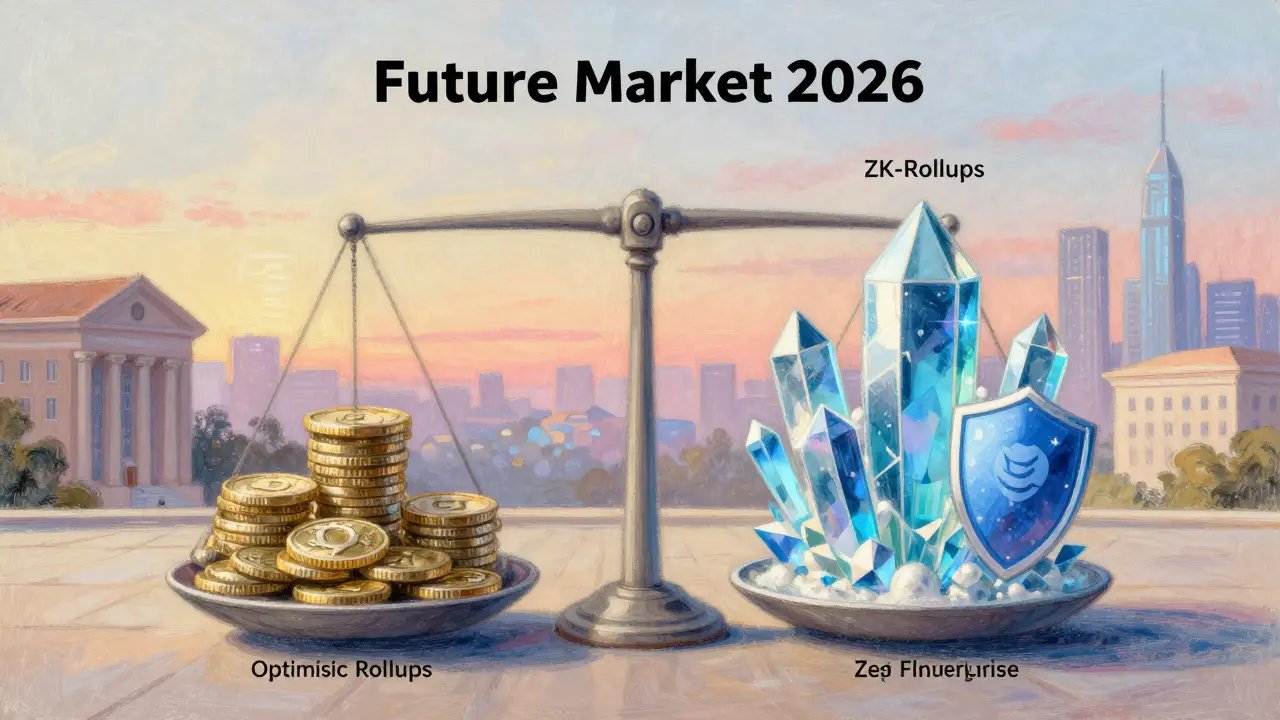
Market Adoption and Future Outlook
As of early 2026, the market is split. Optimistic Rollups, led by Arbitrum and Optimism, still control the majority of Total Value Locked (TVL) in Layer 2s, holding about 58% of the market. This is largely due to first-mover advantage and the ease of migration for existing DeFi protocols.
However, momentum is shifting. ZK-Rollups grew by 120% year-over-year in 2025, outpacing the 85% growth of Optimistic chains. Institutional adoption is heavily favoring ZK technology due to its regulatory compliance and security guarantees. Major traditional finance firms entering DeFi are building on ZK stacks. Meanwhile, the gaming industry, which demands low latency and fast finality, is increasingly migrating to ZK platforms like Immutable X.
Looking ahead, convergence is likely. We are seeing hybrid approaches emerge, such as Linea by ConsenSys, which incorporates elements of both. Furthermore, upcoming Ethereum upgrades like Pectra will introduce standardized blob transactions, which will reduce data costs for both types of rollups, potentially making ZK-Rollups even more competitive on price. By 2027, analysts predict ZK-Rollups could capture 60% of the Layer 2 market share as proof generation costs continue to fall.
Which One Should You Choose?
Your choice depends entirely on your priorities.
- Choose Optimistic Rollups if: You are building a general-purpose DeFi application, need maximum compatibility with existing Ethereum tools, want the lowest possible deployment friction, and your users are tolerant of slower withdrawal times.
- Choose ZK-Rollups if: You are building a game, an identity platform, or an enterprise solution where privacy and instant finality are non-negotiable. Also choose ZK if you believe in the long-term cryptographic security model and want to future-proof your infrastructure against potential fraud proof vulnerabilities.
There is no single "best" solution yet. The ecosystem benefits from competition. For now, Optimistic Rollups provide the immediate relief Ethereum needs, while ZK-Rollups represent the ultimate destination for scalable, private, and secure blockchain computing.
What is the main difference between Optimistic and ZK-Rollups?
The main difference lies in verification. Optimistic Rollups assume transactions are valid and wait for a challenge period (usually 7 days) to detect fraud. ZK-Rollups use cryptographic proofs to verify transaction validity instantly before submitting them to the mainnet, offering near-instant finality.
Are ZK-Rollups more expensive than Optimistic Rollups?
Generally, yes, but the gap is narrowing. ZK-Rollups require more computational power to generate proofs, leading to higher fees ($0.20-$1.50) compared to Optimistic Rollups ($0.10-$0.50). However, for complex smart contract interactions, ZK-Rollups can sometimes be more cost-efficient due to better data compression.
Why do Optimistic Rollups have a 7-day withdrawal period?
The 7-day period is a "challenge window" for fraud proofs. Since the system assumes transactions are valid, it needs time for anyone to spot and report an invalid transaction. If no fraud is reported within this week, the withdrawal is finalized. ZK-Rollups do not need this wait because validity is proven cryptographically upfront.
Can I deploy my existing Ethereum smart contracts on ZK-Rollups?
Historically, no, but this has changed. Early ZK-Rollups required specialized languages like Cairo. However, newer platforms like zkSync 3.0 and Scroll offer full EVM compatibility, allowing developers to deploy standard Solidity smart contracts with minimal adjustments, similar to Optimistic Rollups.
Which Layer 2 is better for gaming?
ZK-Rollups are generally better for gaming. Games require fast finality so players can instantly trade assets or cash out winnings. The 7-day withdrawal delay of Optimistic Rollups is unacceptable for most gaming experiences. Additionally, ZK-Rollups offer better privacy features, which are often desired in gaming environments.
Is Ethereum planning to replace Rollups?
No. Ethereum’s roadmap explicitly supports Rollups as the primary scaling solution. Upgrades like Pectra and Dencun are designed to make Rollups cheaper and more efficient by introducing blob transactions. Both Optimistic and ZK-Rollups will continue to coexist and evolve alongside Ethereum.