

Patient Data Privacy with Blockchain: How It Works, Benefits, and Real-World Challenges

Imagine handing over your entire medical history to a hospital system, trusting them to keep it safe. Now imagine that same system getting hacked, exposing your sensitive diagnoses to the world. This isn't a hypothetical nightmare; it's happening right now. In the first half of 2023 alone, more than 41 million healthcare records were breached. According to the World Economic Forum, 95% of patients are deeply concerned about their health data being stolen or leaked online. The old way of storing patient information-centralized databases run by hospitals and insurance companies-is failing us. Enter blockchain technology, which is emerging as a powerful tool for patient data privacy by putting control back in the hands of individuals.
But how does this actually work? Is it just another tech buzzword, or can it truly secure your medical records? Let's break down what blockchain means for your health data, why traditional systems are vulnerable, and what real-world implementations look like today.
The Problem with Centralized Health Records
To understand why blockchain matters, we first need to look at how patient data is currently stored. Most hospitals use Electronic Health Record (EHR) systems like Epic or Cerner. These are centralized databases. Think of them like a giant filing cabinet in one room. If someone breaks into that room, they have access to everything inside.
This "single point of failure" is the biggest weakness. When hackers target these central servers, the cost is staggering. The 2023 IBM Cost of a Data Breach Report found that the average healthcare data breach costs $10.93 million per incident. Beyond the money, there's trust. Patients don't know who has accessed their records, when, or why. They are passive subjects in their own healthcare journey.
Traditional systems also struggle with interoperability. Your doctor at Hospital A might not be able to easily see records from Clinic B because the software doesn't talk to each other. This leads to duplicated tests, medication errors, and fragmented care. We need a system that is secure, transparent, and gives patients actual ownership of their data.
How Blockchain Secures Patient Data
Blockchain is a decentralized digital ledger that records transactions across many computers so that any record can be verified without needing a central authority. In the context of healthcare, it works differently than Bitcoin. We aren't trying to mine coins; we're trying to secure data.
Here is the core concept: instead of storing your full medical record on the blockchain, the system stores an encrypted version of the file on a decentralized storage network (like IPFS) and keeps a unique cryptographic hash (a digital fingerprint) on the blockchain. This hash proves that the data hasn't been tampered with. If a hacker changes even one letter in your diagnosis, the hash changes, and the system flags it immediately.
Let's look at a specific framework called SPChain, detailed in a January 2025 study published in Nature Scientific Reports. Here is how the process works step-by-step:
- Patient Registration: You create an identity on the platform.
- Key Generation: The system generates a public key and a private key for you. Only you hold the private key.
- Data Encryption: Your medical record is encrypted using AES symmetric encryption.
- Decentralized Storage: The encrypted file is sent to IPFS (InterPlanetary File System).
- Hash Recording: The address of that file and its hash are recorded on the permissioned blockchain (EHRChain).
- Access Control: When a doctor needs to see your record, they request access via a smart contract. You approve it using your private key.
This structure ensures that no single entity owns your data. Even the hospital administrators can't change your past records without leaving a permanent, visible trail. This immutability is the cornerstone of trust in blockchain systems.
Patient Autonomy: The Game Changer
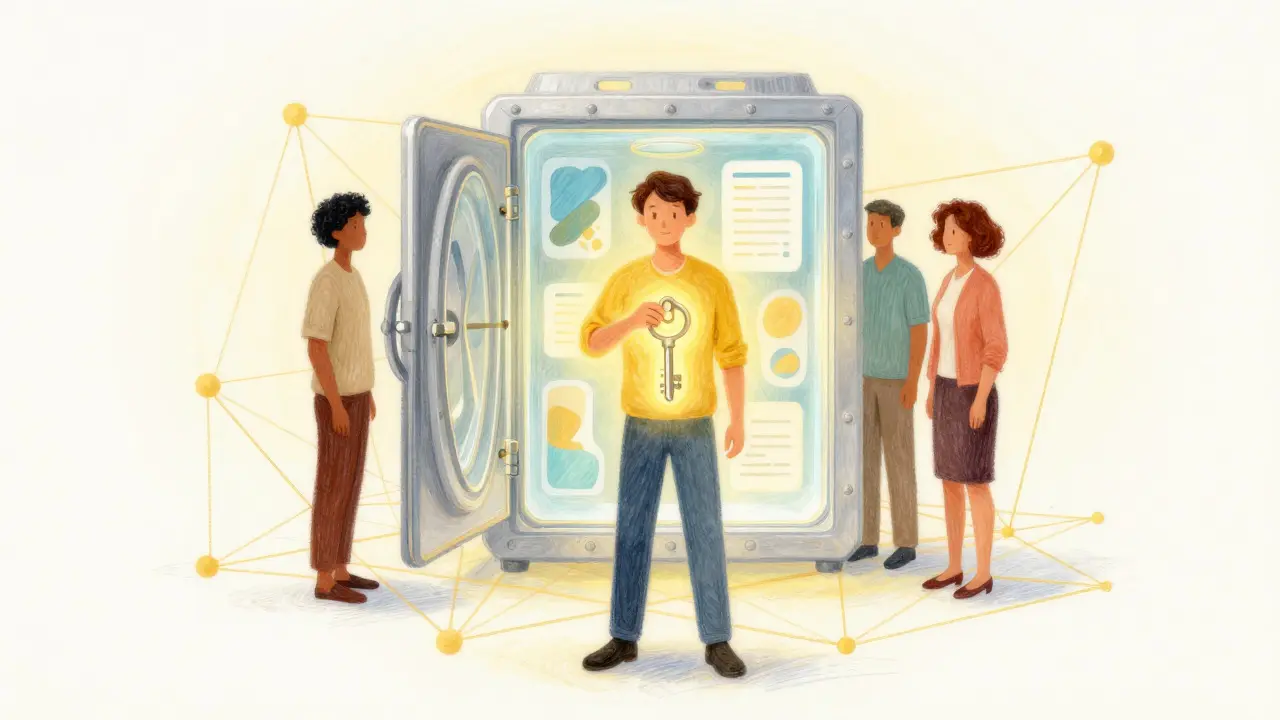
The most exciting aspect of blockchain for healthcare is patient autonomy. In current systems, providers control access permissions. With blockchain frameworks like SPChain, you do.
You can set granular privacy preferences. Want your cardiologist to see your heart data but hide your mental health notes from your primary care physician? You can configure that. This is managed through smart contracts-self-executing code on the blockchain that enforces rules automatically.
A study in PMC11073478 (March 2024) highlighted that this empowerment encourages patients to engage more actively in their health management. When people feel safe sharing their data, they are more willing to participate in clinical trials and share accurate histories, leading to better treatment outcomes. It shifts the dynamic from "doctor knows best" to "patient-led care."
Performance and Scalability: The Reality Check
It’s not all perfect. Blockchain introduces some technical trade-offs that healthcare IT teams must consider. The biggest issue is speed and scalability.
Centralized databases like those used by Epic can process 1,000 to 10,000 transactions per second. Current blockchain implementations handle roughly 50 to 200 transactions per second. For routine longitudinal records, this is fine. But for a busy emergency department where seconds count, this latency can be a bottleneck.
There is also computational overhead. The cryptographic operations required to secure keys and verify hashes add approximately 15-22% processing time compared to traditional databases. However, the security benefits often outweigh this cost. The Nature study noted transaction processing times of 2.3-4.7 seconds per record, with 99.98% data integrity. That level of accuracy is critical when lives are on the line.
| Feature | Centralized EHR (e.g., Epic) | Blockchain (e.g., SPChain) |
|---|---|---|
| Data Control | Provider/Hospital owned | Patient owned |
| Breach Cost (Avg) | $10.93 million | $7.21 million |
| Transaction Speed | 1,000-10,000 TPS | 50-200 TPS |
| Transparency | Low (Black box) | High (Immutable audit trail) |
| Interoperability | Limited (Silos) | High (Standardized protocols) |

Real-World Implementations and Adoption
Is this just theory? No. Several projects are already proving the concept. In Kenya, Snark Health implemented a blockchain solution that reported 82% patient satisfaction with data control features. Users actively managed their access permissions monthly. In Tanzania, AID:Tech saw a 40% reduction in unauthorized data access incidents within six months.
In Uganda, Mediconnect has processed 1.2 million patient records with zero reported breaches since Q3 2023. These success stories show that when infrastructure is adapted to local needs, blockchain can significantly enhance security and trust.
However, adoption faces hurdles. Dr. Deborah Peel, founder of Patient Privacy Rights, warned that "blockchain alone cannot solve all privacy issues; it must be combined with robust identity management and patient education." There is genuine confusion among users. On Reddit’s r/HealthIT community, users shared frustrations about losing private keys, which locked them out of their records for weeks. Recovery processes are still complex and user-unfriendly.
As of Q2 2024, Gartner reports that while 37% of healthcare organizations are piloting blockchain solutions, only 8% have fully operational patient-controlled data systems. The market is growing fast though-projected to reach $8.92 billion by 2028. Companies like Guardtime and Medicalchain are leading the charge, but widespread enterprise adoption requires easier integration with legacy systems.
Regulatory Compliance and Future Outlook
One major advantage of blockchain is its potential to simplify compliance with regulations like HIPAA (USA) and GDPR (EU). Because every access attempt is logged immutably, audits become straightforward. You don't need to guess who viewed a record; the blockchain tells you exactly who, when, and from where.
Looking ahead, interoperability standards are evolving. HL7 International announced a working group in June 2024 to develop FHIR (Fast Healthcare Interoperability Resources) blockchain implementation guides. By 2027, analysts predict 60% of patient data sharing will occur through blockchain-enabled systems. Biometric authentication integrated with blockchain keys, as seen in ACHealthChain pilots, is reducing unauthorized access by 73%. The future of patient data privacy isn't just about hiding data; it's about giving patients the keys to their own digital health vaults.
Is blockchain secure enough for sensitive medical data?
Yes, blockchain offers high security through cryptographic hashing and immutability. Studies show it reduces data breach costs and provides definitive evidence against man-in-the-middle attacks. However, security depends heavily on proper key management by the patient.
What happens if I lose my private key?
Losing your private key can lock you out of your records, as there is no central administrator to reset it. Current recovery mechanisms are complex, involving multi-signature wallets or trusted third-party guardians. This is a major area of improvement for future user interfaces.
Does blockchain replace existing EHR systems like Epic?
Not entirely. Blockchain acts as a layer on top of or alongside existing EHRs to manage access rights and verify data integrity. It integrates with systems via standards like FHIR rather than replacing the clinical workflow tools doctors use daily.
Is blockchain compliant with HIPAA and GDPR?
Can patients really control who sees their data?
Yes. Through smart contracts, patients can grant temporary or permanent access to specific providers. They can also revoke access instantly. This granular control is a significant shift from the all-or-nothing approach of traditional systems.
Why is blockchain slower than traditional databases?
Blockchain requires consensus among multiple nodes and complex cryptographic verification for every transaction. This distributed nature adds latency (15-22% overhead) compared to the direct read/write capabilities of centralized servers.






looks like another tech fix for a management problem tbh
Hey Matt! It's definitely more than just management, though you're right that culture matters. The key here is the cryptographic hash ensuring data integrity. When a doctor accesses your record, the system logs it immutably on the chain. This means no one can quietly alter your diagnosis later without everyone knowing. It’s about trust through math rather than trust through corporate promises. Plus, with IPFS storage, the actual heavy files aren't clogging up the blockchain itself, which helps with scalability issues we often hear about. :)
You naive fools are walking right into the surveillance state trap. Blockchain doesn't secure privacy; it creates an immutable ledger of your every move for the algorithmic overlords to harvest. They don't want to 'protect' your data; they want to own the metadata graph of your biological existence. The 'decentralization' is a myth sold by venture capitalists who know full well that the node operators will be Big Tech subsidiaries within five years. Once your private key is linked to your biometric identity, you have zero anonymity. You are now a permanent entry in a global database that cannot be deleted because 'immutability' is their god. Wake up before you sign away your digital soul.
Carl, you’re always so gloomy! But seriously, isn't it fascinating how this shifts the paradigm? Imagine holding the keys to your own medical vault. It’s like having a personal bank for your health secrets. The drama of losing a key is real, sure, but think of the empowerment! You become the CEO of your own body’s data. It’s not just tech; it’s a philosophical shift from passive patient to active guardian. Pretty wild concept when you really let it sink in, don’t you think?
The fundamental flaw in this argument lies in the assumption that patients possess the requisite technical acumen to manage cryptographic keys. Furthermore, the latency issues cited-specifically the 15-22% processing overhead-are unacceptable in acute care settings where milliseconds dictate survival outcomes. To suggest that a permissioned blockchain can seamlessly integrate with legacy EHR systems without significant refactoring is intellectually dishonest. The interoperability standards mentioned are still in their infancy, and HL7 FHIR implementations vary wildly across vendors. Until we see a unified protocol that addresses both the Byzantine Generals Problem and clinical workflow efficiency, this remains a solution in search of a problem.
I’ve been reading up on these SPChain frameworks and honestly, the idea of granular control is what gets me excited. I mean, why should my primary care doctor need to see my therapy notes if it’s not relevant to my blood pressure? It feels like such a basic right that we’ve never really had before. I worry about the learning curve though, especially for older folks who might struggle with digital wallets. But if it means fewer duplicated tests and less anxiety about hackers stealing my info, I’m all for it. It’s nice to feel like I have some agency in a system that usually treats me like a number.
everyone is so obsessed with this buzzword. its not magic. its just a database with extra steps. and dont get me started on the environmental cost of all those nodes running 24/7. we are burning resources to solve a problem created by bad coding practices in the first place. typical tech bro solutionism.
Candice, hold up! It’s not about the buzzword, it’s about the architecture. Traditional databases are single points of failure, plain and simple. Blockchain distributes that risk. And regarding energy costs, most healthcare blockchains are permissioned and use Proof-of-Authority or similar low-energy consensus mechanisms, not Proof-of-Work like Bitcoin. So the carbon footprint is negligible compared to the security gains. We need to look at the actual implementation details, not just throw shade. It’s a powerful tool if used correctly!
the epistemological shift here is profound. we move from institutional authority to cryptographic verification. yet the human element remains the weak link. if the user loses the key the data becomes orphaned truth. inaccessible. eternal silence. is that privacy or erasure? the jargon obscures the existential dread of being locked out of one's own history. interesting paradox.
They’re watching you even when you’re ‘private’ 😡👁️ The ‘smart contracts’ are just code written by the same people who want to sell your data to pharma companies. Don’t fall for it! 🚩📉 #BigPharma #SurveillanceState
Most people won't bother setting up the keys properly. They'll write them on a sticky note and leave it on their monitor. Then they'll blame the technology when they get hacked. It's always the user error. Simple as that.
Dave!!! You are absolutely right about the user experience challenge!! That is exactly why education is paramount!!!! We need robust recovery protocols like multi-signature wallets involving trusted family members or guardians!!!!! It is not enough to just build the tech!!!! We must empower the people!!!! Think about the potential for global health equity if developing nations can bypass expensive centralized infrastructure!!!!! Let us embrace this future with open arms and rigorous training programs!!!!!
The transaction throughput bottleneck is the elephant in the room. 200 TPS is laughable for a national health service. However, the audit trail benefits for HIPAA compliance are undeniable. If hospitals can automate their audit responses using immutable logs, the administrative savings alone could justify the slower access times for non-emergency records. We need a hybrid approach: fast centralized cache for active treatment, blockchain for historical integrity and consent management.
I appreciate the balanced view here. It’s easy to get swept up in the hype, but acknowledging the speed limitations and key management headaches is crucial. I think the real win is the interoperability aspect. Being able to share records between Hospital A and Clinic B without faxing PDFs would be a game-changer for patient safety. Even if it’s slower, if it prevents medication errors due to fragmented data, it’s worth it. Let’s hope the UI/UX improves so regular people don’t feel intimidated by the tech.