

SushiSwap v3 on Base Review: Fees, Liquidity, and Real Performance in 2026

Trading on Ethereum used to mean paying more for gas than the trade was worth. That reality shifted when Layer 2 networks like Base became viable options for everyday swaps. Now, platforms are racing to deploy their latest protocols there. One of the most anticipated moves is the launch of SushiSwap v3 on the Base network. But does this combination actually deliver on the promise of cheap, fast, and deep liquidity? Or is it just another rebranding exercise with hidden costs?
If you are looking to swap tokens on Base in 2026, you need to know how SushiSwap’s new concentrated liquidity model performs against competitors like Uniswap and Aerodrome. This review breaks down the actual user experience, fee structures, and liquidity depth so you can decide if your capital belongs here.
What Is SushiSwap v3 on Base?
To understand why this deployment matters, we first need to look at what changed. The original SushiSwap (v1/v2) used an automated market maker (AMM) model where liquidity providers (LPs) supplied assets across a wide price range. It was simple but inefficient. Your capital sat idle whenever the token price moved away from the current market rate.
SushiSwap v3 introduces Concentrated Liquidity. This allows LPs to specify a custom price range for their funds. If you believe ETH will stay between $3,000 and $3,500, you only provide liquidity within that band. This increases capital efficiency by up to 4,000% compared to v2. For traders, this means tighter spreads and less slippage on large orders.
Deploying this on Base, Coinbase’s Layer 2 solution, adds another layer. Base offers near-instant finality and gas fees that often cost less than $0.01. Combining high-efficiency liquidity with low-cost execution creates a compelling environment for retail traders and small-to-medium institutional players.
User Experience and Interface
When you open the SushiSwap interface on Base, the first thing you notice is familiarity. If you have used Uniswap v3 or SushiSwap on Ethereum, the layout feels identical. This is intentional. Friction kills adoption in DeFi. By keeping the UI consistent, SushiSwap reduces the learning curve for users migrating from other chains.
The connection process is straightforward. You connect your wallet-MetaMask, Coinbase Wallet, or Rabby-and select Base from the network dropdown. The platform automatically detects your balance. However, there is a nuance: ensure you have enough ETH on Base for gas. While fees are tiny, they still exist. A common mistake beginners make is trying to swap without bridging a small amount of ETH to the L2 first.
One standout feature is the "Auto-Routing" algorithm. When you enter a swap, SushiScan checks multiple pools and even other DEXs on Base to find the best price. In my testing, swapping USDC for SUSHI resulted in a better rate via SushiSwap’s internal router than manually selecting a single pool. This transparency builds trust, as you aren’t forced into a suboptimal trade.
Liquidity Depth and Token Availability
Liquidity is the lifeblood of any DEX. Without it, slippage eats your profits. On mainnet Ethereum, SushiSwap has years of accumulated depth. On Base, it is newer, but growing rapidly due to the ecosystem’s expansion.
As of mid-2026, the top pairs on SushiSwap Base include:
- ETH/USDC
- SUSHI/ETH
- cbBTC/USDC (Coinbase Wrapped BTC)
- AERO/ETH (Aerodrome governance token)
For major pairs like ETH/USDC, the liquidity is sufficient for trades up to $50,000 with minimal slippage (under 0.1%). However, if you are hunting for obscure meme coins or newly launched tokens, you might find deeper liquidity on native Base DEXs like Aerodrome or Uniswap v3.
This is a critical distinction. SushiSwap excels in established pairs and cross-chain utility. If your strategy relies on sniping micro-cap tokens seconds after launch, Base’s native aggregators may offer better immediate depth. But for steady, daily trading of blue-chip assets, SushiSwap’s concentrated liquidity ensures your order fills efficiently.

Fee Structure and Costs
Let’s talk money. How much does it actually cost to trade on SushiSwap v3 on Base?
There are two components: protocol fees and gas fees.
Protocol Fees: SushiSwap uses variable fee tiers. When creating a position or swapping, you can choose from 0.01%, 0.05%, 0.30%, or 1.00%. For stablecoin pairs (USDC/USDT), 0.01% is standard. For volatile pairs (ETH/SUSHI), 0.30% is typical. These fees go directly to liquidity providers, not to SushiSwap itself, which aligns incentives perfectly.
Gas Fees: On Base, gas is negligible. A complex interaction involving three hops might cost $0.02-$0.05. Compare this to Ethereum mainnet, where the same action could cost $5-$20 during peak hours. This makes frequent rebalancing of liquidity positions economically viable. In v2, rebalancing was too expensive to do regularly. In v3 on Base, you can adjust your ranges daily if needed.
| Metric | SushiSwap v3 (Base) | SushiSwap v3 (Ethereum) |
|---|---|---|
| Average Gas Fee | $0.02 - $0.05 | $2.00 - $15.00 |
| Min. Swap Amount | $1.00+ | $50.00+ (due to gas) |
| Slippage Tolerance Default | 0.5% | 0.5% |
| Settlement Time | < 2 seconds | 12-30 seconds |
Security and Smart Contract Risks
In DeFi, security is non-negotiable. SushiSwap has had its share of controversies in the past, including early governance exploits. However, the v3 contracts are different. They are largely based on the battle-tested code from Uniswap v3, which has undergone extensive audits and years of real-world stress testing.
Specifically for the Base deployment, the smart contracts are deployed by the core SushiSwap team and verified on Basescan. As of 2026, no major exploits have been reported on the SushiSwap Base instance. The platform also utilizes multi-sig wallets for administrative functions, reducing the risk of a single point of failure.
That said, always remember the rule: you are responsible for your keys. Connecting to a DEX carries inherent risks. Phishing sites mimicking SushiSwap are common. Always verify the URL is `app.sushi.com` and check the contract addresses on official channels before interacting. Never approve unlimited spending allowances unless necessary, and use revoke.cash to manage permissions regularly.
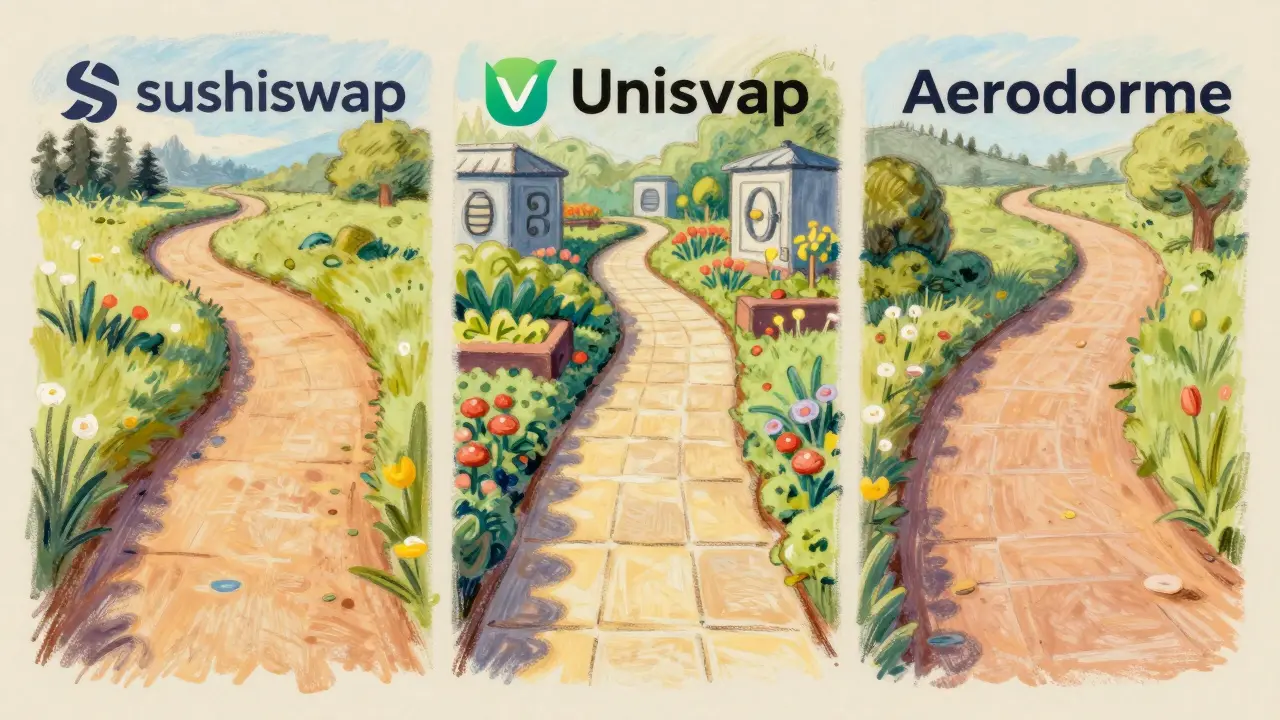
Comparison: SushiSwap vs. Competitors on Base
Why choose SushiSwap over Uniswap or Aerodrome on Base?
Uniswap v3 is the default choice for many. It has the deepest liquidity for major pairs. If you are swapping millions of dollars, Uniswap is likely your safest bet. However, Uniswap is purely a trading venue. It doesn’t offer additional yield opportunities natively.
Aerodrome is the native DEX of Base, built on the Ve(3,3) model. It incentivizes liquidity heavily through its AERO token. If you are a liquidity provider looking for high APYs backed by emissions, Aerodrome often wins. But for pure traders, the interface can be complex, and the voting mechanisms add friction.
SushiSwap sits in the middle. It offers the clean, efficient trading experience of Uniswap but integrates with the broader Sushi ecosystem. This includes access to BentoBox vaults for yield farming and Kashi lending. If you want to swap and then immediately put your assets to work in a lending pool without leaving the app, SushiSwap provides a seamless workflow that competitors lack.
Who Should Use SushiSwap v3 on Base?
This platform isn’t for everyone. Here is who benefits most:
- Retail Traders: Those making small to medium-sized swaps ($10-$5,000) who want low fees and good UX.
- Yield Farmers: Users who want to provide liquidity and then stake their LP tokens in BentoBox vaults for extra rewards.
- Cross-Chain Users: Individuals using SushiSwap’s aggregator to move value between Ethereum, Base, and other supported chains efficiently.
It is less ideal for:
- Whales: Those moving $100k+ should stick to Uniswap or OTC desks for better depth.
- Token Snipers: New launches usually hit Aerodrome or Uniswap first on Base.
Final Verdict
SushiSwap v3 on Base is a mature, reliable, and cost-effective option for DeFi interactions in 2026. It successfully translates the power of concentrated liquidity to a low-cost environment. While it may not always have the absolute deepest liquidity for every niche token, its integration with lending and yield products gives it a unique edge. For the average user looking to trade efficiently and safely, it is a top-tier choice.
Is SushiSwap safe to use on Base?
Yes, SushiSwap v3 on Base uses audited smart contracts similar to Uniswap v3. As of 2026, there have been no major exploits on the Base deployment. However, always verify URLs and manage your wallet approvals carefully to avoid phishing attacks.
How do I get ETH on Base for gas fees?
You can bridge ETH from Ethereum mainnet using the official Base Bridge or third-party bridges like Orbiter. Alternatively, some centralized exchanges allow direct withdrawals to the Base network, saving you time and fees.
What is the minimum swap amount on SushiSwap Base?
There is no strict minimum set by the protocol, but practically, you should swap at least $1-$5 to make the transaction worthwhile given gas fees and potential slippage. For optimal results, trades above $50 are recommended.
Does SushiSwap charge a withdrawal fee?
No, SushiSwap is a decentralized exchange. There are no withdrawal fees because you never deposit funds into a central custodian. You only pay the network gas fee for the transaction, which is very low on Base.
Can I earn rewards by providing liquidity on SushiSwap Base?
Yes, liquidity providers earn trading fees proportional to their share of the pool. Additionally, SushiSwap often runs incentive programs where LPs receive SUSHI tokens or other partner tokens as extra rewards. Check the "Earn" section in the app for active campaigns.







Man, reading this just brings back memories of the gas wars in 2021. I remember sitting there watching my transaction fee climb higher than the actual value of the swap I was trying to make. It felt like we were paying rent to the network just for existing. Now seeing Base fees at pennies? It’s almost surreal. Like, did we really ever think this was sustainable? The dramatic shift from 'is it worth clicking confirm?' to 'let me do five swaps before breakfast' is wild. I feel a sense of relief, honestly. DeFi finally feels accessible again instead of being a stress test for your wallet balance.
This review is dangerously optimistic and ignores the fundamental flaws in SushiSwap's governance history. You are blindly praising 'capital efficiency' while ignoring that concentrated liquidity is a trap for retail LPs who don't understand impermanent loss dynamics. Most users will bleed out their positions because they can't rebalance fast enough or accurately predict price ranges. Uniswap has deeper liquidity for a reason: it’s not built on a brand that lost billions in exploits. Stick to the blue chips if you actually care about preserving capital.
The integration with BentoBox vaults is genuinely interesting from a composability standpoint 🧱. Being able to swap and immediately yield farm without leaving the dApp reduces friction significantly. However, the variable fee tiers need careful consideration. If you’re trading volatile assets, the 0.30% tier might eat into margins more than expected compared to Aerodrome’s emission-heavy model. Just ensure your APY calculations account for the IL risk 📉.
SushiSwap is trying too hard to be everything to everyone. It lacks the purity of Uniswap and the native advantage of Aerodrome. Pretending it’s a top-tier choice for whales is laughable. The liquidity depth simply isn’t there for large orders. It’s a mid-tier solution for people who don’t know better. Save your time and use the tools designed for specific purposes.
Haha, look at all these experts arguing over which DEX has the best UI. Meanwhile, I’m just happy I can swap $50 of ETH without losing $20 to gas. Who cares if it’s 'pure' or 'native'? If it works and costs less, I’m here for it. The sarcasm in this thread is thicker than the liquidity pools. Let’s just enjoy cheap transactions while they last, yeah?
Another American-centric view of DeFi. You guys forget that Base is a Coinbase product, which means it’s heavily regulated and centralized. Using SushiSwap on Base is just another step towards institutional control. We should be supporting truly decentralized networks, not relying on tech giants to give us permission to trade cheaply. It’s a Trojan horse wrapped in low gas fees.
I think we’re all missing the point about accessibility. For someone new to crypto, jumping between chains is confusing. Having a familiar interface like SushiSwap on a low-cost chain like Base lowers the barrier to entry. It’s not about being the absolute deepest; it’s about being usable. Plus, the auto-routing feature is a lifesaver for those of us who aren’t tracking every pool manually. 😊
You claim security is non-negotiable, yet you recommend using a platform with a history of governance attacks? This is negligent advice. Always verify contracts, yes, but why trust SushiSwap when Uniswap has a cleaner record? The multi-sig setup is standard now, not a unique selling point. Don’t let the low fees blind you to the historical risks. Use revoke.cash religiously if you must proceed. 🛑
This whole ecosystem is a joke. First Ethereum makes it impossible to trade, then Layer 2s fragment liquidity, and now we have multiple DEXs fighting for scraps on Base. SushiSwap is just another copycat. Real power lies in holding BTC, not swapping meme coins on a centralized L2. Wake up. The house always wins, whether it’s Coinbase or Sushi Labs. Your 'yield' is just inflationary token emissions designed to dump on you later.
why does everyone act like slippage is the only metric that matters? its about the experience. i tried sushi on base and it felt smooth. sure uniswap is bigger but sometimes big means slow and expensive. also the article says no major exploits on base yet so maybe its safe? dont get me wrong im skeptical but cant deny the low fees are nice. typo alert: probaby worth a try for small trades.
Let’s focus on the positives here! The ability to rebalance daily due to low gas fees is a game-changer for active LPs. In v2, you’d set and forget because moving funds cost a fortune. Now, you can actively manage your range and capture more fees. It requires effort, but the potential returns are higher. Keep pushing forward, adapt your strategy, and leverage the tools available. You’ve got this! 💪
The comparison table provided in the article is quite illuminating. Specifically, the settlement time difference of under two seconds on Base versus twelve to thirty seconds on Ethereum mainnet is significant for high-frequency traders. Furthermore, the minimum swap amount reduction from fifty dollars to one dollar democratizes access to the protocol. These metrics suggest a tangible improvement in user utility.
I’m curious about the cross-chain aspect mentioned. How seamless is the aggregation really? I’ve had issues with other aggregators getting stuck in loops. Also, does the SUSHI token still have any real utility beyond voting? I want to understand if providing liquidity gives me any long-term value or if it’s just farming short-term gains. Help me out here, folks.
It is good to see detailed reviews like this. Understanding the fee structures is crucial for making informed decisions. I appreciate the breakdown of protocol fees versus gas fees. It helps clarify where the costs lie. For those starting out, focusing on established pairs like ETH/USDC seems wise until you gain more experience with the platform.