

Top DeFi Protocols by Total Value Locked (TVL) in 2026

Money doesn't sleep, and neither does the decentralized finance world. If you’ve been watching crypto since 2020, you know that "Total Value Locked" or TVL is the primary metric used to measure the amount of assets deposited into decentralized finance protocols, has become the north star for investors. But here’s the catch: TVL isn’t just a number on a dashboard. It’s a pulse check on where trust-and capital-is flowing in real-time. As we move through mid-2026, the landscape has shifted dramatically from the speculative frenzy of early years to a more mature, utility-driven ecosystem. Understanding which protocols hold the most value helps you see not just who is popular, but who is actually working.
What Is TVL and Why Does It Matter?
Let’s strip away the jargon. TVL represents the total USD value of all cryptocurrency assets currently sitting inside a protocol’s smart contracts. Think of it like checking the balance of every ATM in a bank network combined. When you deposit ETH into a lending pool or stake your tokens for yield, that money becomes part of the protocol’s TVL. The data comes from on-chain balances multiplied by current market prices, pulled via oracles like Chainlink is a decentralized oracle network that provides real-world data to smart contracts.
Why should you care? Because TVL signals adoption. High TVL usually means users trust the code enough to leave their money there. However, it’s not perfect. A protocol can have high TVL simply because it offers unsustainable yields that attract "mercenary capital"-users who will leave the moment better rates appear elsewhere. Experts now look at "TVL efficiency," measuring fees generated per dollar locked, to separate robust platforms from empty vessels.
The Heavyweights: Top DeFi Protocols by TVL
As of mid-2026, the hierarchy of DeFi power is clear. While Ethereum remains the dominant layer with over $86 billion in TVL across its ecosystem, individual protocols are carving out massive niches. Here are the leaders shaping the industry right now.
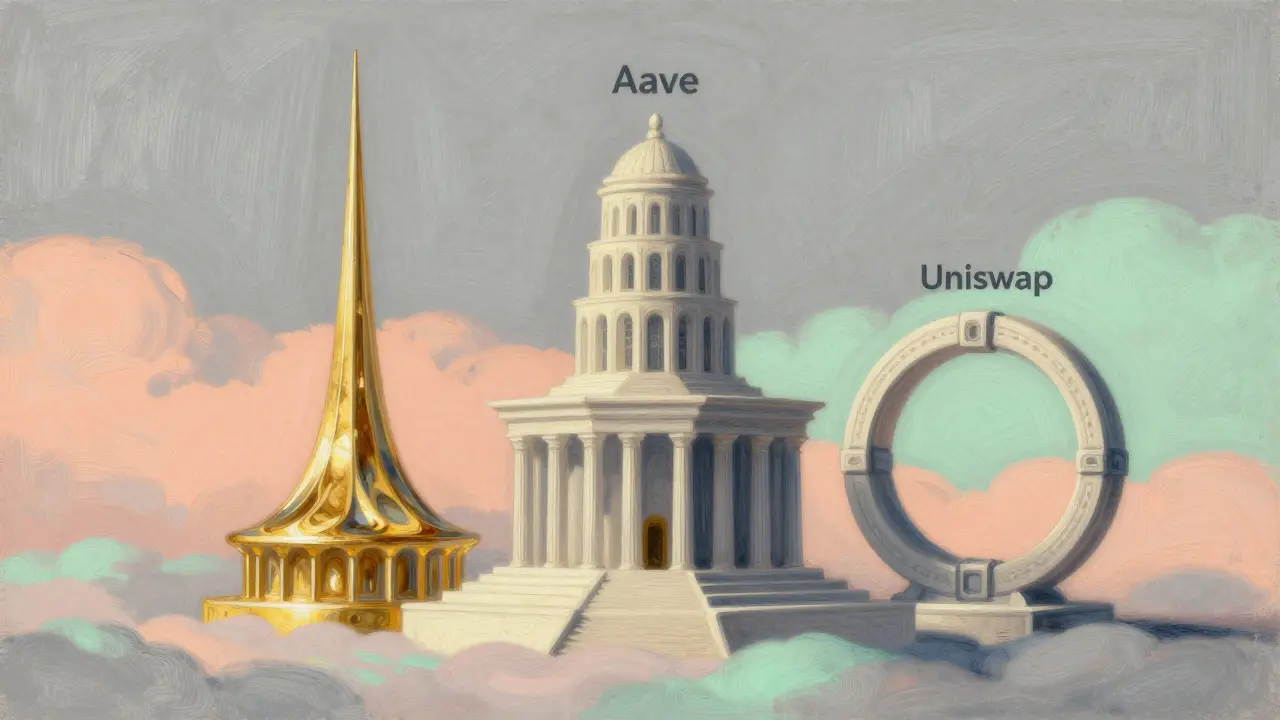
| Protocol | Primary Category | Approx. TVL | Key Feature |
|---|---|---|---|
| Lido Finance is a liquid staking solution allowing users to stake ETH while maintaining liquidity | Liquid Staking | $13.9 Billion | Issuance of stETH derivative |
| MakerDAO (Sky Protocol) is a decentralized credit platform issuing the DAI stablecoin | Stablecoin/Lending | $4.9 Billion | DAI stablecoin circulation |
| Aave is a decentralized non-custodial liquidity protocol for earning interest | Lending/Borrowing | $4.5 Billion | Isolated pools & credit delegation |
| EigenLayer is a restaking protocol enabling ETH stakers to secure additional services | Restaking | $3.8 Billion | Shared security model |
| Uniswap is a leading decentralized exchange protocol using automated market makers | DEX (Exchange) | $3.2 Billion | Concentrated liquidity (v3) |
| Curve Finance is a decentralized exchange optimized for stablecoin trading | DEX (Stablecoins) | $2.1 Billion | Low slippage swaps |
Deep Dive: The Leaders Explained
Lido Finance: The Liquid Staking Giant
Lido dominates the sector with nearly $14 billion in TVL. Its innovation was simple but powerful: it solved the liquidity problem of traditional staking. Normally, when you stake ETH, it’s locked up. Lido gives you stETH-a token representing your stake-that you can trade or use as collateral elsewhere. This captured over 32% of Ethereum’s liquid staking market. However, users should be aware of depegging risks, as seen during market volatility in 2024, where stETH briefly traded below the price of ETH.
Aave: The Lending Standard
Aave operates across nine chains, making it one of the most accessible lending protocols. With $4.5 billion locked, it stands out for its isolated lending pools, which prevent bad debt in one asset from collapsing the entire system. During the 2024 market crash, Aave’s design reduced bad debt by 78% compared to competitors. Its credit delegation feature allows borrowers to take loans without locking collateral if someone else vouches for them, adding a social layer to finance.
MakerDAO (Sky Protocol): The Stablecoin Engine
Behind the scenes of much of DeFi sits MakerDAO, now transitioning to the Sky Protocol brand. It holds $4.9 billion in TVL primarily to back DAI, the decentralized stablecoin pegged to the US Dollar. With borrowing rates around 5.8%, it attracts those seeking predictable yields. The complexity lies in collateral management; users must actively monitor their positions to avoid liquidation if asset prices drop sharply.
Uniswap vs. Curve: The Exchange Battle
If you want to swap volatile tokens, Uniswap is your go-to. Its v3 concentrated liquidity model allows providers to allocate capital within specific price ranges, boosting efficiency for professionals but complicating things for beginners. On the other hand, Curve Finance specializes in stablecoins. With lower fees (averaging 0.04%), it’s the backbone for arbitrageurs and yield farmers moving large sums with minimal slippage.
EigenLayer: The Restaking Innovator
EigenLayer introduced "restaking," allowing ETH validators to reuse their staked assets to secure other networks. This novel approach attracted $3.8 billion quickly. However, it introduces new slashing risks-if a validator misbehaves on a secondary service, they could lose their original ETH stake. It’s high reward, but higher technical risk.
Beyond Ethereum: Multi-Chain Reality
While Ethereum holds 60% of the market share, ignoring other chains is a mistake. Solana has surged to $13.2 billion in TVL, driven by low fees and high speed. Binance Smart Chain maintains $10.2 billion, appealing to users accustomed to centralized exchange ecosystems. Even Bitcoin sidechains are growing, holding $8.1 billion as developers find ways to bring DeFi to the largest blockchain. JustLend on Tron, for instance, holds $3.7 billion, showing that niche ecosystems can still command significant capital.

How to Evaluate Protocols Safely
Don’t just chase the highest TVL. Follow these steps to assess a protocol’s health:
- Check Revenue Generation: Does the protocol make money? Look for fee generation metrics. Protocols that rely solely on token emissions are fragile.
- Verify Audits: Ensure top firms like CertiK or OpenZeppelin have audited the code. Over 63% of top protocols now use multi-sig treasury controls to mitigate hack risks.
- Assess Oracle Reliability: Most exploits happen due to faulty price feeds. Check if the protocol uses multiple oracles like Chainlink or Pyth Network.
- Review User Experience: Complex interfaces lead to user errors. In Q2 2025 alone, $417 million was lost due to simple mistakes like misconfigured slippage settings.
Future Outlook: Where Is TVL Heading?
Analysts predict total DeFi TVL could reach $210-240 billion by late 2026. The trend is shifting toward "TVL 2.0," where sustainability matters more than sheer size. Institutional involvement is rising, with custodians like Fireblocks managing billions in stablecoin pools. Regulatory clarity remains the biggest wildcard, but as frameworks solidify, expect more traditional finance giants to integrate with these decentralized rails.
What is the safest DeFi protocol by TVL?
Safety is relative, but protocols like Aave and MakerDAO are considered among the safest due to their long track records, extensive audits, and conservative risk management strategies. They prioritize stability over high-risk yields.
Does high TVL mean a protocol is profitable?
Not necessarily. High TVL indicates capital inflow, but profitability depends on fee generation. Many protocols have high TVL but operate at a loss, relying on token subsidies to attract users.
What happened to Anchor Protocol's TVL?
Anchor Protocol’s TVL collapsed by 99% after its underlying asset, TerraUSD, depegged in 2022. This serves as a cautionary tale that unsustainable yields can mask fundamental fragility.
How do I track TVL in real-time?
You can use aggregators like DefiLlama or CoinGecko. These platforms pull data directly from blockchains and update TVL figures every few seconds, providing accurate snapshots of protocol health.
Is Lido Finance centralized?
Lido is often criticized for centralization concerns because a small group of node operators manages a large portion of the staked ETH. However, it is working on decentralizing its operator set to mitigate this risk.






The ontological framework of Total Value Locked is fundamentally flawed as a metric for systemic integrity. One must interrogate the epistemological validity of equating capital deposition with trust, particularly when such capital is merely mercenary in nature. The hegemony of Ethereum, while currently dominant, exhibits signs of stagnation that only a superficial analysis would overlook. We are witnessing the commodification of security through restaking mechanisms like EigenLayer, which dilute the foundational principles of decentralized consensus. It is imperative that we critique these structures rather than blindly accepting their narrative dominance.
stop overthinking it just put your money where your mouth is and watch it grow dont let fear stop you from winning big
i mean honestly everyone keeps talking about lido but nobody talks about how risky steth actually is during volatility its just wild to me that people ignore the depeg risks so easily
the paradigm shift towards tvl efficiency is indeed a fascinating development in our collective economic consciousness isn't it? one might argue that the pursuit of yield has become somewhat absurdly detached from actual utility yet here we are celebrating protocols that essentially function as digital vaults for speculative assets
i've been watching this space for years and it's interesting to see how things have settled down a bit since the crazy days of 2021. feels like people are finally looking at whether these protocols actually make sense instead of just chasing the highest number they can find on a chart
does anyone else think that solana is gonna take over ethereum soon or am i just dreaming? the fees are so much lower and its way faster for trading
you need to look at the revenue generation metrics before you even consider putting money into any of these protocols. high tvl means nothing if the protocol is burning cash to keep users happy. aave and makerdao are solid because they have real business models behind them not just token emissions
it's like a giant cosmic dance of numbers going up and down. one day you're king of the hill with billions locked in and the next day you're wondering why your stablecoin lost its peg. the whole ecosystem feels like a rollercoaster ride through a funhouse mirror where everything looks bigger than it really is
i totally get why people are worried about centralization with lido though. it's scary to think that a small group of operators controls so much of the network. hopefully they fix that soon because decentralization is supposed to be the whole point of crypto right?
im still confused about how restaking works exactly. like if i stake my eth and then use it again for another service what happens if one of them fails? does my original stake get slashed too? seems kinda risky tbh
listen up folks! we need to stop ignoring the multi-chain reality. bitcoin sidechains are growing fast and tron is holding its own. don't be stuck in the ethereum echo chamber when there are other opportunities out there waiting for you to grab them
hey guys i think its important to remember that audits arent enough. you gotta check the oracle reliability too. chainlink is good but pyth network is also getting popular. dont just trust one source for price feeds because that's how hacks happen
typical western ignorance. you people obsess over tvl while ignoring the fundamental moral decay of unregulated financial systems. anchor protocol collapsed because it was built on sand and now you're all running around like headless chickens trying to find the next safe haven. pathetic.
oh my god i just read about curve finance and wow those low slippage swaps sound amazing for moving large amounts. i never realized how much money i was losing on regular dexes. this article really opened my eyes to the importance of choosing the right exchange for different types of tokens
let me tell you something about risk management. if you aren't monitoring your positions in makerdao you are asking to get liquidated. it's not hard to understand. you put up collateral and if the value drops you lose it. simple as that. stop complaining when you get wrecked by market volatility
great breakdown of the current landscape! 🚀 i love seeing how eigenlayer is innovating with shared security. it's exciting times for defi. just remember to do your own research before diving in. safety first always! 👍
the concept of tvl efficiency is really key here. it separates the wheat from the chaff. many protocols look impressive on paper but fail to generate sustainable revenue. we need to focus on long-term viability rather than short-term hype cycles
it is truly remarkable to observe the evolution of decentralized finance from its chaotic beginnings to the more structured environment we see today. the integration of institutional players suggests a maturation of the industry that could lead to greater stability and widespread adoption in the coming years provided regulatory frameworks continue to develop in a supportive manner
man i wish i had started investing back in 2020. missed out on so much gains. now im just trying to catch up with some smaller caps. hope i dont regret it later
your analysis is superficial at best. you fail to address the systemic risks associated with smart contract vulnerabilities which remain the single biggest threat to defi. citing tvl as a north star is laughable when a single bug can wipe out billions in seconds. educate yourself before posting garbage
i appreciate the detailed explanation of uniswap v3 concentrated liquidity. it sounds complicated but i guess it makes sense for professional traders. maybe i'll try using it once i feel more comfortable with the basics
how utterly banal. another listicle pretending to offer insight into a field that is largely driven by speculation and greed. the notion that 'trust' can be quantified by dollars locked in code is a testament to the intellectual poverty of the crypto community. please spare us the jargon
as someone who has been following the cross-chain developments closely, i find the growth of solana and binance smart chain particularly intriguing. it highlights the diversity of solutions available to users depending on their specific needs for speed cost and accessibility. it is a vibrant ecosystem indeed