

How Composability Drives DeFi Innovation
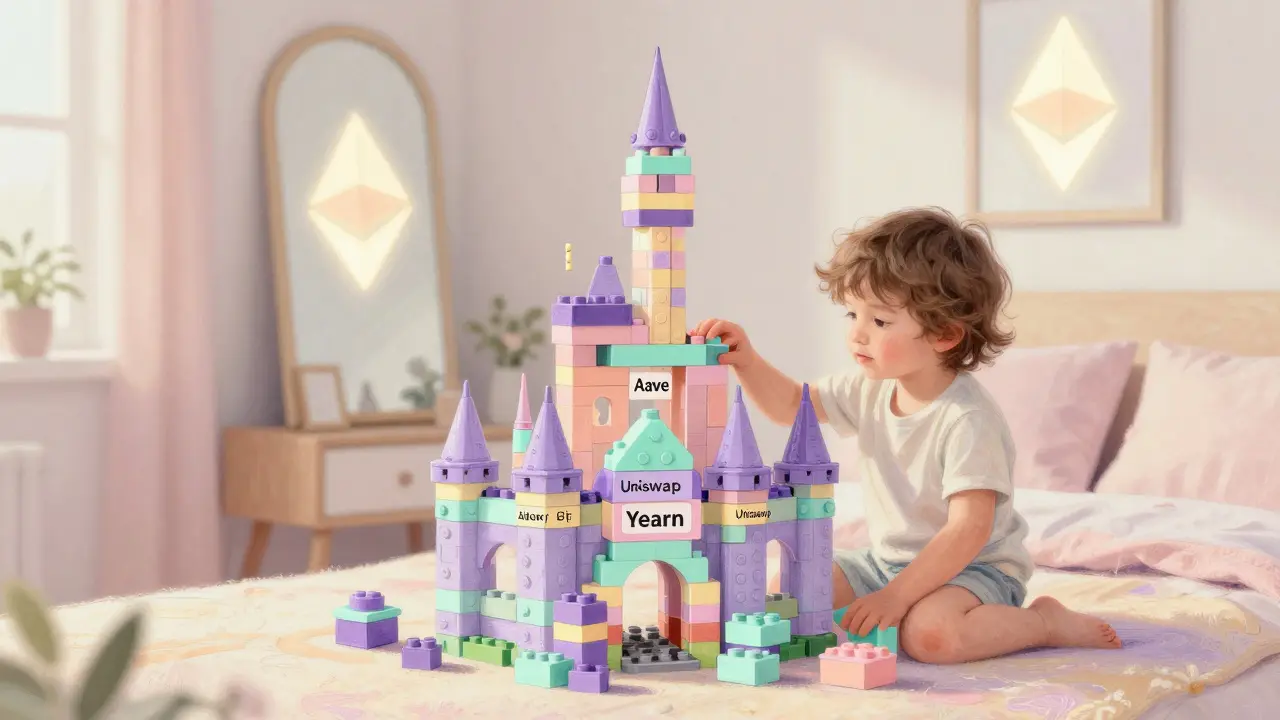
Imagine building a financial system out of Lego blocks. You snap together a savings app, a lending platform, and a trading exchange - all using the same digital cash. No banks, no paperwork, no waiting weeks for approvals. That’s DeFi. And the reason it works at all is something called composability.
What Composability Actually Means in DeFi
Composability isn’t a buzzword. It’s the core reason DeFi exists. It means protocols can talk to each other like apps on your phone. A lending platform like Aave can use liquidity from Uniswap. A yield optimizer like Yearn can pull assets from multiple lending pools. Each piece is a building block, and together they form something bigger than any single part. This didn’t happen by accident. It started with Ethereum’s ERC-20 token standard in 2015. Suddenly, every new token could move between wallets, exchanges, and apps without custom code. That was the first Lego brick. Then came smart contracts - self-executing code that runs exactly as written. No middlemen. No hidden fees. Just rules everyone agrees on. By 2020, during what’s now called “DeFi Summer,” these blocks started snapping together fast. Total value locked in DeFi jumped from $1 billion to over $10 billion in just five months. Why? Because developers weren’t starting from scratch. They were stacking what already worked.How It Works: The Technical Backbone
Three things make composability possible: smart contracts, open APIs, and standardized code. Smart contracts are the engines. APIs are the wiring. Standards like ERC-20 and ERC-721 are the shape of the bricks. Take Uniswap. Its automated market maker (AMM) contracts let anyone swap tokens. But they were built with openness in mind. Other protocols can directly interact with Uniswap’s liquidity pools. That means a protocol like Aave can accept Uniswap LP tokens as collateral. No permission needed. No approval process. Just code calling code. This cuts development time by 60-70%, according to Chainlink’s 2022 report. Instead of building a new exchange from zero, a team can plug into existing infrastructure. That’s why hundreds of DeFi apps popped up in just a few years. But it’s not magic. There are rules. Every protocol must follow the same function signatures. If one contract expects a token to have a certain name or decimal place, and another doesn’t match, the whole thing breaks. That’s why open-source code is non-negotiable. Everyone needs to see how the pieces fit.Why It’s Better Than Traditional Finance
In traditional finance, your money is locked in silos. Your savings account can’t pay your loan. Your brokerage can’t lend your stocks. You need separate accounts, separate logins, separate rules. In DeFi, your DAI stablecoin can do three things at once. You mint it through MakerDAO. Deposit it into Compound to earn interest. Then use the interest-bearing cDAI as collateral on Aave to borrow more. All with the same dollar. That’s called “capital efficiency.” In traditional systems, you’d need three separate pools of cash. In DeFi, one dollar becomes three. Chainlink’s 2022 analysis showed this multiplier effect isn’t theoretical. Users are already doing it. One Reddit user reported earning 12.7% APY by stacking Aave, Uniswap, and Yearn - all using the same ETH. That’s impossible with Robinhood or Chase. And it’s not just users. Enterprises are watching. J.P. Morgan’s Onyx team started using DeFi-style composability in their JPM Coin system in late 2023. The European Central Bank called it “a fundamental architectural advantage.”
The Dark Side: When Lego Towers Collapse
But here’s the catch: when blocks connect, a crack in one can bring down the whole tower. In March 2023, Euler Finance got hacked. A flaw in its lending logic let attackers drain $600 million. And because Euler was connected to Aave, Compound, and others, the damage spread. Tokens flooded into other protocols, crashing prices. It wasn’t just one hack - it was a chain reaction. The Terra-Luna collapse in 2022 was another example. A stablecoin algorithm failed. That triggered a panic across dozens of DeFi apps that used LUNA as collateral. No regulator stepped in. No firewall blocked the spill. The system just… unraveled. Critics like Nouriel Roubini call it a “house of cards.” And they’re not wrong. Traditional finance uses regulation, capital buffers, and legal barriers to contain risk. DeFi uses code audits and community governance. That’s a huge trade-off: speed vs. safety. Gartner’s 2023 report says composability is moving out of the “peak of inflated expectations.” That’s good. It means people are starting to build responsibly - not just frantically.Real User Experiences: Wins and Wipes
Most DeFi users aren’t coders. They’re people trying to earn better returns. Tools like Zapper.fi and Zerion made it easier. You can click a button and deploy your ETH across five protocols at once. One user on Reddit said they made 18% in six months using a composite strategy. Another lost $3,200 when a Curve Finance pool went sideways - and it dragged down their Yearn vault because the two were linked. Twitter data from early 2023 showed 68% of positive DeFi posts mentioned “money legos.” But 82% of negative posts blamed composability for losses. The lesson? The same feature that creates opportunity also creates vulnerability.
What’s Changing Now (2026)
The biggest hurdle? Gas fees. On Ethereum, a single multi-protocol transaction used to cost $10-$50. That made small users pay more than they earned. That changed with Ethereum’s Dencun upgrade in early 2024. Proto-danksharding slashed gas costs for composability transactions by 90%. Suddenly, stacking Aave + Uniswap + Pendle became affordable even for $500 deposits. Chainlink’s CCIP Composability Layer, rolling out in mid-2024, is letting protocols on Solana, Arbitrum, and Base talk to Ethereum. Cross-chain composability is no longer a dream - it’s happening. Stellar’s network, meanwhile, is proving native composability can be faster. Its path payment system handles multi-asset swaps with 23% quicker finality than Ethereum L1.Where This Is Headed
MIT’s Digital Currency Initiative put it best: composability isn’t good or bad. It’s a tool. Like fire. Useful. Dangerous. Needs rules. The next wave isn’t about more protocols. It’s about better safety. Circuit breakers. Risk isolation. Standardized error codes. Developers are already working on EIP-5256 to make cross-protocol failures less catastrophic. By 2030, Messari predicts 95% of financial infrastructure will use composability - whether it’s on-chain or in legacy banks borrowing the idea. The future isn’t about replacing banks. It’s about making finance modular. Open. Adaptable. And yes - risky. But if you understand the blocks, you can build something powerful.What You Can Do Today
You don’t need to be a coder to use composability. But you do need to understand the risks. Start with tools like Zapper.fi or DeFiSaver. They show you what’s connected. Watch how your assets move. Learn which protocols your yield comes from. Don’t stack too many risky protocols. If you’re using a new, un-audited lending app as collateral, you’re playing with fire. Track gas costs. A three-step transaction might cost more than your earnings. Use Layer 2s like Arbitrum or Base - they’re cheaper and still fully composable. And always, always check the documentation. MakerDAO’s guides are clear. Some newer protocols? Not so much. A 43% failure rate due to bad docs isn’t a bug - it’s a warning.

Post Comment



man i just used zapper.fi to stack my eth across aave and uniswap and ended up with 14% in 3 months… no bank ever gave me that. also i spelled aave wrong like 5 times but you get the point 😅
Composability is the real revolution here-not because it’s flashy, but because it’s fundamentally redefining how capital moves. In traditional finance, your money is stuck in silos, chained by bureaucracy and legacy systems. In DeFi, your DAI isn’t just a token-it’s a dynamic asset that can earn yield, be collateralized, and swap liquidity-all in one transaction, with no middleman. This isn’t innovation; it’s evolution. And yes, it’s messy. Euler’s collapse, Terra’s implosion-these aren’t failures of the concept, they’re growing pains of an open system that doesn’t have a central authority to bail it out. That’s the trade-off: autonomy over safety. And honestly? I’ll take it.
you people are acting like this is some kind of miracle… it’s a house of cards made of spaghetti code and drunk devs. one smart contract glitch and your entire portfolio evaporates. i lost $12k because some ‘yield optimizer’ called ‘MoonLoot’ didn’t check if the LP token had decimals. it’s not finance-it’s gambling with extra steps. and don’t even get me started on the ‘degen’ culture. 🤡
Interesting perspective. The technical architecture is sound, but the human element remains a wildcard. People treat DeFi like a casino, not a financial system. Simplicity in design doesn’t guarantee safety. Still, the potential is undeniable.
it’s like… if finance was a song, traditional banking is a symphony with sheet music and conductors. DeFi? It’s a jam session in a garage. everyone’s playing different instruments, some off-key, but sometimes… magic happens. 🎸💸
composability is the future but we need better tooling for non-coders. i tried to use a yield strategy last week and got stuck because the interface didn’t explain what ‘rebase’ meant. i’m not a dev but i want to earn better returns. why is it still so hard?
yo i just wanna say-this is dope. i used to think crypto was all about hype, but seeing how protocols talk to each other? mind blown. 🤯 also, use arbitrum. gas fees on mainnet are wild. and hey, if you’re new, start small. no need to throw your rent money in a vault you don’t understand. we got you 💪
Let us not forget: this entire system is built on trustless code, yet relies entirely on centralized oracle feeds, exchange listings, and developer goodwill. The ‘openness’ is a facade. Behind every ‘decentralized’ protocol is a team with a Discord admin panel and a private wallet. This isn’t liberation-it’s rebranded surveillance capitalism with more emojis.
composability = fire. you can cook with it… or burn your house down. i lost $800 last year because i didn’t check if the token i was staking had a transfer tax. lesson learned. now i only use audited stuff. also, why does everyone say ‘money legos’? sounds like a kid’s toy. 🧱
you all sound like you’re in a cult. ‘money legos’? really? this isn’t a game. people are losing their life savings because someone coded a reentrancy bug and now your ‘yield’ is a meme. you think you’re pioneers? you’re just the latest generation of day traders with a blockchain tattoo.
It’s not innovation. It’s a bubble.
i just started learning this stuff and honestly? it’s wild how one token can do so many things. i used to think ‘earn interest’ meant a 0.5% savings account. now i’m earning 8% just by holding dAI and letting it do its thing. still scared i’ll mess up… but kinda excited too 😊
composability is like a jazz band where everyone’s improvising but somehow the song still works. sure, someone might hit a wrong note and the whole thing screeches-but when it clicks? it’s beautiful. the key is knowing when to step back, when to listen, and when to trust the rhythm. also-use layer 2s. please. your wallet will thank you. 🎶
you’re all idiots. this is just a pyramid scheme with a whitepaper.
gas fees still suck on eth. i tried a 3-step trade last week and paid $28 in fees to earn $12. that’s not finance, that’s a tax.
i come from a country where people still use cash. seeing this system work? it gives me hope. not everyone has access to banks. but if you have a phone and a little data, you can start building wealth. that’s powerful.
they call it ‘composability’ but it’s just a glorified domino effect. one bad contract, and the whole thing collapses like a Jenga tower. and the devs? they’re already gone, with their bags full of ETH. this isn’t finance-it’s a heist with code.
EVERY SINGLE TIME. someone says ‘money legos’ and I die a little inside. it’s not cute. it’s not clever. it’s infantilizing an entire financial revolution. these aren’t toys-they’re protocols with billions at stake. and yet we talk about them like we’re explaining blocks to a toddler. 🤦♂️
they’re lying about the ‘dencun upgrade’. gas fees didn’t drop that much. it’s just marketing. the real winners are the VCs who dumped their tokens right before the ‘revolution’.
interesting how the same tech that empowers people also exposes them to risks they can’t even understand. i wonder if we’re moving too fast.
if you’re not using arbitrum or base, you’re leaving money on the table. also, check out the new circuit breaker proposals-this is where the real innovation is happening now. not more apps. better safety. 🔒
you think you’re smart because you use zapper? you have no idea how many of your assets are tied to protocols that don’t even have a website. i checked. 7 of the 12 you’re staking in? no docs. no team. just a contract. you’re not building wealth-you’re gambling with ghosts.
composability is the reason DeFi will crash harder than Mt. Gox. every protocol is a hostage to every other. one hack, one oracle failure, one bad upgrade-and it’s all gone. this isn’t finance. it’s a Russian roulette with 100 chambers and one bullet. and you’re the one pulling the trigger.