

Uniswap v4 on Avalanche: The Best Decentralized Exchange for Low-Cost Crypto Swaps
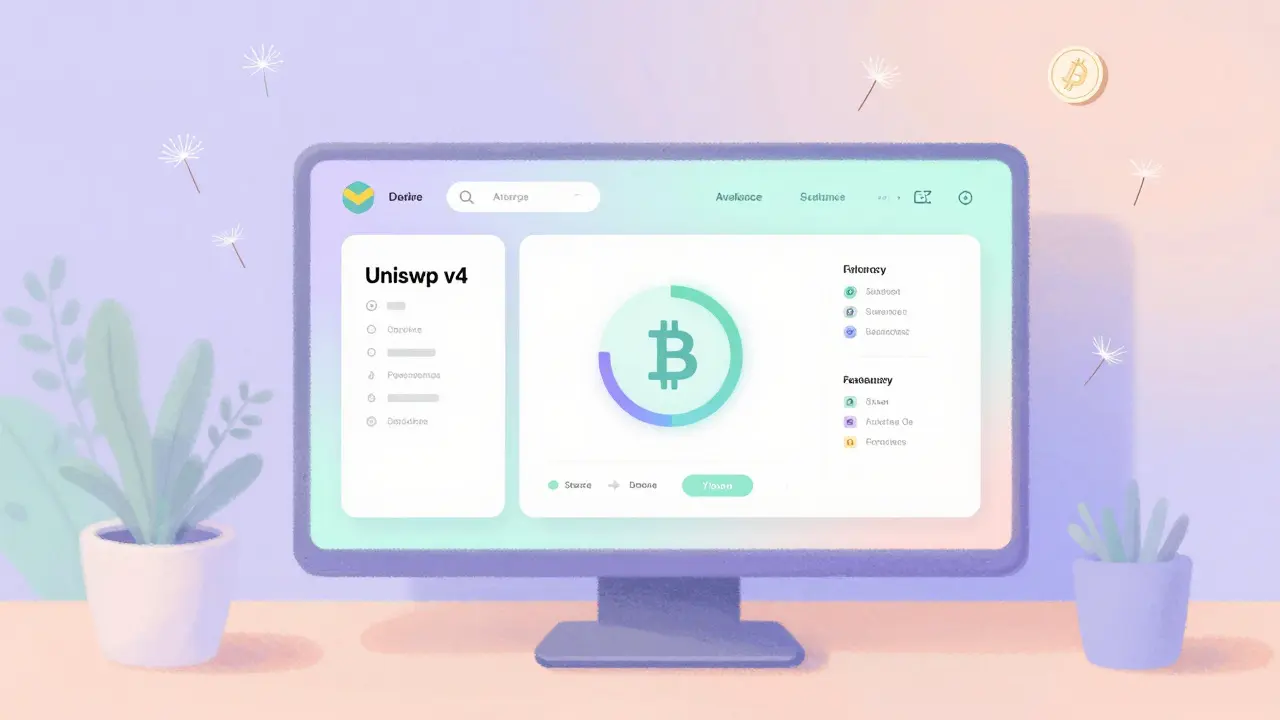
When you want to swap crypto without a middleman, Uniswap v4 on Avalanche is one of the few platforms that actually makes it fast, cheap, and simple. Forget the old days of paying $50 in gas fees just to trade ETH for USDC. That’s not just outdated-it’s gone. Uniswap v4, launched in early 2025, is the most advanced version of the world’s largest decentralized exchange, and running it on Avalanche changes everything.
Why Uniswap v4 Is a Game Changer
Uniswap has been the go-to DEX since 2018. It didn’t need ads or influencers. It won because it worked. No sign-up. No KYC. Just connect your wallet and trade. But v4 isn’t just an upgrade-it’s a rewrite. The big shift? hooks. These are like plug-ins for the protocol. Developers can now build custom logic directly into trades: automated rebalancing, dynamic fees, limit orders, even conditional swaps that trigger only when a token hits a certain price. Before v4, every pool was the same. Now, a liquidity pool for a volatile memecoin can have a 1% fee, while a stablecoin pair runs at 0.01%. That flexibility didn’t exist before. And it’s not theoretical. Real pools are already using it. On Avalanche, this means you’re not stuck with rigid rules. You get precision.Why Avalanche Makes Uniswap v4 Even Better
Uniswap runs on 34 blockchains. But Avalanche stands out. Why? Because it’s fast, cheap, and reliable. While Ethereum can take minutes and cost $10-$50 in gas during peak times, Avalanche confirms transactions in under a second for under $0.10. That’s not a small difference-it’s the difference between trading and waiting. The Alpenglow upgrade in late 2024 boosted Avalanche’s throughput even further. Now, it handles thousands of transactions per second with near-zero downtime. For DeFi users, that means fewer failed swaps, faster liquidity additions, and smoother trading during volatility spikes. If you’re swapping tokens like AVAX, WETH, or new tokens from early-stage projects, Avalanche is the quiet powerhouse behind the scenes.How Fees Compare: Uniswap v4 vs. Centralized Exchanges
Let’s talk numbers. Uniswap v4’s standard fee is 0.3% per swap. That’s the same as most DEXs. But here’s the catch: you’re not paying extra for custody, support, or insurance. You’re paying for execution. Compare that to Coinbase Advanced, which charges 0.6% for market orders under $10,000. Or Kraken, which charges 0.16% but only if you’re a high-volume trader. Most retail users pay more on centralized platforms. On Avalanche, the total cost of a $1,000 swap is roughly $0.30 in protocol fee + $0.05 in network fee. Total: $0.35. On Ethereum, that same swap could cost $1.50-$5 in gas alone, even with layer-2s. On BNB Chain, it’s cheaper than Ethereum but slower than Avalanche. On Polygon, fees are low, but liquidity is thinner. Avalanche strikes the best balance.
What You Can Do With Uniswap v4 on Avalanche
- Swap any token-over 10,000 tokens are listed, including new ones that haven’t hit centralized exchanges yet.
- Use concentrated liquidity-if you’re a liquidity provider, you can lock your funds between $1,800 and $2,200 for ETH, not the whole range. This cuts capital waste by up to 400%.
- Trade NFTs-Uniswap’s built-in NFT aggregator pulls listings from OpenSea, Blur, and Magic Eden into one search.
- Set limit orders on-chain-no need for third-party services. Your order executes directly on the blockchain when the price hits your target.
- Access new tokens early-if a project launches on Uniswap v4 on Avalanche, it’s often live there before it’s listed on Coinbase or Binance.
Who Should Use It (And Who Shouldn’t)
If you’re new to crypto and just want to swap ETH for USDT, Uniswap v4 on Avalanche is perfect. The interface is clean. You pick a token, enter the amount, click swap, and confirm. Done in under 90 seconds. No learning curve. But if you’re trying to provide liquidity? That’s a different story. You need to understand impermanent loss-the risk that your assets lose value compared to just holding them. On volatile pairs, this can hurt. On stablecoin pairs, it’s minimal. The protocol doesn’t warn you. You have to know. If you’re a developer? This is the best platform to build on. The hooks system lets you create custom trading bots, yield optimizers, or even new financial products without starting from scratch. Many DeFi protocols now build on top of Uniswap v4 instead of creating their own DEX. If you’re looking for fiat on-ramps? Uniswap doesn’t do that. You need a centralized exchange first to buy crypto with USD, then bridge it to Avalanche and connect to Uniswap.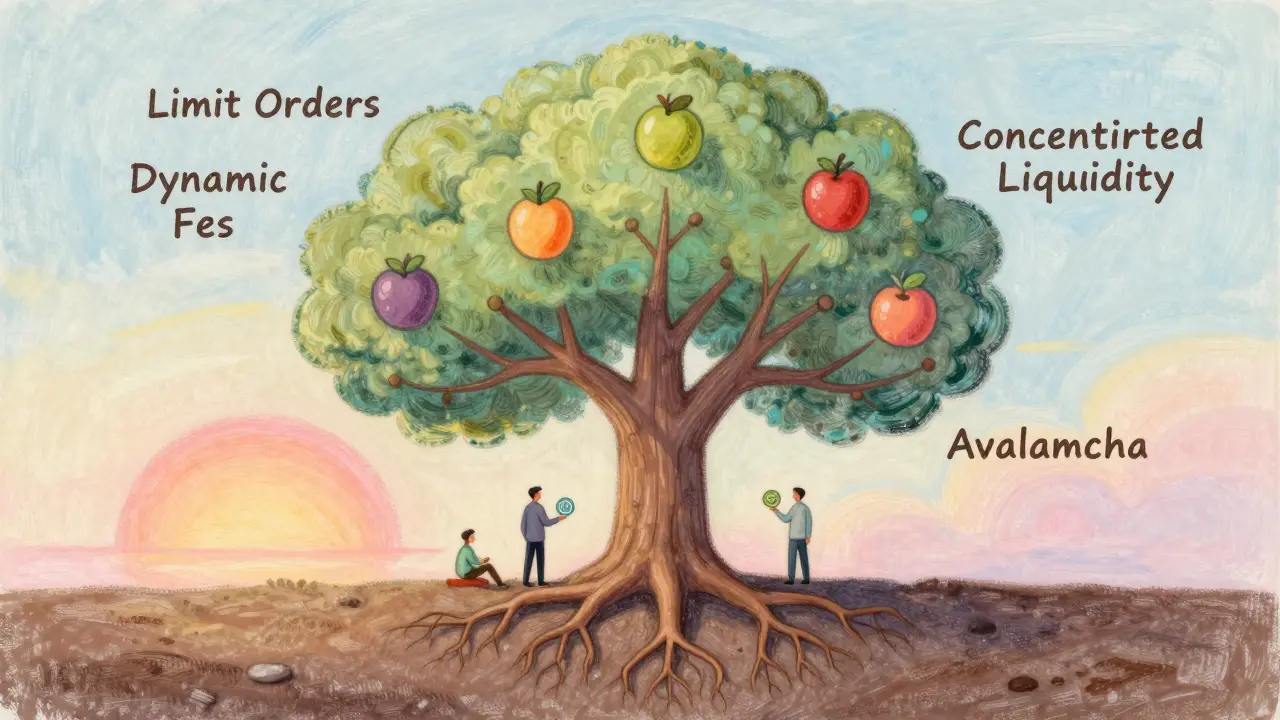
Real User Experience: What People Actually Say
Reddit users on r/Uniswap and r/Avalanche are split between two camps: those who used to hate Ethereum fees and those who switched to Avalanche and never looked back. One user wrote: “I used to wait 20 minutes for a swap on Ethereum. Now I do three swaps in the time it takes to make coffee.” Another said: “I added liquidity to a new DeFi token on Uniswap v4. Gas was $0.08. On Ethereum, it would’ve cost me $12.” The most common complaint? “I didn’t realize how much I was losing on Ethereum.” That’s not a bug-it’s a wake-up call. Most people don’t realize how much they’re paying in hidden fees until they try a faster chain.Security and Trust
Uniswap’s code is open-source. It’s been audited by Trail of Bits, CertiK, and other top firms. No major exploits since launch. The protocol doesn’t hold your funds. You do. That’s the whole point. But that also means if you send crypto to the wrong address, or approve a malicious contract, there’s no customer service to help you. Always double-check the contract address. Scammers clone Uniswap interfaces all the time. Bookmark the official site: app.uniswap.org. Never click links from Twitter or Discord DMs.What’s Next for Uniswap v4 on Avalanche
The roadmap is simple: more hooks, more chains, more users. Developers are already building tools that auto-rebalance your liquidity based on volatility signals. Others are creating “liquidity mining” pools that reward users with tokens just for providing capital. Avalanche is working on cross-chain bridges that let you move assets directly from Ethereum to Avalanche without wrapping. The bigger picture? Uniswap v4 isn’t just a DEX anymore. It’s a financial infrastructure layer. And Avalanche is becoming its most practical home.Is Uniswap v4 on Avalanche safe to use?
Yes, if you use the official app at app.uniswap.org and connect your wallet properly. The protocol has been audited and has no known exploits. But since it’s decentralized, you’re responsible for your own security. Never share your private key, and always verify contract addresses before approving transactions.
How much does it cost to swap on Uniswap v4 via Avalanche?
The protocol fee is typically 0.3% per trade. The Avalanche network fee is usually under $0.10. So a $500 swap costs about $1.50 in protocol fees plus $0.05 in gas. That’s far cheaper than Ethereum or centralized exchanges like Coinbase, which charge 0.6% or more.
Can I use Uniswap v4 without a wallet?
No. You need a Web3 wallet like MetaMask, Rabby, or Coinbase Wallet to connect to Uniswap. There’s no sign-up or email required-just connect your wallet and start trading. Wallets are free and easy to set up in under 5 minutes.
Does Uniswap v4 support fiat currency?
No. Uniswap only accepts cryptocurrency. To buy crypto with USD, you need a centralized exchange like Coinbase, Kraken, or Binance. Then, you can transfer your crypto to your wallet and bridge it to Avalanche before using Uniswap.
What’s the difference between Uniswap v3 and v4?
Uniswap v3 introduced concentrated liquidity, letting LPs focus capital in price ranges. v4 added hooks-custom code that lets developers build advanced features directly into the protocol, like limit orders, dynamic fees, and automated rebalancing. v4 is more flexible, cheaper to deploy pools, and supports native ETH without wrapping. It’s a major leap forward.
Is Uniswap v4 better than SushiSwap or PancakeSwap?
For most users, yes. Uniswap has the deepest liquidity, the most token listings, and the most developer activity. SushiSwap and PancakeSwap are good alternatives, but they lack the same level of innovation and ecosystem support. Uniswap v4’s hooks system is unmatched. If you want the most reliable and feature-rich DEX, Uniswap is still the standard.






Let me guess - you’re still using Ethereum and wondering why your swaps cost more than your coffee? Welcome to 2025. Uniswap v4 on Avalanche isn’t just better - it’s the only sane choice left. Stop paying for gas like it’s a subscription service.
They don’t want you to know this, but Avalanche is basically a Fed-controlled sidechain. Why do you think the fees are so low? They’re not saving you money - they’re tracking your every trade. Uniswap v4? More like Uniswap v4: Surveillance Edition. 🕵️♂️
Hey, new to this? Just connect MetaMask, go to app.uniswap.org (NOT the sketchy link from that Discord DM), and swap away. Seriously - it’s like ordering pizza. Pick token, enter amount, click swap. Done. No PhD required. 🙌
India crypto is future. USA stuck in old tech. Avalanche faster. Fees $0.05. 🇮🇳🔥
Oh wow, so now we’re supposed to be impressed that a platform charges 0.3% and calls it ‘cheap’? Meanwhile, on-chain limit orders are still a pain to set up, and half the devs don’t even understand hooks. This isn’t revolution - it’s a marketing brochure with a blockchain.
The structural elegance of Uniswap v4’s hook architecture represents a paradigmatic shift in decentralized financial infrastructure - a move from monolithic liquidity provision to modular, programmable capital allocation. One must, however, remain cognizant of the ontological responsibility inherent in self-custody.
Guys. Guys. I just did a $200 swap on Avalanche. Gas was 4 cents. I cried. Not because I was emotional - because I realized I’d been throwing away $15 every time I traded on Ethereum. I’m sorry, past me. I didn’t know. 😭
Official site is app.uniswap.org. Always check. Scammers are everywhere. Don’t be the guy who loses his ETH to a fake site. Simple.
You got this! Swap, stake, repeat. 🚀
OMG I just tried it and my swap went through in 3 sec?? I thought my phone was lagging 😱
so cool that we can trade new tokens before they even hit binance! i love this!! 🌟
Why does everyone act like this is magic? You still need to understand impermanent loss. You still need to check contract addresses. You still need to not be an idiot. This isn’t a fairy tale - it’s a tool. Use it right, or get rekt. 💅
The integration of modular hooks into Uniswap v4 reflects a maturation of DeFi protocols from utility-driven platforms to programmable financial ecosystems. This evolution necessitates greater user education, particularly regarding risk exposure in concentrated liquidity pools. The technology is sound; the responsibility remains with the operator.
gas fee $0.05? wow. but how to connect wallet? i no understand
So you’re saying I should trust a platform that doesn’t even have a customer service line? What if I send ETH to the wrong address? What then? Huh? WHAT THEN? 😭
They’re using Avalanche because it’s easier to control. You think they want you to be free? They want you to trade faster so they can track your movements. This isn’t decentralization - it’s surveillance with lower fees.
Oh wow, another article that treats 0.3% as ‘cheap.’ Let me guess - you also think $100k in gas fees is ‘reasonable’ if you’re ‘doing DeFi.’
Meanwhile, real people are getting rug-pulled by ‘limit orders’ that never execute because the hooks weren’t properly tested. This isn’t innovation. It’s gambling with code.
And don’t even get me started on ‘NFT aggregator.’ You mean you’re pulling listings from OpenSea? So you’re just a middleman with a new logo?
Stop pretending this is the future. It’s just the same old mess with a prettier UI.
Everyone says ‘just use Avalanche’ like it’s the answer to everything. But what about the people in countries where MetaMask is blocked? What about the elderly who just want to send crypto to their grandkids? This isn’t for everyone - it’s for the tech elite.
And let’s not pretend hooks are magic. Most devs use them to make complex bots that front-run retail users. You’re not getting an advantage - you’re just part of the herd.
So you’re telling me I should trust a platform where the devs don’t even warn me about impermanent loss? That’s not innovation. That’s negligence. And you call this ‘user-friendly’? I’ve seen better UX on a 2012 Android app.
The technical merits of Uniswap v4 on Avalanche are undeniably significant. The reduction in transaction latency and cost represents a meaningful advancement in accessibility. However, one must also consider the broader socio-technical implications of centralized liquidity incentives and the potential for protocol centralization through dominant liquidity providers.
Just tried it and I’m obsessed. I swapped my last $50 of Shiba to PEPE and it was faster than my TikTok load time. So cool!! 💖
Hook-based liquidity provisioning? That’s just a fancy way of saying ‘algorithmic arbitrage on steroids.’ You think you’re the trader? You’re the liquidity. You’re the data point. You’re the yield farmer getting squeezed by MEV bots. This isn’t DeFi. It’s a casino with a whitepaper.
Of course it’s ‘the best.’ Because the narrative demands it. The media, the influencers, the VCs - they all get paid to push this. But the real question is: who owns the hooks? Who controls the upgrade paths? Who audits the auditors? This isn’t freedom. It’s curated compliance with a blockchain veneer.
And don’t tell me about ‘open-source.’ Every major exploit since 2020 came from code that was ‘publicly audited.’
Wake up. This isn’t innovation. It’s theater.
Wow. So now the paranoid guy thinks Avalanche is a Fed tool? And the elitist thinks hooks are theater? Meanwhile, I’m swapping WETH for USDC for $0.08 while you’re all typing essays. The market doesn’t care about your theories - it cares about speed and cost.
Go ahead. Keep overthinking it. I’ll be over here making coffee while my trades execute.