

What is Fluence (FLT)? A Guide to the Decentralized Computing Network

Remember that massive Microsoft outage in July 2024? For days, businesses froze, emails bounced, and the internet felt like it was holding its breath. That moment wasn't just an inconvenience; it was a wake-up call for anyone relying on centralized cloud giants. Enter Fluence, a decentralized computing platform built to prevent single points of failure from crashing your digital life.
If you've seen the ticker symbol FLT popping up on charts or heard whispers about "DePIN" (Decentralized Physical Infrastructure Networks), you might be wondering what this actually does. Unlike Bitcoin, which stores value, or Ethereum, which hosts smart contracts, Fluence sells something tangible: raw computing power. It turns idle hardware around the world into a global, censorship-resistant cloud network. But does it work? Is it worth your attention? Let's break down exactly what Fluence is, how the FLT token fits in, and whether this project can really challenge AWS and Azure.
The Core Problem: Why We Need Decentralized Cloud
We live in an era dominated by three major cloud providers: Amazon Web Services (AWS), Microsoft Azure, and Google Cloud. They control nearly everything. The problem? They are central points of failure. When one goes down, millions of services go with it. Plus, they lock you in. Migrating away from AWS is expensive and technically painful.
Fluence Labs, founded by Evgeny Ponomarev, set out to fix this. Launched officially on February 15, 2024, the platform aims to eliminate vendor lock-in and slash costs. Their bold claim? Offering enterprise-grade infrastructure at roughly 75% lower prices than traditional providers. How? By tapping into a global marketplace of unused compute resources instead of building massive, energy-hungry data centers.
This isn't just theoretical. In September 2024, CEO Evgeny Ponomarev told Hashing it Out that DePIN represents the next wave of crypto infrastructure specifically because it solves the single point of failure inherent in today’s internet architecture. The logic is simple: if your app runs on a mesh of thousands of independent nodes worldwide, taking down the whole system becomes nearly impossible.
How Fluence Works: The DePIN Model
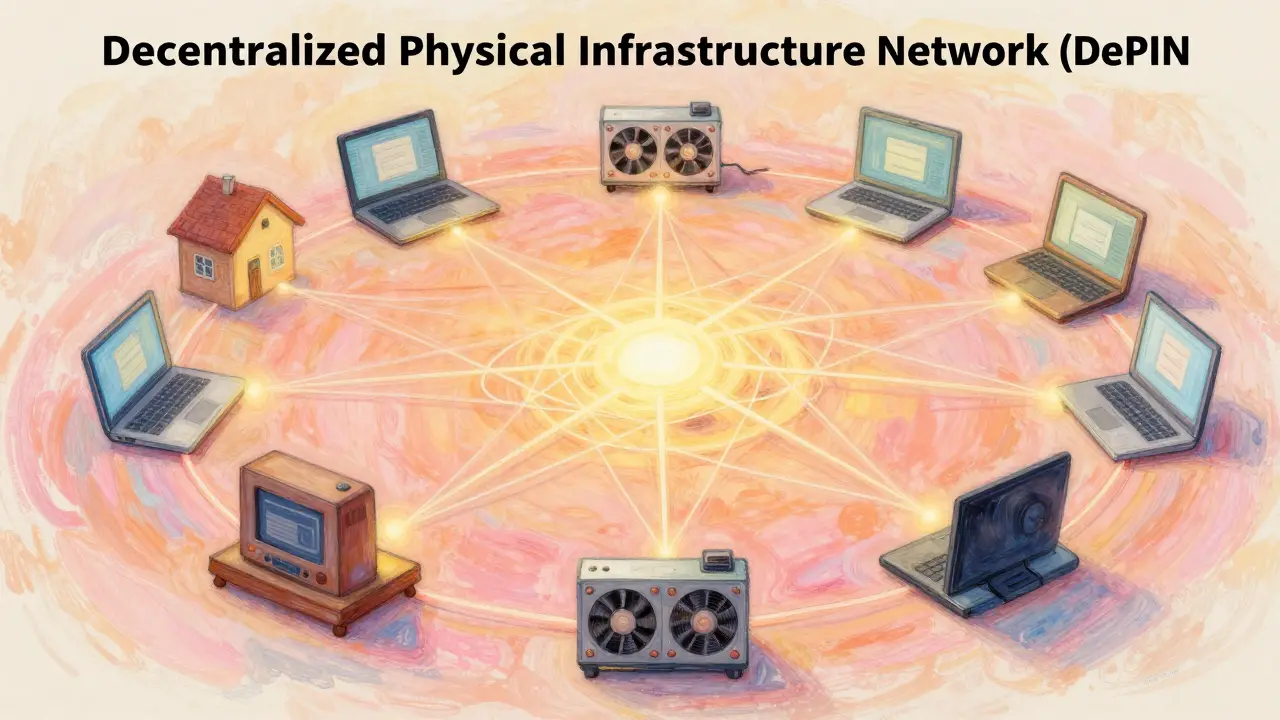
To understand Fluence, you need to grasp the concept of DePIN stands for Decentralized Physical Infrastructure Network. Think of it like Airbnb, but for computer processing power.
Here is the flow:
- Hardware Providers: Individuals or companies with spare GPUs, CPUs, or storage connect their devices to the Fluence network. They monetize this idle capacity.
- Developers/Users: Instead of renting a server from AWS, developers deploy their applications on Fluence. The platform automatically routes tasks to available nodes globally.
- The Network: Fluence’s software orchestrates these connections, ensuring data integrity and security through cryptographic proofs.
The result is a peer-to-peer network where compute resources are tokenized digital assets. As of late 2024, Fluence had over 2,847 active node operators. While this sounds small compared to AWS’s scale, it’s growing rapidly as AI demand spikes and centralized GPU shortages bite hard.
Understanding the FLT Token
You can’t use the network without the native currency. FLT is an ERC-20 token on the Ethereum blockchain. It serves three main purposes:
- Paying for Compute: Developers spend FLT to run their applications on the network.
- Staking Rewards: Node operators stake FLT to prove they are honest and reliable. In return, they earn rewards. The staking program launched in September 2024 offers APYs between 8.5% and 14.2%, depending on how long you lock up your tokens.
- Governance: Holders can vote on protocol upgrades and fund allocations.
Let’s look at the numbers. FLT has a maximum supply of 1 billion tokens. All of them were already circulating by October 2024, meaning no new inflation from minting. However, distribution matters. Here is how the pie was sliced:
| Category | Vesting Schedule | Notes |
|---|---|---|
| Public Round | 100% Unlocked | Raised $150k at $0.05/token |
| Investors | 12-month cliff + 12-month vesting | Prevents immediate dumping |
| Team & Advisors | 12-month cliff + 12-month vesting | Aligned with long-term growth |
| Liquidity | 100% Unlocked | Ensures trading depth |
| Incentives | Released over 24 months | Rewards early adopters |
The price action has been volatile. After hitting an all-time high of $1.54 in March 2024, FLT crashed to around $0.02 by late 2024. This drop reflects broader market skepticism about DePIN viability and the specific challenges Fluence faces in scaling. Always check current prices on exchanges like MEXC before making any moves.
Fluence vs. The Competition
Is Fluence unique? Not entirely. It sits in a crowded field of decentralized compute projects. To see where it stands, we need to compare it against both its crypto peers and the traditional cloud giants.
| Feature | Fluence (FLT) | Render Network (RNDR) | AWS (Centralized) |
|---|---|---|---|
| Primary Focus | General-purpose compute & AI | GPU rendering for creative arts | Enterprise cloud services |
| Cost Efficiency | ~75% cheaper than AWS | Competitive for rendering | High, with hidden egress fees |
| Censorship Resistance | High (Peer-to-Peer) | Medium | Low (Subject to corporate policy) |
| Uptime SLA | ~92.7% | Varies by node | 99.99%+ |
| Developer Ease | Steep learning curve (3-4 weeks) | Moderate | Easy (Mature tools) |
Unlike Render, which focuses heavily on graphics and video processing, Fluence positions itself as a general-purpose platform. It wants to handle diverse workloads, including decentralized AI/ML training. However, it lacks the polished developer experience of AWS. If you’re used to clicking a button to spin up a server, Fluence will frustrate you. You need technical expertise in distributed systems. Surveys show developers take 3-4 weeks to become proficient with Fluence’s CLI tools.
The Real Risks: What Critics Say
It’s easy to get excited about the vision, but let’s talk about the cracks in the foundation. Industry analyst Sarah Chen from Messari rated Fluence as "promising but high-risk" in her Q3 2024 report. Her main concern? Economic viability. With network utilization rates below 35% in mid-2024, there’s a gap between supply (nodes) and demand (apps).
Then there’s the reliability issue. David Lin, a cloud infrastructure expert, pointed out in a TechCrunch article that the "75% cost savings" claim ignores hidden costs. Managing decentralized infrastructure requires significant engineering overhead. If your app crashes because a random node in Ohio went offline, who do you call? Fluence’s customer support averages 72+ hours response time, according to Trustpilot reviews. That’s unacceptable for mission-critical business apps.
Furthermore, geographic concentration remains a risk. As of August 2024, 78% of Fluence nodes were located in North America and Europe. This limits the true "global" redundancy benefit and exposes the network to regional regulatory shifts.

Who Should Use (or Buy) FLT?
So, is Fluence right for you? It depends on your role.
For Developers: If you’re building censorship-resistant apps, decentralized AI models, or experimental protocols that don’t require 99.99% uptime, Fluence is worth exploring. The open-source nature and lower costs are attractive. But be prepared to write custom code and debug distributed issues. It’s not a plug-and-play solution yet.
For Investors: FLT is a high-beta play on the DePIN narrative. If you believe decentralized infrastructure will capture even 1% of the cloud market, FLT could surge. However, the token has dropped 85% from its peak. You’re betting on execution, adoption, and a favorable crypto market cycle. The staking yields (up to 14.2%) provide some cushion, but only if the token price holds steady.
For Enterprises: Probably not yet. Unless you have a very specific need for censorship resistance and a team of distributed systems experts, stick with AWS or Azure. The lack of Service Level Agreements (SLAs) and mature support makes Fluence too risky for core business operations in 2026.
Future Roadmap: Vision 2026
Fluence isn’t standing still. At DePIN Day Bangkok in October 2024, they unveiled their "Vision 2026" roadmap. Key goals include:
- Integration with major AI frameworks to simplify model training on the network.
- Expansion to 100+ countries by Q2 2025, aiming to diversify node geography.
- Implementation of zero-knowledge proofs (ZKPs) to enhance verifiable computing, ensuring users can trust the results returned by remote nodes without seeing the raw data.
Delphi Digital predicts a 45% probability of Fluence achieving sustainable network effects by 2026. The catalyst? The exploding demand for decentralized AI infrastructure, projected to reach $12.4 billion by 2026. If Fluence can solve its latency and reliability issues, it could ride that wave.
Is Fluence (FLT) a good investment in 2026?
Fluence is a high-risk, high-reward asset. It benefits from the growing DePIN and AI sectors but suffers from low network utilization and technical complexity. Only invest what you can afford to lose, and consider staking for yield if you hold long-term.
How does Fluence differ from Render Network?
Render Network focuses primarily on GPU rendering for creative industries like 3D animation and VR. Fluence is a general-purpose decentralized computing platform designed for diverse workloads, including AI/ML training and standard web hosting, aiming for broader applicability beyond graphics.
Can I use Fluence for my startup's website?
Not recommended for critical production sites yet. Fluence currently reports ~92.7% uptime compared to AWS's 99.99%. It also lacks mature enterprise support and SLAs. It’s better suited for experimental apps or non-critical backend processes.
What is the total supply of FLT tokens?
The maximum supply of FLT is 1.00 billion tokens. As of late 2024, the entire supply was already circulating, though some portions held by investors and the team are subject to vesting schedules that unlock over time.
Where can I buy Fluence (FLT)?
FLT is traded on several cryptocurrency exchanges, including MEXC. You can buy it using other cryptocurrencies or fiat via supported payment methods on these platforms. Always verify the contract address (0x236501327e701692a281934230af0b6be8df3353) to avoid scams.