
600,000 Bangladeshis Use Binance Despite Total Crypto Ban: The Underground Reality
Imagine a country where the central bank explicitly tells you that buying Bitcoin is illegal, yet half a million people are doing it anyway. This isn’t a glitch in the matrix; it’s the daily reality for Jonathan Jennings’s readers looking at the financial landscape of Bangladesh. As of mid-2026, over 600,000 citizens are actively using Binance, the world's largest cryptocurrency exchange by trading volume to trade digital assets. They are operating in direct defiance of one of the strictest government bans on earth.
This creates a bizarre paradox. On paper, Bangladesh is a fortress against crypto. In practice, it hosts a thriving, shadow economy that moves millions of dollars daily. Why do so many people risk legal trouble to access these markets? And how does the government fail to stop them? Let’s look at the mechanics of this underground boom.
The Legal Wall: How Bangladesh Bans Crypto
To understand why users hide, you first need to understand what they are hiding from. Bangladesh doesn’t have a single law titled "The Crypto Ban Act." Instead, it uses a patchwork of older financial laws to crush the industry. The primary weapon is the Foreign Exchange Regulation Act of 1947. This colonial-era law gives the government control over all foreign currency transactions. Since cryptocurrencies like Bitcoin and Tether are treated as foreign assets, buying them without permission is technically a violation.
The Bangladesh Bank, the central bank of Bangladesh responsible for monetary policy, has been vocal since 2014. They issued warnings that virtual currencies violate anti-money laundering (AML) laws and the Money Laundering Prevention Act of 2012. If you use a credit card to buy crypto, the bank can flag the transaction. If you try to settle international debts in Bitcoin, you’re breaking the Foreign Exchange Regulation Act. The message is clear: crypto is not legal tender, and engaging with it carries serious compliance risks.
Here is the catch: there is no specific prison sentence listed just for holding Bitcoin. However, if authorities link your crypto activity to money laundering or tax evasion under the Income Tax Ordinance of 1984, the penalties become severe. This ambiguity creates a "grey zone" where users know they aren't fully protected, but also don't see police raiding homes solely for having a wallet.
The 600,000 Strong: Who Is Using Binance?
Despite the threats, demand is skyrocketing. The figure of 600,000 active Binance users in Bangladesh is not just a statistic; it represents a significant portion of the country’s digitally engaged population. These aren't just tech-savvy teenagers. They include:
- Freelancers: Bangladesh is a global hub for freelance work. Many workers get paid in US Dollars via crypto because traditional banking channels are slow, expensive, and often reject payments from Western clients due to strict compliance checks.
- Dollar Investors: With the Bangladeshi Taka (BDT) facing inflationary pressure, citizens view stablecoins like Tether (USDT), a cryptocurrency pegged to the value of the US Dollar as a safe haven. It’s easier to hold USD digitally than to open an offshore bank account.
- Speculators: Like anywhere else, many users are drawn by the potential for high returns in volatile assets like Bitcoin and Ethereum.
The accessibility is key. You don’t need a VPN to download Binance. The app is still available on the Google Play Store. While the government could block the domain, the sheer number of users suggests that technical blocking efforts are either ineffective or not prioritized compared to other internet controls.
How It Works: The Underground Mechanics
If banks are watching, how do people move money? The answer lies in sophistication and local networks. There are two main ways this happens.
1. The Agent Network (P2P Trading)
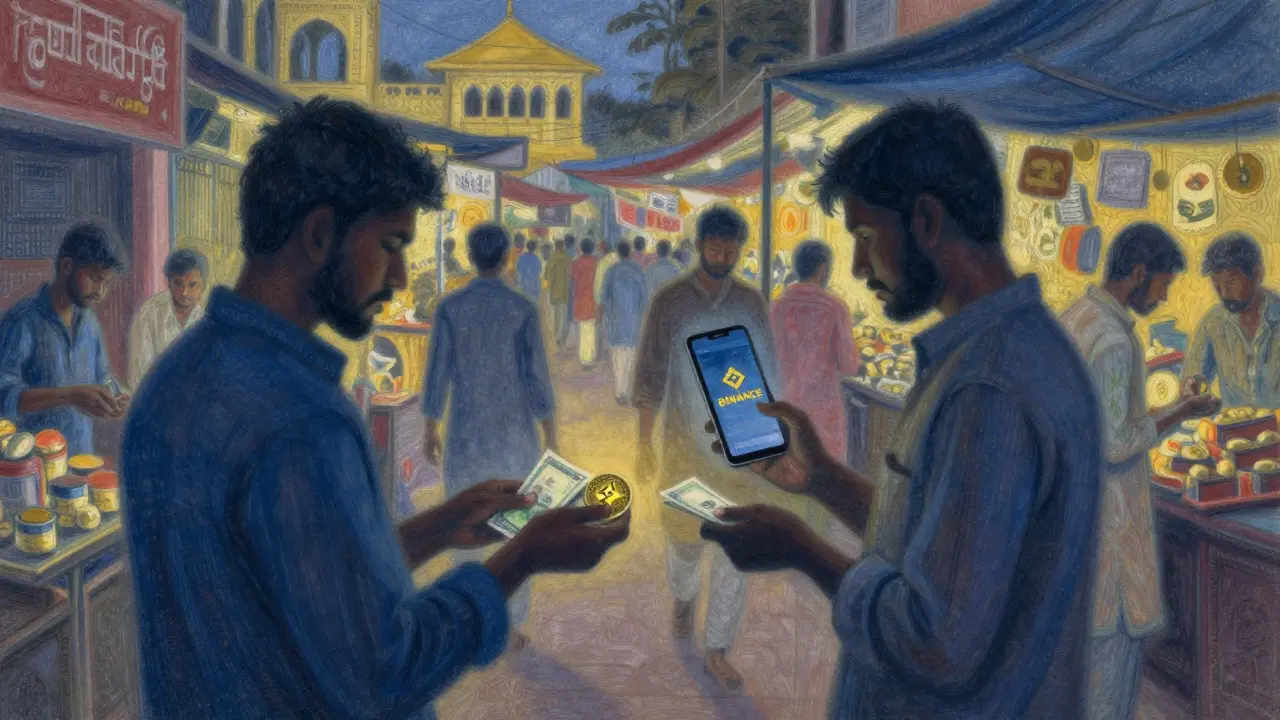
This is the most common method. Users don’t send money directly from their bank accounts to Binance. Instead, they use Peer-to-Peer (P2P) platforms. Here’s how it looks in real life:
- You find a verified merchant on Binance P2P who accepts Bangladeshi Taka.
- You transfer BDT to their local bank account (e.g., Sonali Bank, Brac Bank) using mobile banking apps like bKash or Nagad.
- Once the merchant confirms receipt, Binance releases the crypto to your wallet.
The merchant charges a small commission. To the bank, it looks like a normal person-to-person transfer. No keywords like "Bitcoin" appear in the transaction description. This makes it incredibly hard for the Financial Intelligence Unit (FIU) to trace unless they are monitoring specific high-value patterns.
2. Credit Card Loopholes
Some users still use cards, but this is risky. When you pay in USD, the transaction leaves a clear footprint. Banks can identify these merchants and potentially freeze accounts. Because of this, most experienced users avoid card purchases entirely, opting for the agent network instead.
The Paradox: Blocking Crypto, Embracing Blockchain
Perhaps the most confusing part of this story is the government’s stance on technology. In 2020, Bangladesh released a National Blockchain Strategy, a government plan to integrate blockchain technology into public services. They recognize that blockchain is essential for digital transformation, supply chain tracking, and secure data storage.
So, why ban the coins but love the chain? It’s a contradiction that experts find frustrating. Dr. B M Mainul Hossain, a professor at Dhaka University, argues that "banning is not a solution." He points out that sitting back and doing nothing ignores the reality of global finance. By banning crypto, the government pushes activity into the shadows, making it harder to monitor for actual crimes like terrorism financing or drug trafficking.
If the government regulated crypto, they could track transactions, impose taxes, and protect consumers. Instead, they have created a black market where users operate without oversight. The National Board of Revenue treats crypto income under general tax laws, but without clear guidelines, most users likely go unreported.
Risks and Realities for Users
Let’s be honest: using Binance in Bangladesh is not without danger. While mass arrests are rare, the risks are real.
| Risk Type | Description | Likelihood |
|---|---|---|
| Account Freezing | Banks may freeze accounts if they detect suspicious large transfers linked to known crypto agents. | Moderate |
| Fraud Scams | Unregulated P2P markets attract scammers who take Taka and never release crypto. | High |
| Legal Action | Direct prosecution for simple holding is rare, but prosecution for facilitating large-scale illegal forex is possible. | Low |
| Tax Audits | Future clarity on crypto taxes could lead to retroactive audits for undeclared income. | Uncertain |
The biggest immediate threat isn’t jail; it’s fraud. Because the market is underground, there is no consumer protection. If a P2P seller scams you, you cannot call the police and expect them to recover your funds easily. You are on your own.
Why Won’t They Stop It?
You might wonder, if the ban is so strict, why hasn’t the government shut down Binance? Or blocked the IP addresses?
First, enforcement is resource-intensive. Monitoring millions of small bank transfers is nearly impossible for the current infrastructure of the Bangladesh Bank. Second, the economic pressure is too high. Freelancers need to get paid. Businesses need to import goods. Crypto fills a gap that the traditional banking system, with its slow processing times and high fees, fails to address.
Compare this to neighbors like India or Indonesia. They have restricted crypto as a payment method but allow it as an investment asset. Bangladesh goes further by banning it almost entirely. Yet, the result is similar: people still use it. The difference is that in India, the conversation is happening in the open. In Bangladesh, it’s happening in whispers.
The Future: Regulation or Repression?
As we move through 2026, the pressure is mounting. The 600,000-user base is growing. Global trends are shifting toward regulation rather than prohibition. Countries like El Salvador and Switzerland have shown that integrating crypto can boost tourism and finance.
Experts predict that Bangladesh will eventually have to choose. They can continue the cat-and-mouse game, which drives more money into untraceable channels, or they can adopt a regulatory framework. A balanced approach would involve:
- Recognizing crypto as a digital asset, not currency.
- Requiring exchanges to register with the Financial Intelligence Unit.
- Implementing KYC (Know Your Customer) standards to prevent money laundering.
- Creating a clear tax structure for crypto gains.
Until then, the 600,000 Bangladeshis on Binance will continue to navigate the grey zone. They are betting that the government’s desire for financial stability outweighs its fear of innovation. For now, the underground market remains the most efficient way for many to participate in the global digital economy.
Is it illegal to own Bitcoin in Bangladesh?
Technically, yes. The Bangladesh Bank states that cryptocurrencies are not legal tender and that trading or holding them violates the Foreign Exchange Regulation Act and anti-money laundering laws. However, there are few reported cases of individuals being prosecuted solely for holding crypto.
Can I use my bank card to buy crypto on Binance in Bangladesh?
You physically can, as the apps are accessible, but it is highly discouraged. Transactions made with cards leave a clear trail in USD, which banks can flag. Most users prefer Peer-to-Peer (P2P) trading using local bank transfers or mobile wallets like bKash to avoid detection.
Why does Bangladesh ban crypto but support blockchain?
The government distinguishes between the underlying technology and the financial asset. The 2020 National Blockchain Strategy recognizes blockchain's utility for secure data and efficiency. However, they view cryptocurrencies as a threat to monetary sovereignty, fearing money laundering and capital flight.
What are the biggest risks for crypto traders in Bangladesh?
The primary risks are fraud in unregulated P2P markets and potential bank account freezes if transactions are flagged as suspicious. Legal prosecution is rare for small holders but possible for those facilitating large-scale illegal forex trades.
Will Bangladesh legalize cryptocurrency soon?
There is no official timeline. However, experts argue that the growing underground market and global regulatory trends will force the government to consider a regulated framework rather than a total ban, similar to approaches taken by neighboring countries like India.