

Crypto Exchange Availability by Region Worldwide: Where You Can Trade and Where You Can't
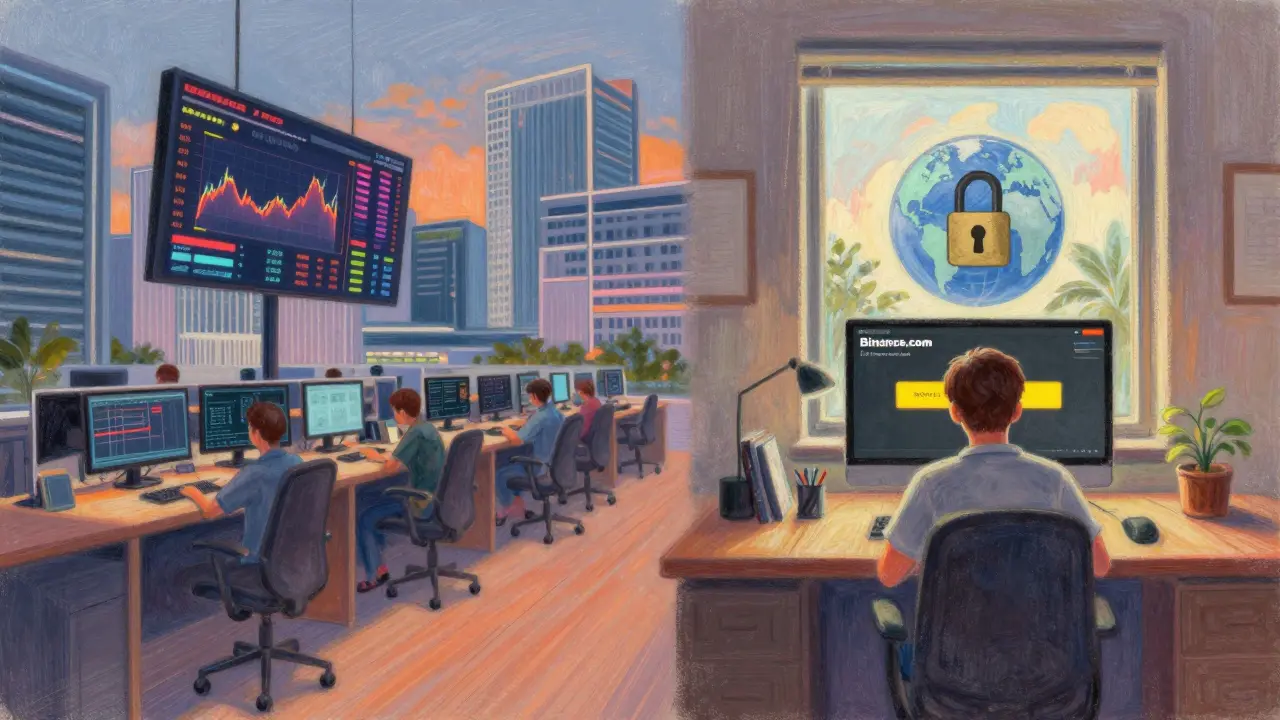
Not all crypto exchanges work everywhere. If you're trying to trade Bitcoin or Ethereum, your location might be the biggest roadblock-not your wallet, not your internet speed, but the laws where you live. In 2025, the global crypto exchange market hit $48.41 billion, and it's expected to grow past $122 billion by 2032. But that growth isn't spread out evenly. Some countries have clear rules and thriving platforms. Others? You can't even open an account without breaking the law.
Why Crypto Exchanges Are Blocked in Some Places
Crypto exchanges don’t just pick where to operate. They’re forced to. Governments control whether a platform can legally offer services like buying, selling, or storing digital assets. If a country’s regulators don’t approve, exchanges either leave or build separate versions just for that market.
Take Binance. It’s the biggest exchange in the world, handling nearly 40% of all trading volume. But in the United States, Binance doesn’t operate as Binance.com. Instead, it runs Binance.US-a stripped-down version with fewer coins, stricter KYC rules, and no futures trading. Why? Because in November 2023, Binance paid a $4 billion fine to U.S. regulators. The Department of Justice and SEC accused it of failing to prevent money laundering and not reporting suspicious activity. The founder, Changpeng Zhao, pleaded guilty and stepped down. That’s not a minor setback. It’s a full exit from the U.S. market under court supervision.
This isn’t unique. Countries like Japan, Singapore, and the UK have clear licensing systems. Exchanges apply, get approved, and operate openly. But in places like Nigeria, India, or Brazil, rules shift constantly. One month, exchanges are allowed. The next, they’re banned from advertising. Users get caught in the middle.
Where Crypto Exchanges Are Most Available
Some regions don’t just allow crypto-they rely on it. Ukraine leads the 2025 Global Crypto Adoption Index. Why? Because after the war started, traditional banking became unreliable. People turned to crypto to receive aid, pay for goods, and send money abroad. Exchanges like Bybit and KuCoin saw massive growth there.
Moldova and Georgia follow close behind. Both have low banking penetration and high mobile internet access. Crypto isn’t a luxury there-it’s a lifeline. In Georgia, you can use a local exchange to convert Bitcoin to lari (the national currency) at ATMs. In Moldova, remittances from abroad often arrive as USDT.
Asia shows a different pattern. Hong Kong, Vietnam, and Singapore have embraced crypto with clear rules. Hong Kong now licenses exchanges directly. Singapore treats crypto as a financial asset, not a currency. That means exchanges like Gate.io and MEXC can operate legally with full features. South Korea? It’s strict but fair. You need a real-name bank account to trade, but once you have it, you can access almost any coin.
Then there are the unexpected players. Yemen, Jordan, and Venezuela rank high in adoption. Why? Hyperinflation. In Venezuela, the bolívar lost 90% of its value in five years. People use crypto to buy food, medicine, and fuel. In Yemen, where banks are broken and cash is scarce, crypto is the only way to receive international payments. Exchanges don’t need to advertise there-they’re already in use.
How Binance, Gate.io, and Others Adapt to Regions
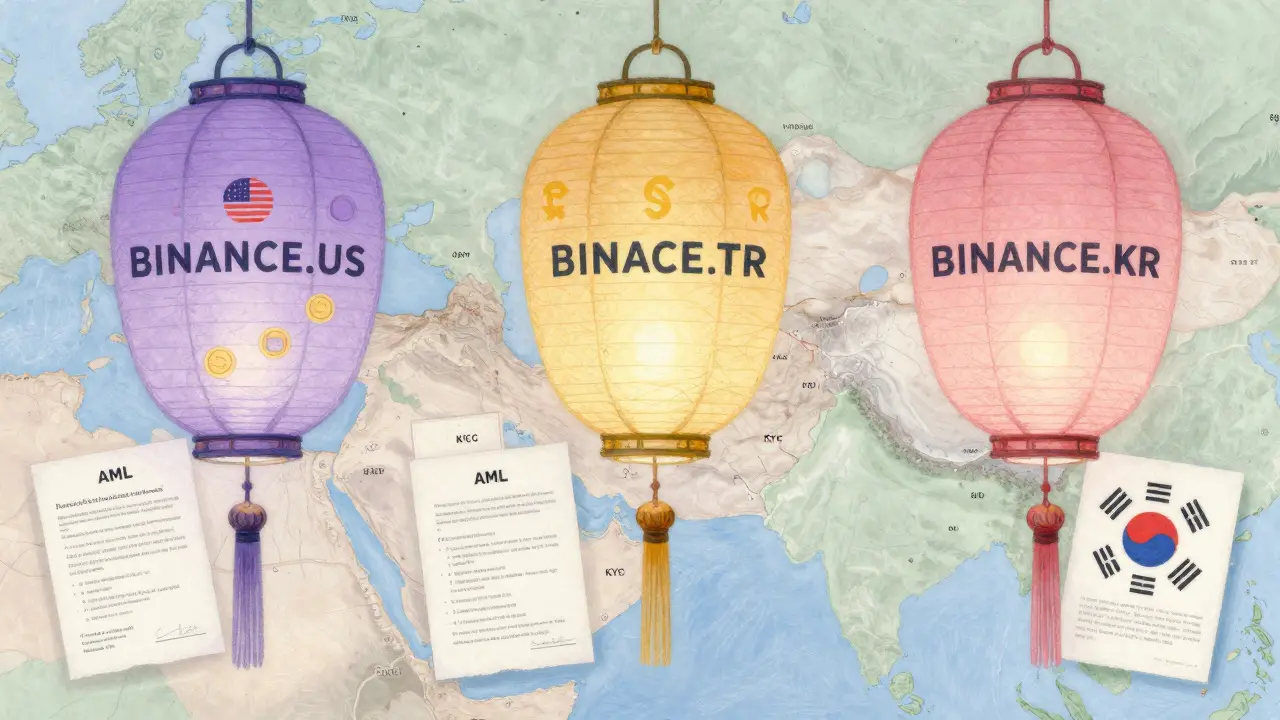
You won’t find one global version of Binance anymore. Instead, there are regional forks:
- Binance.US: Only 130+ coins, no leverage, no derivatives. Built to meet U.S. compliance rules.
- Binance TR: Turkey-only version. Supports TRY deposits and local tax reporting.
- Binance.KR: South Korea’s version. Follows strict AML rules and requires real-name verification.
Each one has its own team, its own legal team, and its own rules. That’s not convenience-it’s survival.
Gate.io, the second-largest exchange, didn’t build regional versions. Instead, it focused on markets with lighter regulation. It grew 14.4% in spot trading volume month-over-month in April 2025. Why? Because it operates where others can’t. In Southeast Asia, Latin America, and parts of Africa, Gate.io offers full access to 1,200+ coins, margin trading, and staking-all without the U.S.-style compliance burden.
Bitget and MEXC follow the same strategy. They target regions where regulators haven’t cracked down yet. That’s why they’re growing faster than Binance in 2025.
Spot Trading Dominates Everywhere
No matter where you are, spot trading is king. It accounts for 61.3% of all exchange volume in 2025. Spot trading means buying or selling crypto at the current price-no futures, no options, no leverage. It’s simple. And that’s why it’s popular everywhere.
In Ukraine, people use spot trading to convert USDT to local currency. In Nigeria, they buy Bitcoin spot to protect savings. Even in the U.S., where derivatives are restricted, spot trading is the only option most retail users have.
Bitcoin and Ethereum dominate spot markets. But in places like Venezuela or Nigeria, stablecoins like USDT and BUSD are the real trading pairs. Why? Because they don’t swing wildly. You want stability when you’re using crypto to pay rent.
What Happens When Exchanges Leave a Country
When an exchange pulls out, users don’t just lose access. They lose money.
In 2024, Binance shut down its service in Canada. Thousands of users couldn’t withdraw their funds for months. Some lost thousands of dollars in fees trying to move assets through third-party services. Others had to wait over a year to get their money back.
Same thing happened in Germany when Bitstamp paused services. Users had to file legal claims just to access their wallets. There’s no global safety net. If your exchange leaves your country, you’re on your own.
That’s why some users now use decentralized exchanges (DEXs) like Uniswap or PancakeSwap. They don’t need to sign up. You connect your wallet, trade directly, and keep control. No KYC. No regional restrictions. But they’re harder to use, slower, and riskier if you make a mistake.
The Future: Regulation Will Decide Where You Can Trade
By 2032, the crypto market will be twice as big. But that doesn’t mean everyone will have equal access.
Countries with clear rules-like Switzerland, Japan, and Singapore-will attract more exchanges. They’ll become crypto hubs. Countries with bans or uncertainty-like China, Russia, or Egypt-will see underground trading grow. Peer-to-peer (P2P) platforms will explode there.
Mobile apps will get smarter. AI will detect if you’re in a restricted region and auto-switch you to a compliant version. But you’ll still need to prove your location. No more VPNs to bypass bans. Exchanges now use device fingerprinting, IP tracking, and even phone number verification to lock you out.
The bottom line? Your crypto experience isn’t about how tech-savvy you are. It’s about where you live.
Can I use Binance if I live in the United States?
No, you can’t use Binance.com in the U.S. It’s blocked. But you can use Binance.US, which is a separate platform with fewer coins and no leverage trading. It’s legal, but limited. If you try to access Binance.com from a U.S. IP, you’ll get blocked instantly. The platform now uses location detection to prevent access.
Which countries have the most crypto exchange options?
Singapore, Japan, Switzerland, and Hong Kong offer the widest selection of exchanges with full features. These countries have clear licensing systems, so exchanges like Binance, Kraken, and Coinbase operate without restrictions. You can trade Bitcoin, Ethereum, Solana, and even lesser-known tokens with margin and derivatives.
Why do some exchanges only work in certain regions?
Exchanges must comply with local laws. If a country requires AML checks, taxes on crypto gains, or limits which coins can be traded, the exchange has to build a custom version for that market. It’s cheaper than fighting lawsuits. That’s why Binance has Binance.US, Binance.KR, and Binance.TR-each one tailored to local rules.
Is it safe to use a VPN to access crypto exchanges?
It’s risky. Many exchanges now detect and ban VPN traffic. If you’re caught, your account can be frozen. Worse, you might violate local laws. In countries like India or Russia, using a VPN to access crypto exchanges could lead to fines or legal trouble. Even if the exchange doesn’t catch you, your bank might flag your transactions.
What’s the difference between spot trading and other types?
Spot trading means buying or selling crypto at the current market price. No borrowing, no leverage, no future contracts. It’s the simplest and most widely available form of trading. Derivatives, futures, and margin trading are restricted in many countries because regulators see them as too risky for average users. Spot trading is allowed almost everywhere-even in strict markets.
Do I need to pay taxes on crypto trades in my country?
In most countries, yes. The U.S., UK, Canada, Australia, and the EU all tax crypto as property or income. Even in places like Ukraine and Georgia, where crypto is widely used, tax reporting is required. Exchanges now automatically send tax reports to users and sometimes directly to tax authorities. Ignoring it can lead to audits or penalties.
If you're trying to trade crypto, check your local laws first. Don't assume what works in one country works everywhere. The global crypto market is growing-but your access to it isn't.


U.S. laws exist for a reason. You think it's unfair? Too bad. Crypto isn't a right, it's a privilege. And if you can't follow the rules, don't complain when you get blocked. 🇺🇸💀
I mean, I get why Binance.US is so limited, but honestly? It's like they took a Ferrari and removed the engine. You can still drive it... slowly. On gravel. With the parking brake on.
I just don't get why people are so mad about not being able to trade derivatives. Like... you're not a hedge fund. You're just someone who bought Dogecoin because Elon tweeted it. Chill. 🤷♀️
It's not about regulation. It's about power. The state doesn't want you to have financial sovereignty. They want you to be dependent. Binance.US? That's not compliance. That's colonization. They took your money, your freedom, your crypto dreams... and gave you a debit card with 130 coins and no leverage. And they call it 'safe'. I call it slavery with a UX redesign. 🌍💔
In India, we’ve been through so many crypto rollercoasters-bans, reversals, taxes, then back to ‘maybe’. But people still trade. We use P2P, we use USDT, we use WhatsApp groups. The system tries to stop us, but we adapt. Crypto isn’t about laws-it’s about survival. 🇮🇳❤️
The institutional adoption curve is clearly bifurcating: regulated jurisdictions are becoming liquidity hubs, while unregulated markets are evolving into DeFi-native economies. The convergence point? Probably not where regulators think it’ll be.
They say Binance paid $4B. But who really paid? The users. The ones who lost access. The ones who had to scramble. The ones who got locked out. And now they’re telling us it’s 'compliance'? Nah. It’s a cover for a corporate takeover. They didn’t get fined. They got bought.
I live in India. We don’t have Binance, but we have WazirX, CoinDCX, and a million Telegram groups. We don’t need big names. We need access. And we’ve built it ourselves. The system thinks it controls crypto. It doesn’t. We do.
Honestly, spot trading being the most popular makes total sense. Most people just want to buy and hold. Derivatives are for gamblers. And regulators are right to limit them. Keep it simple. Stay safe.
The fact that Binance operates 17 different regional forks proves one thing: the global market is not monolithic. It’s fractured. And that fracture isn’t accidental-it’s intentional. Governments didn’t just regulate crypto. They weaponized geography.
Y’all are overthinking this. Crypto isn’t about where you live-it’s about what you do. If you’re buying Bitcoin to protect your savings? Good. If you’re trading leverage to get rich quick? You’re gonna lose. Simple as that. 💪🙌
So let me get this straight… the U.S. government fined Binance $4 billion… and now we’re supposed to be grateful they let us use Binance.US? That’s like a thief returning your wallet… after stealing your watch, your shoes, and your dignity. Thanks, I guess?
I mean... i dont get why people are so mad about not having futures. like. you dont even know what a margin call is. you just wanna 'go brrrr'. calm down. 🤓
Let’s not forget: the reason exchanges are region-locked isn’t just regulation-it’s liability. If one user in Ohio loses $20K on a leveraged trade and sues, the exchange gets crushed. So they don’t offer it. Not because they’re evil. Because they’re corporations. And corporations are allergic to risk. And yes, that’s why Gate.io is growing faster-it doesn’t care about your liability. It just wants volume.
I’ve seen people in Ukraine use crypto to buy medicine. I’ve seen people in Nigeria use it to send money home. This isn’t speculation. This is life. And if your country blocks it? That’s not protection. That’s neglect.
The fact that Moldova and Georgia are top adopters is kinda beautiful. They didn’t wait for permission. They just started using it. And now they’re ahead of half the EU. Sometimes the best innovation happens where no one’s looking.
Spot trading is king because it’s the only thing everyone can understand. Buy low. Sell high. No math. No drama. Just crypto.
I live in the UK and we got banned from Binance too. But guess what? We got Kraken. And Coinbase. And Bitstamp. So… y’all in the US are just whining. We’ve had it worse and still traded. Get over it.
You think this is about regulation? No. This is about control. The state doesn’t want you to have money outside its system. They don’t want you to be free. They want you to be dependent. And they’ll use every law, every fine, every ‘compliance’ tool to make sure you stay in line. This isn’t finance. It’s a prison. And Binance.US? That’s the cell.