

Crypto Adoption in Russia: How Sanctions and Regulations Shape a Nation's Digital Economy

When international sanctions cut Russia off from SWIFT and Western banking systems in 2022, something unexpected happened: millions of Russians turned to cryptocurrency-not as a speculative gamble, but as a lifeline. Today, crypto adoption in Russia is one of the highest in the world, driven not by tech hype, but by necessity. With 20 million people actively using digital assets-13.6% of the population-Russia has built a parallel financial system out of Bitcoin, Ether, and stablecoins like USDT.
Why Russians Use Crypto: Sanctions, Not Speculation
Most countries see crypto as an investment. In Russia, it’s a tool. After Western payment processors like Visa and Mastercard pulled out, businesses couldn’t pay overseas suppliers. Families couldn’t receive money from relatives abroad. Traditional banks froze accounts. That’s when crypto stepped in.Peer-to-peer trading became the new norm. Russians started buying Bitcoin and USDT from local sellers on platforms like LocalBitcoins and Paxful, then using those coins to pay for software licenses, medical equipment, or even groceries from international vendors. Transaction fees dropped from 5% on wire transfers to under 0.5%. Delivery times shrank from days to hours.
One small software company in Novosibirsk, for example, switched from bank transfers to USDT payments when its U.S. clients couldn’t send money. Within six months, its international revenue doubled. “We didn’t choose crypto,” said the owner in a Telegram interview. “Crypto chose us.”
Who’s Using It-and How Much?
The numbers are stark. As of March 2025, Russian users held 827 billion rubles ($10.15 billion USD) in cryptocurrency across exchange wallets. That’s up 27% from the year before. Bitcoin dominates, making up 62.1% of holdings. Ether trails at 22%, and stablecoins like USDT and USDC account for nearly 16%-a sign people aren’t just gambling; they’re preserving value.Most users are men aged 25 to 44, living in big cities like Moscow, St. Petersburg, or Kazan. Urban residents make up 89% of crypto users. But adoption isn’t limited to tech-savvy elites. Shop owners, teachers, and truck drivers now use crypto to get paid, send money, or buy goods from abroad.
Chainalysis ranked Russia #10 globally in crypto adoption in 2025, even though it dropped from #8 the year before. The real story? Russia is #4 in institutional adoption. That means businesses, freelancers, and exporters are using crypto more than average users. Meanwhile, DeFi usage is weak-ranked #52-because most Russians don’t trust decentralized protocols. They want speed, reliability, and someone to call if things go wrong.
The Legal Gray Zone: Ownership Allowed, Payments Banned
Here’s the twist: Russia doesn’t let you use crypto to buy a coffee. The 2021 law “On Digital Financial Assets” says you can own Bitcoin, but you can’t use it to pay for goods or services. That’s why less than 0.5% of Russian businesses accept crypto directly-even though over 20 million people hold it.This contradiction creates chaos. You can legally buy Bitcoin on a Russian exchange. You can legally hold it in your wallet. But if you try to pay your landlord in USDT? That’s a legal gray area. Banks might freeze your account. Tax authorities might ask questions. Courts haven’t ruled on it yet.
The result? A two-tier system. Individuals use crypto for cross-border transactions and inflation protection. Merchants stick to cash or bank transfers. It’s not illegal to pay with crypto-but it’s risky. Most businesses avoid it entirely.
How Russians Access Crypto: Local Exchanges and P2P Networks
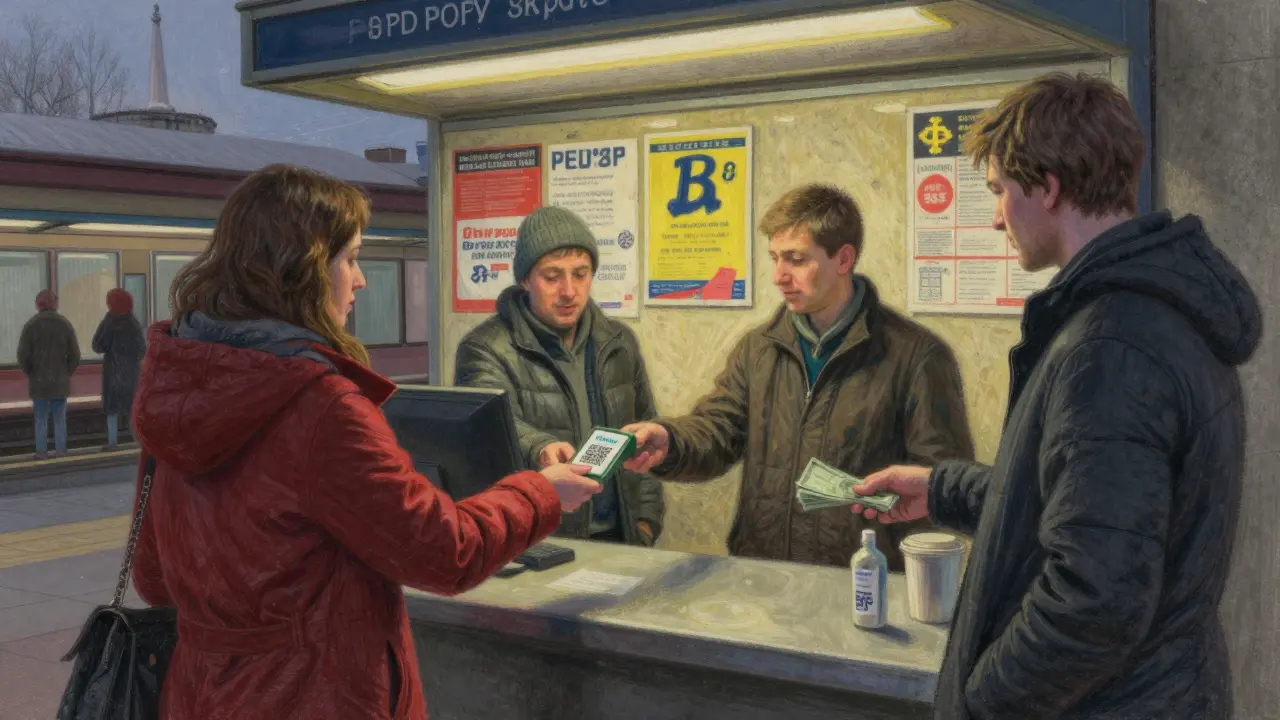
International exchanges like Binance and Coinbase are blocked in Russia. Garantex, once the largest local platform, was sanctioned by the U.S. Treasury in 2022. So what’s left?Domestic platforms like BitPrepay, EXMO, and CEX.IO (operating under Russian licenses) now handle 78% of all trading volume. These platforms require strict ID checks and report transactions to the government. Still, many users rely on peer-to-peer networks-Telegram groups, WhatsApp chats, and even bulletin boards in metro stations-to buy and sell crypto directly.
Identity verification takes 3-5 days. Customer support is slow, with an average rating of 3.8/5. Documentation is outdated because regulations change every few months. One user reported his account frozen for three weeks during a routine review, costing him 250,000 rubles in missed trading opportunities.
Security is another concern. With no regulated custodial services, users hold their own keys. Phishing scams, fake exchanges, and social engineering attacks are common. The Russian Crypto Association says 68% of new users need help setting up their first wallet.
The Central Bank’s Changing Stance: From Blockade to Integration
For years, the Bank of Russia called crypto “a threat to financial stability.” But in October 2025, everything changed. Deputy Finance Minister Ivan Chebeskov admitted: “About 20 million Russians now use crypto. We must address it, not resist it.”Then came the bombshell: the Bank of Russia announced it will soon allow commercial banks to handle cryptocurrency transactions-under strict capital and reserve requirements. This is huge. It means your Sberbank account might soon let you buy Bitcoin with rubles, just like you’d buy foreign currency.
The central bank is also running a nationwide survey from January 15 to February 28, 2026, to map out how much crypto people hold, where it flows, and who’s using it. This isn’t just data collection-it’s the first step toward legalizing crypto as a financial asset, not just a commodity.

What’s Next? Growth, Risks, and Geopolitics
Statista predicts Russia’s crypto market revenue will hit $2.3 billion in 2025, up from $1.79 billion in 2024. By the end of 2026, user numbers could hit 23.5 million-16% of the population.But risks loom. The U.S. Treasury has signaled it will increase scrutiny on Russian crypto activity. More sanctions could cut off access to global blockchain tools. If the government cracks down on P2P trading, adoption could stall.
On the flip side, if banks integrate crypto smoothly, Russia could become the first major economy to fully absorb digital assets into its financial system-without relying on Western infrastructure. That’s why the Atlantic Council warns this could create “geopolitical consequences.” Russia isn’t just using crypto. It’s building a new financial model.
Real Stories: Successes and Failures
A freelance developer in Yekaterinburg started using USDT to pay for cloud servers in Singapore. Before, wire transfers took five days and cost $30. Now, payments clear in 12 minutes for $0.30. “I saved $1,200 last year just on fees,” he said.Another user, a small importer in Rostov, used Bitcoin to pay for machinery from China after sanctions blocked his bank’s access to yuan. “The seller didn’t even ask for crypto before,” he told a local news outlet. “Now he prefers it.”
But there are losses too. A woman in Vladivostok lost 800,000 rubles after sending funds to a fake exchange that vanished overnight. Another had her account frozen for three weeks because her bank flagged a $100 USDT deposit as “suspicious.”
These aren’t outliers. They’re the daily reality of crypto in Russia: powerful, useful, but fragile.
The Bottom Line
Crypto adoption in Russia isn’t about innovation. It’s about survival. Sanctions forced a nation to build its own financial alternative. And it worked. Millions now use crypto to pay, trade, and protect their wealth. The government is no longer fighting it-it’s trying to control it.For now, the system is messy. Regulations shift weekly. Platforms come and go. But the demand won’t disappear. Whether Russia ends up with state-backed digital rubles or a hybrid crypto economy, one thing is clear: the people have already decided. Crypto isn’t the future here. It’s the present.
Is it legal to use cryptocurrency in Russia?
Yes, owning cryptocurrency is legal in Russia. You can buy, hold, and trade Bitcoin, Ether, and stablecoins without breaking the law. However, using crypto to pay for goods or services is prohibited under the 2021 “On Digital Financial Assets” law. This creates a legal gray zone: you can have crypto, but you can’t spend it like money in most cases. Violating this rule can lead to bank account freezes or tax investigations.
Can Russian banks handle cryptocurrency transactions?
As of late 2025, Russian banks are not yet allowed to handle crypto directly. But in October 2025, the Bank of Russia announced plans to permit commercial banks to offer crypto services under strict capital and reserve requirements. A nationwide survey from January to February 2026 is gathering data to shape this new policy. If approved, you could soon buy Bitcoin through Sberbank or VTB, just like you’d buy foreign currency.
Why is Bitcoin so popular in Russia compared to other cryptos?
Bitcoin dominates because it’s the most trusted, liquid, and globally recognized asset. Russians use it primarily as a store of value and for cross-border transfers. With 62.1% of all crypto holdings in Russia being Bitcoin, users see it as digital gold-something that holds value even if local banks freeze accounts. Stablecoins like USDT are second because they’re pegged to the dollar, making them useful for international trade. Ethereum and other altcoins are less popular because they lack the same level of liquidity and recognition in Russia’s regulated environment.
How do Russians buy crypto if international exchanges are blocked?
Most Russians use domestic exchanges like BitPrepay, EXMO, or CEX.IO (Russia-licensed versions). These platforms require ID verification and comply with Russian financial reporting rules. For those who avoid centralized platforms, peer-to-peer (P2P) networks dominate. Telegram groups, WhatsApp chats, and local meetups let users trade directly. Some even use cash deposits or bank transfers to buy crypto from individuals. P2P accounts for over 60% of all crypto trades in Russia.
What are the biggest risks of using crypto in Russia?
The biggest risks are regulatory uncertainty, account freezes, and fraud. The government changes rules frequently-sometimes without warning. Banks may freeze accounts if they detect crypto activity, even if it’s legal. Scammers run fake exchanges and phishing sites targeting inexperienced users. Since there are no regulated custodial services, users must manage their own private keys. If you lose them, your money is gone. According to a 2025 survey, 28% of users reported account freezes during compliance reviews, and 63% cited sudden policy changes as a major frustration.
How does Russia’s crypto adoption compare to other countries?
Russia ranks #10 globally in overall crypto adoption (Chainalysis 2025), ahead of the UK and Brazil but behind India and Ukraine. What makes Russia unique is its institutional adoption-it’s #4 in the world for business and corporate crypto use. Most countries lead with retail users. Russia leads with exporters, freelancers, and small businesses using crypto to bypass sanctions. DeFi usage is weak (#52) because Russians prefer simple, reliable solutions over complex decentralized protocols. Compared to China (banned) or the U.S. (regulated), Russia’s model is a hybrid: unofficially widespread, officially restricted, and slowly being integrated.




Crypto in Russia? More like sanctioned survival. Simple.
I've talked to a few Russian freelancers who switched to USDT last year. Their lives changed. No more 5-day wire delays. No more $40 fees just to pay a designer in Poland. It's not about Bitcoin being cool-it's about getting paid. And honestly? It's beautiful to see people adapt like this. The system's broken? They built a new one. No fanfare. Just work.
The institutional adoption metric is misleading. You're conflating necessity with innovation. This isn't a blockchain revolution-it's a liquidity patch. A temporary workaround for a collapsing fiat infrastructure. And let's not pretend the state isn't surveilling every transaction. The Bank of Russia's survey isn't regulatory curiosity-it's pre-emptive control. They want to know where the money is so they can tax it, freeze it, or nationalize it later.
Russia using crypto? Funny. Meanwhile in India we're banned from even talking about it. Guess who's really free?
Wait wait wait-so the government says you CAN'T pay with crypto... but you CAN own it? That's not a policy. That's a joke. Like saying you can own a gun but can't point it at anything. Who thought this up? Some bureaucrat on mushrooms? And don't even get me started on the 'survey'-that's just the state gathering names for the next purge. Mark my words: this ends with people disappearing for holding too much Bitcoin.
I just read this whole thing and I'm so emotional. I mean, imagine being forced to use crypto just to feed your family. It's not glamorous. It's not about getting rich. It's about not starving. I have a friend whose dad is a truck driver in Ukraine-he does the same thing. Uses USDT to pay for diesel from Belarus. It's not tech. It's humanity. And honestly? We should be helping, not judging.
So let me get this straight. Sanctions forced a nation to build a parallel financial system... and now the central bank wants to regulate it? That’s not integration. That’s surrender with paperwork.
Bro I just used USDT to send $200 to my cousin in Kyiv last week. Took 8 minutes. Cost $0.15. Bank transfer? 3 days. $35. And they still froze my account for 'unusual activity'. Like... what did you expect? We're living in the future. The system's already broken. The question is: are you gonna keep using the broken one or join the one that actually works?
Crypto in Russia? More like crypto chaos. People losing money daily. Scams everywhere. This isn't innovation. It's desperation with a blockchain logo.
They're using crypto because they have no choice. But the real story? The U.S. and EU are the ones who made them do this. This is our fault. We broke their banking system. Now we're mad they found a way out? Pathetic.
The resilience displayed by ordinary Russians in adapting to these circumstances is a profound testament to human ingenuity under duress. One cannot help but observe that the convergence of regulatory ambiguity and grassroots innovation has produced a uniquely organic financial ecosystem-one that, while unorthodox, demonstrates a remarkable alignment between technological capability and societal necessity.
You think Russia is special? Nigeria has been using crypto for 8 years. We don't need sanctions to know the system is rigged. We just know. And we still pay our bills. Still send money home. Still buy food. You think Russia is the first? Nah. We been doing this while y'all were still arguing about Dogecoin.
The 62.1% Bitcoin dominance is statistically insignificant without context. You're ignoring the velocity of circulation. Stablecoins like USDT have higher transactional frequency, yet you're elevating Bitcoin as the 'store of value' narrative because it fits the Western crypto mythology. This is not adoption-it's asset hoarding. And the fact that DeFi usage is #52? That's not a failure. That's wisdom. Russians aren't dumb. They know DeFi is a casino with no dealer oversight.
This is the most beautiful thing I've read all year. Not because it's techy. Not because it's revolutionary. But because it's human. People didn't wait for permission. They didn't protest. They didn't beg for help. They just... figured it out. Using Telegram groups. Cash meetups. Old phones. Shared trust. No banks. No lawyers. Just real people doing real things. And yeah, some got scammed. But most didn't. And they kept going. That’s not crypto adoption. That’s civilization rebuilding itself.
I wonder if this is what freedom looks like now. Not voting. Not flags. Not speeches. But the quiet, stubborn act of choosing how to survive. No one asked for this. No one celebrated it. But millions did it anyway. And now, the state is trying to take it over. I don't know if that's progress or tragedy. Maybe both.
The real story here isn't crypto. It's the collapse of trust in institutions. Russians don't use crypto because they love blockchain. They use it because they stopped believing in banks, governments, and payment processors. The technology is just the vessel. The real revolution is psychological.
I'm so curious-how do people even learn to set up a wallet in this environment? Is there like a community tutor thing? Or do you just pray and hope? I'd be terrified. But also... kinda inspired?
I'd like to thank the authors of this piece for presenting a nuanced and evidence-based perspective. The data on institutional adoption is particularly compelling. It demonstrates that when formal systems fail, informal networks filled with competent, resourceful individuals can create functional alternatives. This is not an anomaly. It is a predictable outcome of systemic stress. We should study this model-not dismiss it.
Oh wow. So now the state is going to 'integrate' crypto? Like, they'll let you buy Bitcoin through Sberbank? That's not integration. That's a trap. You think they're doing this to help people? No. They're doing it so they can track every coin. So they can freeze accounts. So they can tax you on paper gains you never cashed out. This isn't progress. It's a velvet glove on an iron fist.
This made me cry 😭 I have a cousin in St. Petersburg who used USDT to buy insulin for her mom. Bank transfers were blocked. Pharmacies wouldn't ship. She found a guy on Telegram. Paid in crypto. Got the meds in 3 days. No one's writing about this. Just stats. But this? This is life.
I don't get the hype. People are just using crypto because they have no other choice. It's not cool. It's not innovative. It's just... the only thing left. Like eating grass when there's no food.
I think what's really happening here isn't about crypto at all. It's about community. The P2P networks, the Telegram groups, the metro bulletin boards-those aren't just transaction channels. They're social safety nets. People are helping each other. Teaching each other. Protecting each other. That’s the real story. The tech is just the tool.