

Global Crypto Adoption Index by Country 2025: Rankings, Restrictions & Trends

The landscape of cryptocurrency usage changed dramatically in 2025. It is no longer just about who has the most Bitcoin; it is about how deeply crypto is woven into daily life and institutional finance across borders. If you are looking at the global crypto adoption index, you need to understand that the numbers tell two different stories depending on which metric you trust. Are we counting raw transaction volume, or are we measuring per-capita obsession? The answer shifts the top countries entirely.
In September 2025, Chainalysis released its sixth annual Global Crypto Adoption Index. This report ranks 151 countries based on on-chain data and web traffic. At the same time, other firms like ApeX Protocol and Henley & Partners published their own indices, focusing on search behavior and investment migration. These differences matter, especially when you consider how government restrictions shape these numbers.
Who Leads the Global Crypto Adoption Index 2025?
If you look at the total volume of activity, India dominates the chart for the third year in a row. With over 100 million users, India’s sheer population size drives massive on-chain value. But volume isn’t everything. When you adjust for population, the picture changes completely. Ukraine takes the lead, followed closely by Moldova, Georgia, Jordan, and Hong Kong SAR.
| Rank (Total Volume) | Country | Key Driver |
|---|---|---|
| 1 | India | Massive user base (>100M) |
| 2 | United States | Spot Bitcoin ETFs & Institutional Inflows |
| 3 | Pakistan | Retail trading & Remittances |
| 4 | Vietnam | Sustained Southeast Asian integration |
| 5 | Brazil | Latin American market growth |
The rise of the United States to second place is significant. It reflects a shift from retail speculation to professional participation. The approval of spot Bitcoin ETFs brought billions in institutional capital, pushing the US up the rankings despite strict regulatory scrutiny. Meanwhile, Nigeria dropped to sixth place, even after making regulatory progress, showing that policy changes don't always immediately translate to higher indexed scores.
The Impact of Restrictions on Adoption Metrics
You cannot talk about adoption without talking about barriers. Many countries have implemented severe restrictions on cryptocurrency. Bans on exchanges, blocking of P2P networks, and heavy taxation can suppress official metrics. However, these restrictions often drive adoption underground or into decentralized finance (DeFi), which is harder to track.
For example, countries with high inflation or currency instability, such as Venezuela and parts of the Middle East, show high adoption rates despite-or because of-financial instability. People use crypto to preserve wealth. In contrast, nations with strict capital controls may see lower on-chain volumes because users rely on peer-to-peer (P2P) markets that don't always register clearly in centralized service data.
Chainalysis noted in 2025 that they removed the retail DeFi sub-index because it over-weighted "niche behavior." This decision highlights a limitation: if a country bans centralized exchanges but allows self-custody wallets, traditional indices might underreport its true adoption level. Regulatory clarity, rather than outright bans, seems to boost measurable adoption. The US jump correlates directly with clearer frameworks for institutions.

Alternative Indices: Obsession vs. Utility
Not all indices measure the same thing. While Chainalysis focuses on transaction value, ApeX Protocol measures "crypto obsession" using search activity and ownership rates. According to ApeX, Singapore is the most crypto-obsessed nation, with a composite score of 100. Singaporeans make 2,000 crypto-related queries per 100,000 people, and 24.4% of the population owns crypto.
This contrasts sharply with utility-driven adoption. In United Arab Emirates, ownership hit 25.3%, driven by aggressive government support and tax incentives. These countries rank high not because people are fleeing inflation, but because they are actively investing and researching digital assets. This distinction is crucial for businesses deciding where to expand services.
| Index Provider | Primary Metric | Top Country (2025) |
|---|---|---|
| Chainalysis | On-chain transaction value | India |
| ApeX Protocol | Search activity & Ownership % | Singapore |
| Henley & Partners | Investment migration friendliness | Varies by pathway |
Institutional Adoption: The New Frontier
2025 marked a turning point for institutional involvement. Chainalysis introduced a new lens for tracking transfers over $1 million. This change acknowledges that professional money moves differently than retail traders. Countries like Ukraine, Moldova, Slovenia, and Estonia scored highly in this category, suggesting they are becoming hubs for institutional crypto activity relative to their economic size.
This trend is supported by the broader market context. The cryptocurrency sector achieved a compound annual growth rate (CAGR) of 99% from 2018 to 2023, far outpacing traditional payment methods. As institutions enter the space, they demand legal certainty and banking relationships. This is why Henley & Partners launched their index, benchmarking countries based on investment migration pathways for crypto millionaires. They look at regulatory frameworks, taxation, and legal protections.
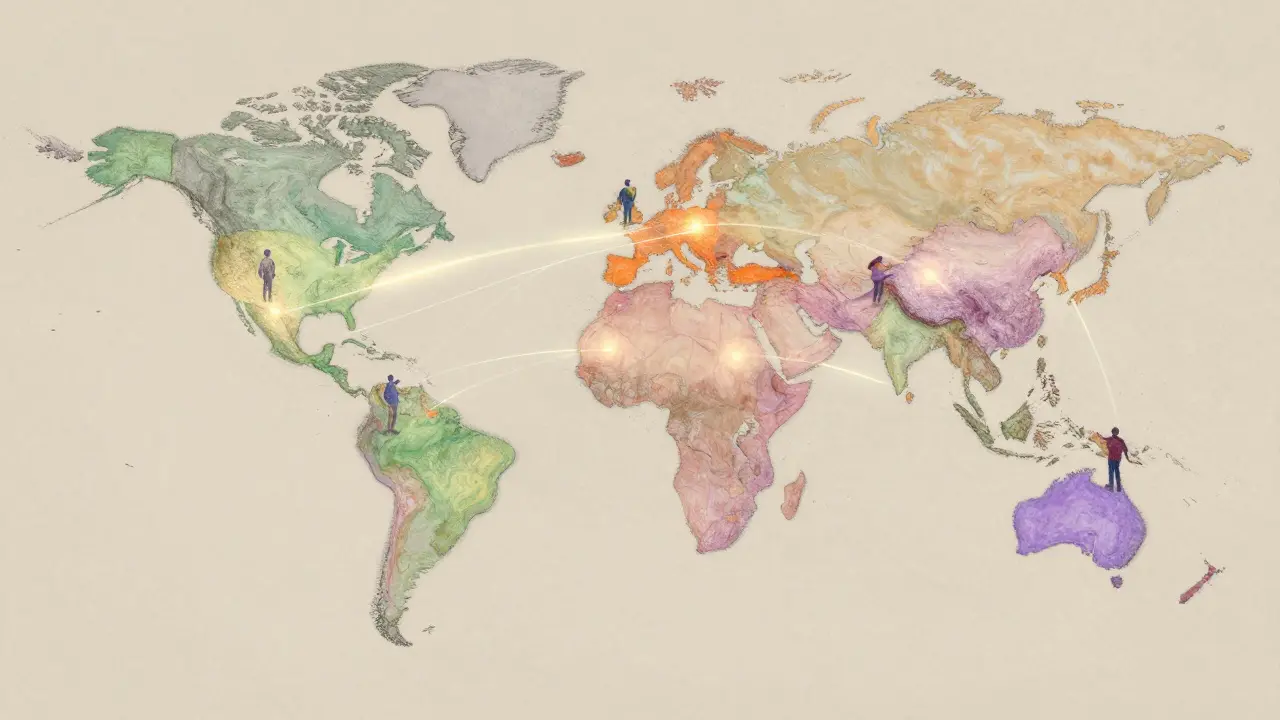
Regional Trends and Demographics
The Asia-Pacific region led global growth with a 69% year-on-year surge in transaction value in 2025. India, Vietnam, and Pakistan drove this momentum. In Eastern Europe, countries like Ukraine and Georgia continue to show high per-capita adoption, likely due to economic pressures and remittance needs. Latin America, particularly Brazil and Venezuela, remains strong for inflation hedging.
Demographically, global crypto ownership reached 12.4% in 2025. Men still dominate ownership at 61%, while women hold 39%. The largest age group is 25-34 years old, representing 34% of owners. In the US specifically, ownership hit 15.56%, indicating steady mainstream penetration despite regulatory debates.
Methodological Limitations and Future Outlook
No index is perfect. Chainalysis admits that web-traffic geolocation has constraints. Decentralized activity is hard to pin to a specific country. Privacy-focused coins and advanced DeFi usage can skew results. Therefore, actual adoption in restrictive regimes might be higher than reported.
Looking ahead, the integration of traditional finance with crypto infrastructure will continue. As regulatory clarity improves in major markets, we expect adoption rates to climb further. The key takeaway for 2025 is that adoption is no longer just a grassroots movement; it is an institutional reality shaped by regulation, technology, and economic necessity.
Which country has the highest crypto adoption in 2025?
According to Chainalysis, India has the highest total crypto adoption due to its massive user base. However, when adjusted for population, Ukraine leads the rankings.
How do government restrictions affect crypto adoption indices?
Restrictions can suppress on-chain volumes tracked by indices, especially if centralized exchanges are banned. However, they may drive users toward P2P markets or DeFi, which are harder to measure accurately.
Why did the United States jump to second place in the 2025 index?
The US rose to second place due to increased institutional adoption following the approval of spot Bitcoin ETFs and clearer regulatory frameworks for professional participants.
What is the difference between Chainalysis and ApeX Protocol indices?
Chainalysis measures actual on-chain transaction values, while ApeX Protocol measures "crypto obsession" through search activity and population ownership percentages.
Which regions showed the fastest growth in 2025?
The Asia-Pacific region saw a 69% year-on-year surge in transaction value, driven largely by India, Vietnam, and Pakistan.