
How to Calculate Impermanent Loss: The Math, Tools, and Real-World Examples
You deposit $1,000 worth of ETH and USDC into a liquidity pool. A month later, ETH price surges by 50%. You check your dashboard and see a red number labeled "Impermanent Loss." Panic sets in. But here is the twist: you haven't actually lost money compared to where you started. You have only lost out on potential gains compared to if you had just held those tokens in your wallet.
This confusing reality is the heart of Impermanent Loss (IL), the single biggest risk for anyone providing liquidity in Decentralized Finance (DeFi). Understanding how to calculate it isn't just academic; it's the difference between profitable yield farming and quietly bleeding value while fees trickle in too slowly to matter.
What Exactly Is Impermanent Loss?
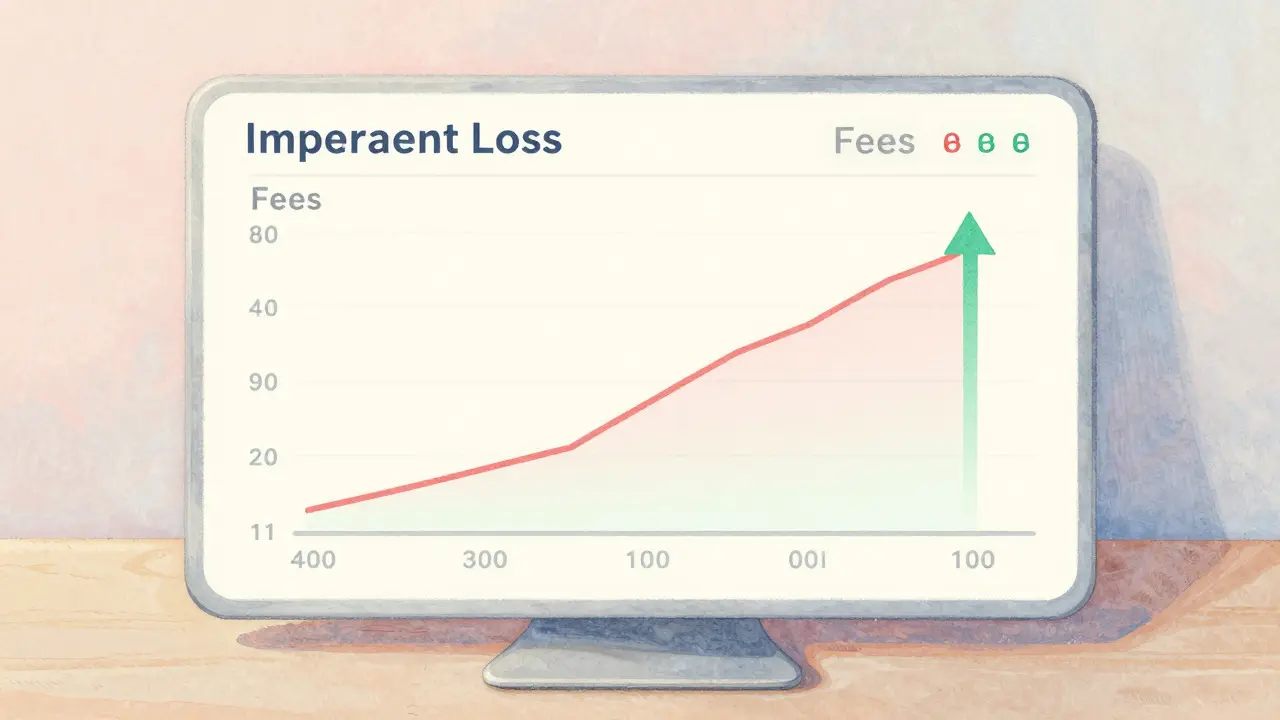
Let's strip away the jargon. Impermanent Loss is an opportunity cost. It happens when the price ratio of the two tokens in your liquidity pool changes significantly from the moment you deposited them.
Automated Market Makers (AMMs) like Uniswap use a mathematical formula called the constant product formula (x * y = k) to price trades. When someone buys ETH from the pool, the amount of ETH decreases, so the price goes up to keep the product constant. This forces the pool to rebalance, selling high-price assets and buying low-price ones. As a Liquidity Provider (LP), you end up holding more of the cheaper token and less of the expensive one.
If prices revert to their original state, that loss disappears-hence "impermanent." If you withdraw your funds while the price divergence remains, that loss becomes permanent. The key insight? You are always comparing your LP position against a "HODL" strategy (just holding the tokens).
The Core Formula: How to Calculate IL for 50/50 Pools
For standard equal-weighted pools (like Uniswap v2 or SushiSwap), the math is straightforward but requires a bit of algebra. The formula relies on the price change multiplier, often denoted as d.
d represents the current price divided by the initial price. For example, if ETH was $2,000 when you entered and is now $3,000, then d = 1.5.
The formula for Impermanent Loss percentage is:
IL = [2 * √d / (1 + d)] - 1
Let's break down a real-world scenario to make this concrete.
- Initial State: You deposit 1 ETH ($2,000) and 2,000 USDC. Total value: $4,000.
- Price Change: ETH rises to $3,000. The multiplier
dis 1.5. - Calculate Square Root: √1.5 ≈ 1.2247.
- Apply Formula: 2 * 1.2247 = 2.4494. Divide by (1 + 1.5) = 2.5. Result: 0.97976.
- Final Step: Subtract 1. 0.97976 - 1 = -0.02024.
Your impermanent loss is approximately -2.02%. This means your portfolio is worth 2.02% less than if you had simply held 1 ETH and 2,000 USDC separately during that price surge.
Quick Reference: Common Price Changes and IL Impact
You don't need to run the square root calculation every time. Here is a cheat sheet based on standard 50/50 weighted pools. These numbers are consistent across major protocols using the constant product model.
| Price Change (Multiplier d) | Impermanent Loss % | Scenario Example |
|---|---|---|
| 1.25x (25% increase) | 0.6% | ETH moves from $2,000 to $2,500 |
| 2.0x (100% increase) | 5.7% | ETH doubles in price |
| 3.0x (200% increase) | 13.4% | Token triples in value |
| 4.0x (300% increase) | 20.0% | Meme coin pumps 4x |
| 5.0x (400% increase) | 25.5% | Extreme volatility event |
Notice the asymmetry? A 2x increase causes a 5.7% loss. A 2x decrease (d=0.5) also causes a 5.7% loss. Volatility hurts regardless of direction.
Calculating IL for Non-Equal Weighted Pools
Not all pools are created equal. Platforms like Balancer allow custom weights, such as 80/20 or 90/10 splits. These pools are designed to minimize impermanent loss for the heavier asset, but they come with higher trading fees for users.
The formula becomes more complex because it accounts for the weight (w) of each asset. For a pool with weight w for the first asset:
IL = [w * d^w + (1-w) * d^(1-w)] - [d^(w*(1-w))]
In practice, you rarely calculate this manually. However, understanding the principle is crucial: the more asymmetric the pool, the lower the impermanent loss for the dominant asset, but the higher the slippage for traders. If you are providing liquidity for a stablecoin pair pegged to USD, the loss is negligible unless one stablecoin de-pegs.
Uniswap V3 and Concentrated Liquidity: The New Risk Profile
Uniswap v3 changed the game by introducing concentrated liquidity. Instead of providing liquidity across the entire price range (from $0 to infinity), you select a specific range, say $2,500 to $3,500 for ETH.
This boosts your capital efficiency-you earn fees on a smaller amount of capital-but it drastically increases impermanent loss risk if the price exits your range.
- Within Range: Your IL behaves similarly to v2, but amplified because your exposure is concentrated.
- Outside Range: If ETH drops below $2,500, your position converts entirely to the quote asset (USDC). You no longer suffer impermanent loss from further ETH drops, but you miss out on any recovery upside until you rebalance.
Calculating IL for V3 requires knowing not just the price change, but also whether the current price is inside or outside your selected tick range. Tools like DeBank or Zapper.fi handle this complexity automatically, showing you the exact IL relative to your specific position bounds.
Tools to Automate the Calculation
Unless you love manual arithmetic, use these trusted tools to estimate your risk before depositing:
- CoinGecko Impermanent Loss Calculator: Simple interface. Enter the price change percentage, and it gives you the theoretical IL instantly. Note: It does not account for fees.
- Daily Defi Calculator: More advanced. Allows you to input fee APY alongside price changes to see net profit/loss scenarios.
- Whiteboard Crypto Interactive Calculator: Great for visual learners. Shows charts of how IL scales with volatility.
Remember, these calculators show theoretical impermanent loss. They do not subtract the trading fees you earn. To know if a pool is profitable, you must compare the IL against the annualized fee income.
When Does Impermanent Loss Become Permanent?
This is the most common question. Impermanent loss becomes permanent the moment you withdraw your liquidity while the price divergence exists. There is no magic reset button.
However, "permanent" doesn't necessarily mean "negative return." If you earned 10% in trading fees over six months, and your impermanent loss was 5%, your net result is still a +5% gain. The loss is only "bad" if it exceeds your fee income.
A study by Gauntlet Network found that in highly volatile pairs, 63% of liquidity providers experienced net losses because IL exceeded fee income. In stablecoin pools, that figure dropped to 18%. Always check the volume-to-value ratio of a pool. High volume generates fees that can offset IL.
Strategies to Mitigate Impermanent Loss
You can't eliminate IL in AMMs-it's baked into the math. But you can manage it:
- Pick Stable Pairs: Providing liquidity for DAI/USDC or USDT/USDC carries near-zero IL risk because the prices are pegged together. Returns are lower, but safer.
- Use Correlated Assets: Tokens like ETH and stETH (staked ETH) move almost identically. IL is minimal because their ratio stays constant.
- Choose Wider Ranges in V3: While less efficient, wider ranges reduce the chance of being completely de-risked into one asset, smoothing out IL spikes.
- Monitor Fee APY: Only enter pools where the projected fee income comfortably exceeds the potential IL for expected volatility levels.
Is impermanent loss the same as losing money?
No. Impermanent loss is an opportunity cost. It means your portfolio grew slower than if you had just held the tokens. You can still be profitable if the trading fees you earn outweigh the impermanent loss. You only lose absolute money if the total value of your deposited assets drops below your initial investment.
Does impermanent loss happen in all DeFi protocols?
It primarily affects Automated Market Makers (AMMs) like Uniswap, SushiSwap, and Curve. Order book-based exchanges or lending protocols (like Aave) do not have impermanent loss in the same way, though they carry different risks like liquidation.
How do I calculate impermanent loss for a 50/50 pool quickly?
Use the formula: IL = [2 * √d / (1 + d)] - 1, where d is the current price divided by the initial price. For quick estimates, remember that a 2x price change results in roughly 5.7% IL, and a 3x change results in about 13.4% IL.
Can I avoid impermanent loss entirely?
You can minimize it significantly by providing liquidity to stablecoin pairs (e.g., USDC/DAI) or correlated assets (e.g., ETH/stETH). In these cases, the price ratio remains nearly constant, resulting in negligible impermanent loss.
Why is impermanent loss worse in Uniswap V3?
Uniswap V3 allows concentrated liquidity within specific price ranges. If the price stays within your range, your capital efficiency is higher, but the impermanent loss impact is amplified compared to V2. If the price exits your range, you hold only one asset, which stops IL accumulation but removes upside potential until you rebalance.