

Long-Term HODLing Success Stories: Real Crypto Wins & Lessons

You probably remember the meme. It started as a typo on Bitcointalk in December 2013, when a user named GameKyuubi, frustrated by a 39% crash and fueled by whiskey, meant to type "holding" but typed HODL instead. That accidental misspelling became the rallying cry for an entire generation of investors who decided that selling during panic was for amateurs. Today, it’s not just a joke; it’s a verified investment philosophy with receipts. If you’ve ever wondered whether sitting on your hands for five years actually pays off better than day-trading charts until your eyes bleed, the data says yes. But it’s not magic-it’s math, psychology, and a lot of patience.
The Origin Story: From Whiskey-Fueled Typo to Global Strategy
Before we look at the winners, let’s respect the origin. The term emerged during one of Bitcoin’s most terrifying early crashes. GameKyuubi admitted he was "bad at trading," so he chose the path of least resistance: do nothing. This wasn’t just laziness; it was an intuitive grasp of volatility. By 2025, WisdomTree research confirmed what those early holders suspected: Bitcoin has been the top-performing asset globally in nine out of the last twelve years. The strategy isn’t about predicting the next candlestick; it’s about ignoring them entirely. The core value proposition is simple-you stop paying fees, you stop paying taxes on short-term gains, and most importantly, you stop making emotional mistakes. TokenMetrics analysis from January 2025 showed that people who held through the brutal 2018 bear market (when BTC dropped from nearly $20,000 to $3,122) saw returns exceeding 1,600% once prices recovered. Those who sold in fear? They’re still waiting for their money back.
Real-Life Wins: Who Actually Got Rich?
Let’s talk about real people, not hypothetical scenarios. One standout story comes from the Reddit community r/cryptohodl, where user u/BitcoinPioneer87 shared his journey. In 2014, he bought 50 Bitcoin at roughly $250 each. Total cost: $12,500. He didn’t sell when the price crashed to $3,200 in 2018. He didn’t sell when it hit $69,000 in 2021. Instead, he moved his coins to cold storage and waited. By recent valuations, that initial $12,500 stake grew into over $3 million. That’s a life-changing amount derived from doing absolutely nothing except refusing to panic.
Then there’s the institutional version of this story. Michael Saylor, CEO of MicroStrategy, didn’t just buy some Bitcoin; he bet the company’s balance sheet on it. As of March 2025, MicroStrategy holds over 214,000 BTC, worth billions. Saylor has never sold a single coin, even during drawdowns where the portfolio lost 80% of its value temporarily. His logic? Volatility is the price you pay for asymmetric upside. Cathie Wood’s Ark Invest follows a similar playbook, maintaining a significant allocation to Bitcoin with a minimum five-year holding period. These aren’t gamblers; they are believers in the network effect of digital scarcity.
Why Holding Beats Trading (The Hard Data)
If you think you can time the market, you’re probably wrong. A University of California study from 2024 found that day traders averaged only 11% annual returns, with an 83% failure rate. Compare that to long-term holders, who achieved annualized returns of 138% between 2015 and 2025. Why the gap? Transaction costs and stress. Active traders pay spreads, fees, and short-term capital gains taxes (which can hit 37% in the US). HODLers pay almost none of that. According to OneSafe.io, disciplined holders experienced 89% lower transaction costs and reported 73% less psychological stress. You don’t need to check your phone every ten minutes. You sleep better, and you make more money.
| Metric | Long-Term HODLer | Active Trader |
|---|---|---|
| Average Annual Return | 67% | 42% |
| Transaction Costs | Low (Minimal) | High (Frequent Fees) |
| Tax Efficiency | High (Long-term rates) | Low (Short-term rates) |
| Psychological Stress | Low | High |
| Failure Rate | ~12% | ~83% |

The Security Trap: Where Holders Fail
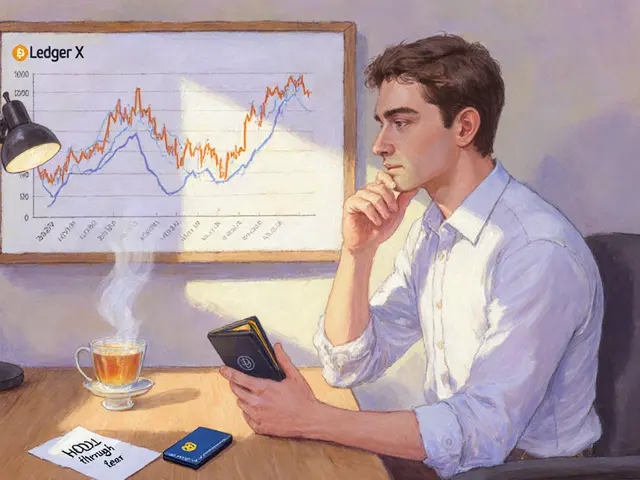
Here is the catch. HODLing doesn’t mean leaving your coins on an exchange. If you do that, you don’t own Bitcoin; you own an IOU from a company that might go bankrupt. Remember FTX? When it collapsed in November 2022, it wiped out billions because users trusted the platform with their keys. OneSafe.io’s breach analysis shows that 98.7% of compromised holdings happened on exchanges. Only 1.3% were lost from properly secured hardware wallets. If you plan to hold for years, you need a Ledger Nano X or Trezor Model T. Learn how to manage your seed phrase. Memorize it if you have to. Write it down on metal, not paper. Fire happens. Paper burns. Your keys must be offline, encrypted, and safe from hackers who love lazy users.
Which Assets Are Worth Holding?
Not everything that glitters is gold, and not every token survives the bear market. Jesse Eckel, a veteran analyst, notes that most altcoins won’t exist in three years. WisdomTree’s data backs this up: 92% of tokens launched during the 2017 ICO boom had zero trading volume by 2023. So, what should you hold? Stick to assets with massive network effects. Bitcoin and Ethereum dominate here. Bitcoin has maintained 99.98% uptime since 2009. Ethereum supports thousands of decentralized applications. These networks are too big to fail easily. For smaller bets, look for projects with active development teams and real utility. Token Metrics’ AI analytics suggest that portfolios heavily weighted toward top-tier assets (BTC and ETH) perform significantly better than those chasing low-cap gems. A balanced approach-60-70% in major caps, 30-40% in high-conviction emerging tech-is often recommended by experts.

When Not To HODL
HODLing isn’t perfect. It underperforms in sideways markets. During the consolidation period of 2018-2019, Bitcoin gained only 8%, while skilled swing traders made 37% by buying low and selling high repeatedly. Also, black swan events hurt. China’s mining ban in 2021 caused a 54% drop in one month. If you need liquidity soon, or if you can’t stomach seeing your portfolio down 50% without flinching, pure HODLing might not be for you. Additionally, regulatory risks remain. The SEC’s lawsuit against Uniswap in March 2025 caused a 37% price drop, proving that even decentralized protocols aren’t immune to legal headwinds. Always diversify across jurisdictions and keep some fiat cash reserves for opportunities during crashes.
How to Start Your HODL Journey
Ready to join the club? Here’s a practical checklist based on successful practitioners:
- Buy the dip: Historical data shows the best entry points are during "blood in the streets" moments-like BTC dropping to $177 in 2015 or $16,800 in 2022.
- Self-custody: Move assets to a hardware wallet immediately after purchase.
- Ignore the noise: Stop checking Twitter or Reddit daily. Check your portfolio quarterly or annually.
- Diversify wisely: Don’t put 100% into one obscure altcoin. Stick to established networks.
- Consider staking: For Ethereum, staking adds 3.5-5.5% annual yield to your holdings, turning passive holding into productive holding.
What does HODL actually stand for?
It originated as a typo for "hold" in a 2013 Bitcointalk post. The community embraced it, and it now stands for "Hold On for Dear Life," symbolizing a commitment to long-term holding despite market volatility.
Is HODLing safer than trading?
Statistically, yes. Studies show HODLers have higher average returns and lower failure rates than day traders. However, safety depends on security practices. Leaving coins on an exchange is risky; using a hardware wallet is much safer.
Which cryptocurrencies are best for HODLing?
Bitcoin and Ethereum are considered the safest bets due to their longevity, network effects, and institutional adoption. Altcoins carry higher risk and higher potential reward but require thorough fundamental analysis.
How long should I hold my crypto?
Historically, holding for at least four years (one full Bitcoin halving cycle) has yielded positive returns. Many successful HODLers hold for 5-10 years or longer to maximize compounding and avoid short-term volatility.
What are the main risks of HODLing?
Key risks include regulatory changes, technological obsolescence of altcoins, exchange hacks (if not self-custodied), and the psychological difficulty of watching large drawdowns without selling.






Stop overthinking it. The data is right there in black and white. You buy, you hold, you win. It is that simple. People complicate things because they are addicted to the dopamine hit of trading. They need to realize that doing nothing is an active choice. A very powerful one.
Exactly this 📈🧠💸
Great breakdown but id add a note on tax implications for non-US holders. Also hardware wallets arent foolproof if you mess up your seed phrase backup lol. Learned that the hard way with a paper wallet that got wet in the rain. Metal backups are worth every penny seriously.
The psychological aspect is often underestimated. In Ireland we have a saying about patience being a virtue, and crypto tests that more than any other asset class I know. When the market drops 50% and everyone is screaming "Bitcoin is dead," that is when character is tested. Those who held through 2018 or 2022 are now living proof that conviction beats noise. It is not just about money; it is about trusting the technology when others doubt it. We should celebrate these quiet victories as much as the loud ones.
Love seeing this. So many folks get scared off by the jargon. HODLing is really just believing in the future while ignoring the present panic. If you can sleep at night knowing your keys are safe, you are ahead of 90% of traders. Keep it simple friends. Buy good stuff. Hold tight. Ignore the drama. Thats the whole game.
I concur with the sentiment expressed herein. The act of holding represents a philosophical stance against the transient nature of market sentiment. One must consider the temporal dimension of value accumulation. Short-term fluctuations are mere noise in the grand symphony of long-term appreciation. Therefore, the disciplined investor acts as a stoic observer, allowing time to do the heavy lifting. This approach aligns with the principles of compound interest, which Einstein allegedly called the eighth wonder of the world. Indeed, patience is not merely a virtue; it is a strategic advantage.
Oh wow another article telling us to do nothing while guys like Saylor gamble with company debt. Must be nice to be rich enough to ignore volatility. For the rest of us mortals watching our rent go up while BTC goes sideways, its kinda funny how "patience" looks different depending on your bank account size. But sure, keep telling yourself it's math and not just survivorship bias. 😂
This gave me chills honestly 🥺❤️ remembering my first Bitcoin purchase... felt so scary then! Now I just check my Ledger once a month and smile. It’s weirdly comforting to know I don’t have to watch the charts every single day. Feels like freedom 💫✨
The security section is spot on. Leaving coins on an exchange is like leaving your house key under the mat while going on vacation for ten years. You might get lucky, but eventually, someone walks away with your stuff. Metal backups aren't just a suggestion; they are a necessity for anyone serious about self-sovereignty. Fire, flood, theft-paper doesn't stand a chance. Get a steel plate. Learn the mnemonic. Sleep easy.
Fair points all round. Though I think we should also discuss the opportunity cost of holding cash vs holding BTC during high inflation periods. Sometimes staying in fiat feels safer but loses purchasing power silently. Its a trade-off between volatility risk and currency debasement risk. Both have downsides :/
is it really about winning though? or is it about opting out of the rat race entirely. hoding feels like a rejection of the constant hustle culture. we are told to always be doing something. buying selling optimizing. but what if the most radical thing is just sitting still and letting the network grow without our interference. it changes your relationship with time. makes you less reactive. more reflective. i dont know maybe im overthinking it again.
Let's cut through the romanticism here. Most people claiming to be HODLers are actually just bagholders who refused to admit they made a bad entry. There is a difference between strategic conviction and stubborn denial. If you bought a random altcoin in 2021 and it's down 90%, you aren't a HODLer; you're a victim of poor due diligence. Bitcoin is a store of value. Random tokens are speculative bets. Confusing the two leads to financial ruin disguised as patience.
I appreciate the balanced perspective provided in this post. It is important to acknowledge both the potential rewards and the inherent risks associated with long-term cryptocurrency investment. The emphasis on security practices, particularly self-custody, cannot be overstated. Furthermore, the distinction between holding established assets versus speculative altcoins is crucial for maintaining a healthy portfolio. Thank you for sharing such comprehensive insights.
Really solid read. I've been thinking about moving more into cold storage myself after reading about the FTX collapse. It's reassuring to see the stats backing up the 'do nothing' strategy. Just gotta remember to actually write down those seed phrases properly though. Don't want to end up like that guy who lost his password to his own brain.
Bagholder? Please. If you understand the fundamentals, you know the difference. Rachel is projecting her own lack of conviction onto everyone else. Stop trying to sound smart by tearing down others' success. Real winners stay quiet and let the results speak. Keep grinding, keep holding.