

SushiSwap on Arbitrum Review: Liquidity, Fees, and Nova vs. One Comparison

Have you ever tried to swap tokens on a decentralized exchange only to watch your trade slip so badly that the price moved against you before you could blink? It’s frustrating, especially when you’re paying high gas fees for it. That is exactly why many traders are looking at SushiSwap on the Arbitrum network. But here is the catch: not all parts of the Arbitrum ecosystem are created equal. If you go to the wrong place within this layer-2 solution, you might find yourself trading in a ghost town with almost no money in the pools. If you go to the right place, you get deep liquidity and fast speeds.
This review cuts through the noise to tell you where SushiSwap actually works well on Arbitrum and where it falls short. We will look at the real numbers for liquidity, fees, and user experience as of mid-2026. Whether you are a seasoned DeFi farmer or just trying to move some assets cheaply, understanding the difference between Arbitrum One and Arbitrum Nova is critical for keeping your capital safe and efficient.
The Core Mechanism: How SushiSwap Works
To understand if SushiSwap is right for you, you first need to know how it ticks. Unlike centralized exchanges like Binance or Coinbase, where a company holds your money and matches buyers with sellers, SushiSwap is an Automated Market Maker (AMM). This means there is no order book. Instead, trades happen against pools of tokens provided by other users.
The math behind these pools is simple but powerful: the constant product formula ($x \cdot y = k$). When you buy a token from a pool, the amount of that token decreases, and the amount of the other token increases, causing the price to adjust automatically. For every swap you make, SushiSwap charges a flat 0.3% fee. Most of that-0.25%-goes back to the people who provided the liquidity. The remaining 0.05% supports the protocol.
This model offers total non-custodial control. You never give up ownership of your assets until the moment of the trade. However, it also means there is no customer support team to call if something goes wrong. If you send funds to the wrong address or interact with a malicious contract, the transaction is final. You are responsible for your own security.
Arbitrum One vs. Arbitrum Nova: A Stark Contrast
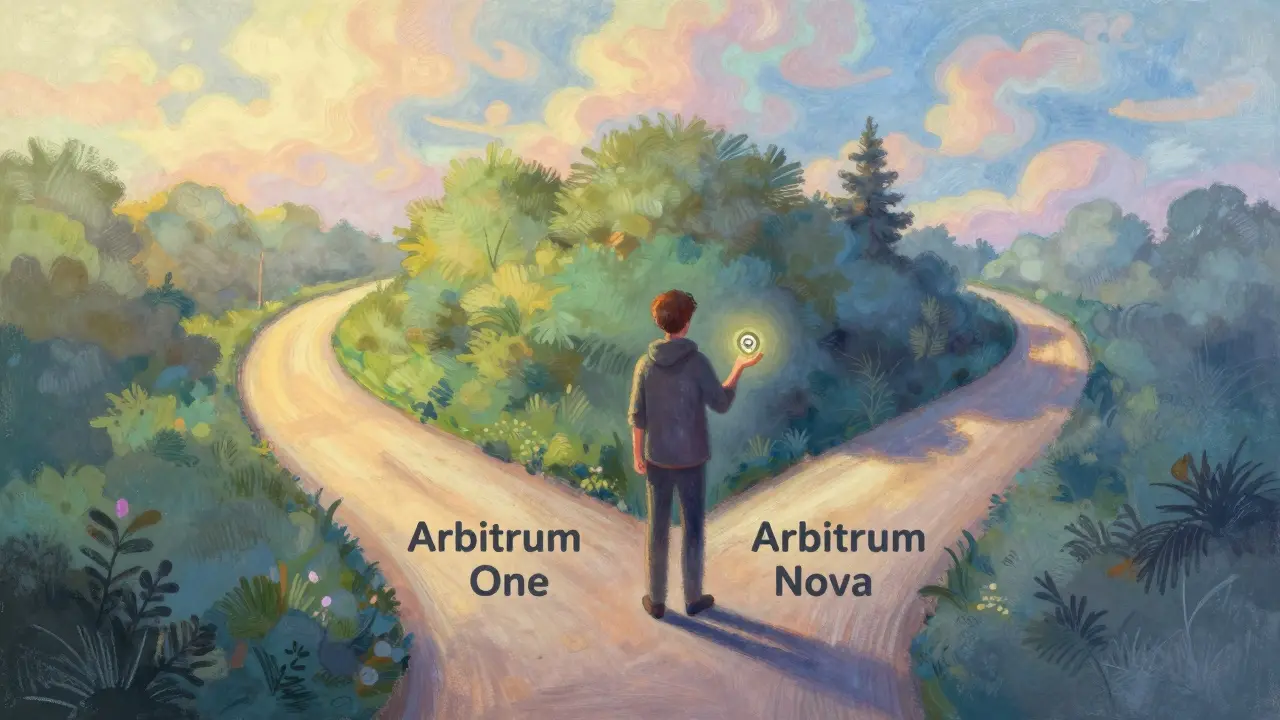
Here is where most reviews fail to help you. They treat "Arbitrum" as one single thing. In reality, SushiSwap performs very differently depending on which specific chain you connect to. As of June 2026, the data shows a massive divide between Arbitrum One and Arbitrum Nova.
| Metric | Arbitrum One | Arbitrum Nova |
|---|---|---|
| Liquidity Depth | High (Major pairs >$100M) | Very Low (Total TVL ~$400k) |
| Daily Volume | Significant multi-million USD flow | ~$6,900 USD |
| Supported Pairs | 100+ ERC-20 tokens | Only 6 coins/pairs |
| Primary Use Case | Active Trading & Yield Farming | Experimental / Micro-transactions |
| Slippage Risk | Low for major pairs | Extremely High |
If you are using Arbitrum One, you are sitting in the lion's den of liquidity. Major pairs like ETH/USDC have pools exceeding $100 million. This depth ensures that even large trades execute with minimal slippage. It is one of the strongest performing environments for SushiSwap across all its 38+ supported networks.
On the other hand, Arbitrum Nova is currently a shadow of its sibling. With daily volume hovering around $6,900 USD and a total value locked (TVL) of only about $400,000, it is barely active. The majority of that tiny volume comes from a single pair: MOON/WETH. If you try to trade anything else, or even a decent-sized amount of MOON, you will likely eat up the entire pool and suffer catastrophic slippage. For now, Nova is strictly for developers testing code or users making negligible micro-transactions.
Fees, Speed, and User Experience
One of the main reasons people choose Arbitrum over Ethereum mainnet is cost. On Ethereum, gas fees can spike to $50 or more during busy periods. On Arbitrum, transactions are significantly cheaper and settle much faster because they bundle multiple transactions together before posting them to the main Ethereum chain.
When you use SushiSwap on Arbitrum One, you benefit from this low-cost infrastructure while accessing deep liquidity. The interface itself is clean and professional. Navigating between swapping, providing liquidity, and staking SUSHI tokens is intuitive. You connect your wallet-MetaMask, WalletConnect, or others-and you are ready to go.
However, keep in mind that while the base fee is low, complex interactions (like adding liquidity to a new pool or claiming rewards) still require some gas. It’s usually a fraction of a cent to a few cents, but it adds up if you are trading frequently. Always check the estimated gas fee before confirming any transaction in your wallet.

Earning Yield: Liquidity and Staking
SushiSwap isn’t just for swapping; it’s designed to let you earn. There are two primary ways to generate returns on Arbitrum:
- Liquidity Provision: You deposit pairs of tokens (e.g., ETH and USDC) into a pool. In return, you earn a share of the 0.25% trading fee generated by swaps in that pool. This is straightforward but carries impermanent loss risk. If the price of one token changes drastically compared to the other, you might end up with less value than if you had just held the tokens in your wallet.
- SUSHI Staking: You can stake your SUSHI governance tokens in the SushiBar to receive xSUSHI. These xSUSHI tokens represent your claim on future protocol revenue. This is a way to participate in the platform’s growth without actively managing liquidity pools.
There is also Kashi, SushiSwap’s lending protocol. Kashi allows you to lend tokens to earn interest or borrow against your collateral to open leveraged positions. While available on Arbitrum, usage varies. On Nova, engagement here is virtually non-existent due to the lack of liquidity. On Arbitrum One, it offers a viable alternative to traditional lending platforms, though you must carefully monitor your collateralization ratio to avoid liquidation.
Limitations and Risks to Watch
No platform is perfect. Even on the robust Arbitrum One network, SushiSwap has limitations. First, while it supports over 100 tokens, it does not support *every* token. If you are holding a niche meme coin or a newly launched project, it might not be listed. You would need to bridge it to another DEX like Uniswap or Camelon, which defeats the purpose of staying within one ecosystem.
Second, governance participation remains low. While SUSHI holders can vote on proposals, actual engagement is often limited to a small group of whales. This means the direction of the protocol is not always driven by the broader community. If you care deeply about democratic decision-making in DeFi, this might be a concern.
Finally, remember the self-custody nature of the platform. There are no password resets. There is no chargeback option. If you lose your private key, your funds are gone forever. If you approve a malicious smart contract, it can drain your wallet. Always verify URLs and contract addresses before interacting.
Who Should Use SushiSwap on Arbitrum?
SushiSwap on Arbitrum One is an excellent choice for:
- Active Traders: Those who want to swap major cryptocurrencies quickly with low slippage and minimal fees.
- Liquidity Providers: Users comfortable with impermanent loss who want to earn steady fee income from high-volume pairs.
- DeFi Enthusiasts: People interested in yield farming, staking SUSHI, or using Kashi for leverage.
It is not recommended for:
- Beginners unfamiliar with wallets: If you don’t understand how to manage seed phrases or approve transactions, stick to centralized exchanges.
- Traders seeking obscure tokens: If the token isn’t in the top 100, SushiSwap might not have it.
- Users on Arbitrum Nova: Unless you are testing micro-transactions, the lack of liquidity makes Nova impractical for real trading.
Final Verdict
SushiSwap on Arbitrum One stands out as a mature, reliable, and highly liquid decentralized exchange. It combines the best aspects of Ethereum’s security with Arbitrum’s speed and low costs. The 0.3% fee structure is standard for AMMs, and the liquidity depth on major pairs ensures you get fair prices.
However, do not confuse it with Arbitrum Nova. The Nova deployment is currently underutilized and lacks the necessary volume for serious trading. Stick to Arbitrum One for the full experience. As long as you understand the risks of self-custody and impermanent loss, SushiSwap remains one of the top choices for decentralized trading in 2026.
Is SushiSwap on Arbitrum safe to use?
Yes, SushiSwap is generally considered safe because it uses audited smart contracts and operates on the secure Arbitrum network. However, since it is non-custodial, you are responsible for securing your own wallet. Never share your private keys, and always double-check contract addresses to avoid phishing scams.
What is the difference between Arbitrum One and Arbitrum Nova on SushiSwap?
Arbitrum One has deep liquidity, high trading volume, and supports hundreds of tokens, making it suitable for regular trading. Arbitrum Nova currently has very low liquidity (around $400k TVL) and limited trading pairs, making it unsuitable for most users except for experimental micro-transactions.
How much does it cost to swap on SushiSwap Arbitrum?
SushiSwap charges a 0.3% trading fee on all swaps. Additionally, you pay a small gas fee to the Arbitrum network, which is typically a fraction of a cent to a few dollars, significantly cheaper than Ethereum mainnet fees.
Can I earn passive income on SushiSwap?
Yes. You can provide liquidity to trading pools to earn a share of the trading fees, or you can stake SUSHI tokens in the SushiBar to earn protocol revenue shares. Both methods carry risks, such as impermanent loss for liquidity providers.
Does SushiSwap support all cryptocurrencies on Arbitrum?
No. While SushiSwap supports over 100 major ERC-20 tokens on Arbitrum One, it does not list every single token available on the network. Niche or newly launched tokens may not have liquidity pools on SushiSwap.
What happens if I lose my wallet access?
Since SushiSwap is decentralized and non-custodial, there is no customer support to recover your account. If you lose your seed phrase or private key, your funds are permanently inaccessible. Always back up your wallet information securely.
Is SushiSwap better than Uniswap on Arbitrum?
Both are strong competitors. SushiSwap often excels in user-friendly features and yield opportunities through its native token incentives. Uniswap may have slightly higher liquidity on certain pairs. It is best to compare prices on both platforms before executing large trades to ensure you get the best rate.


People just want free money without doing the work. It is a trap. The whole system is rigged against you from the start. They want your data and your soul. Do not trust these digital coins.
actually u need to read more about smart contracts bcz ur wrong. i know everything about this tech and its clear that nova is useless but one is ok. stop being so paranoid about it lol
hey there! just wanted to say that arbitrum one is pretty solid for swaps. gas fees are low like the post said. i use it often for eth usdc pairs. make sure u check slippage though bc sometimes it gets weird during high vol times. hope this helps!
SushiSwap on Arbitrum One is adequate. Nova is irrelevant. Stick to the major chains if you value your capital. Simplicity is key.
Hi friends! :) In India we love DeFi too. SushiSwap is good for learning. Just be careful with impermanent loss. It is real risk. Always DYOR before putting money in pools. Stay safe out there! :)
Wow, another review telling us what we already know. Arbitrum One is deep, Nova is shallow. Groundbreaking stuff. Maybe next time write something that doesn't sound like a manual. Thanks for nothing.
The liquidity depth on Arbitrum One demonstrates superior infrastructure compared to other networks. Users should prioritize platforms with proven stability and high transaction volumes. Efficiency is paramount in financial technology.
boring article. everyone knows this. why do people still fall for these scams? its all a grift. i would never touch sushi swap. too risky for my taste.
You need to understand that self-custody is the only way. If you lose your keys, you lose everything. There is no reset button. This is freedom. Embrace the responsibility or stay off-chain.
The philosophical implication of non-custodial finance is profound. We shift power from institutions to individuals. However, this requires discipline. The market does not care about your feelings. Only math matters here.
I've been farming on Arb One for months. The yields are decent if you pick the right pairs. Don't go touching Nova unless you're testing code. The slippage will eat you alive. Keep it simple and stick to ETH/USDC.
great info! i was confused bout nova vs one. thanks for clearing it up. im gonna try swapping some tokens now. feel free to ask me anything if u have questions later! :)
Let's keep the peace here folks. Arbitrum is just a tool. Use it wisely. The jargon can be heavy but once you get the hang of TVL and slippage it makes sense. Let's help each other learn instead of fighting.
They are watching you every time you connect your wallet. The metadata is harvested. You think you are anonymous but the chain analysis firms have your address linked to your identity. It is a surveillance state built on blockchain. Wake up sheeple. The liquidity is fake anyway. It is all printed by the central bank bots. Do not trade. Do not engage. They want your attention and your data. The whole concept of decentralized exchange is a lie told by venture capitalists to dump their tokens on retail investors. I see through the matrix. You are all pawns in a larger game of control. Stop feeding the beast.