

Understanding International Tax Reporting Standards for Crypto Businesses

You thought your digital assets were hidden? Think again. As we move through 2026, the walls around offshore secrecy have crumbled completely. Governments worldwide are now talking to each other, sharing data on where you keep your money. For anyone operating in the blockchain space, understanding International Tax Reporting Standards isn't just bureaucracy-it's survival.
The Foundation of Global Financial Transparency
At its core, international tax reporting is about one thing: visibility. It is a framework built by major global bodies to ensure that cross-border money moves don't go unnoticed. The two giants driving this shift are the Organization for Economic Cooperation and Development (OECD) and the United States Internal Revenue Service (IRS). Together, they created the systems that define how today's world handles tax obligations.
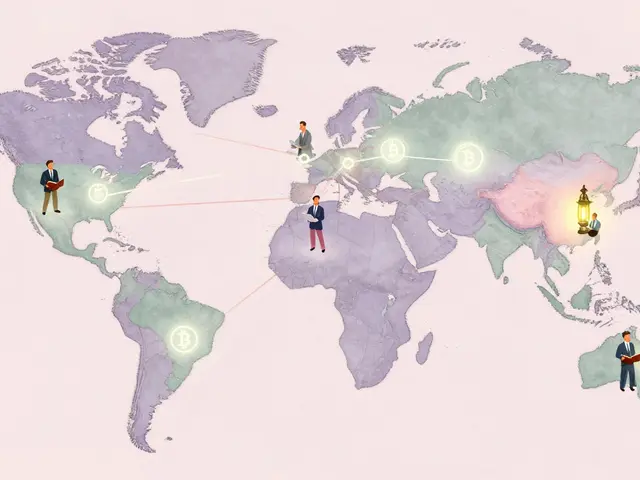
Common Reporting Standard (CRS) was developed by the OECD back in 2014. Unlike older treaties, CRS works on an automatic exchange basis. Imagine 100+ jurisdictions acting as a single network. When a bank in one country identifies a customer who is a tax resident of another participating country, they send that information to the local tax authority, which automatically forwards it to the resident's country.
This contrasts sharply with FATCA. While CRS is the global norm, Foreign Account Tax Compliance Act (FATCA) is distinctly American. Passed earlier as part of the HIRE Act, it demands foreign financial institutions report details on accounts held by U.S. citizens or green card holders. If those institutions say "no," U.S. payers withhold 30% of payments going to them.
Why Blockchain Entities Must Care Now
You might wonder why a decentralized protocol should worry about centralized tax laws. Here is the reality check: you cannot operate without entering the fiat rail. Every stablecoin minted, every exchange listing, and every payroll transaction eventually touches a regulated financial institution. That institution is bound by CRS and FATCA rules.
In 2026, the definition of a "financial account" has expanded significantly. It is no longer just a savings account. It increasingly covers custodial wallet services, centralized exchanges, and even certain staking platforms. When you onboard a client via Know Your Customer (KYC) checks, you are effectively becoming part of this reporting chain. You must collect tax identification numbers (TINs) and residential addresses just as a traditional bank would.
| Standard | Governing Body | Scope | Focus |
|---|---|---|---|
| CRS | OECD / G20 | Global (100+ Jurisdictions) | Tax Residents of Partner Countries |
| FATCA | U.S. Treasury | U.S. Specific | U.S. Persons Abroad |
| BEPS Action Plan | OECD | Multinational Enterprise Profits | Profit Shifting & Base Erosion |
Another critical piece of the puzzle is the Base Erosion and Profit Shifting (BEPS) framework. This targets multinational corporations shifting profits to low-tax zones. If your company utilizes complex token structures to route income through tax havens, BEPS Country-by-Country Reporting (CbCR) forces you to declare exactly where you earn revenue and where you pay taxes.

The Mechanics of Compliance for Web3
Satisfying these obligations requires more than just filing a return. It involves rigorous due diligence. Financial institutions, including those integrating blockchain rails, must verify self-certifications provided by clients. This means checking if a user claiming residence in Malta is actually living there.
To manage this, institutions obtain a Global Intermediary Identification Number (GIIN). The IRS maintains a public list of registered foreign institutions. Before settling any payment, US payers check this list. If your platform lacks a GIIN, you risk being cut off from the banking system entirely. This is why seeing "tax residency" fields in crypto wallet sign-ups has become standard practice.
Data flows continuously. Institutions must report account balances, interest earned, dividends, and proceeds from asset sales. In the context of crypto, this translates to reporting holdings in stablecoins or yield farming returns if the platform deems them reportable financial products. Automation tools are essential here. Manual tracking of hundreds of wallets is impossible. Companies rely on e-invoicing platforms and tax tech stacks to consolidate data across borders into standardized formats.

Risks and Penalties of Non-Compliance
Ignoring these standards is not a viable strategy. The penalties are severe and vary wildly by jurisdiction. In Europe, fines can exceed €50,000 for severe breaches. Some countries apply tiered penalties based on revenue percentages. Beyond direct fines, there is the threat of reputational collapse.
If you fail to validate self-certifications properly, local authorities can sanction you. For U.S.-linked operations, the penalty is the dreaded withholding tax. Non-compliant intermediaries face a 30% reduction on all payments received from U.S. sources. This includes licensing fees, service fees, and royalty payments.
Furthermore, jurisdictions undergo peer reviews by global forums. If your operating country fails to meet international transparency standards, it risks being labeled high-risk. Investors and partners often blacklist companies operating from such regions to protect their own supply chains from audit risks.
Expanding Horizons: Sustainability and ESG
We are currently seeing a convergence of tax and sustainability. The International Sustainability Standards Board (ISSB), launched by the IFRS Foundation, is merging financial transparency with climate disclosure. Their IFRS S1 and S2 standards require companies to disclose sustainability-related risks alongside financial data.
For blockchain projects, this is significant. Energy consumption figures, carbon footprint audits, and proof of environmental impact are becoming integral parts of corporate reporting. The ISSB has backing from the G20 and IOSCO. Essentially, hiding bad tax practices or unsustainable operational footprints is becoming harder as both fall under a unified scrutiny lens. Consolidation of frameworks like CDSB and SASB into the ISSB means fewer silos and more holistic reporting.
What triggers FATCA reporting for crypto exchanges?
FATCA is triggered when an account holder is determined to be a U.S. person. This includes citizens, residents, and certain green card holders. Exchanges must verify this status using passport data or tax residency certificates during the onboarding process.
Is CRS mandatory for small-scale DAOs?
It depends on whether the DAO is registered as a taxable legal entity and operates through banks. Purely on-chain activities with no fiat touchpoints may evade detection, but once you connect to a regulated exchange, the exchange is obligated to report.
What is the consequence of not having a GIIN?
Without a GIIN, U.S. payers cannot legally pay you without withholding tax. You will lose 30% of eligible payments, making cross-border business models unviable for U.S.-based clients.
How does BEPS affect profit shifting strategies?
BEPS Country-by-Country reporting forces multinationals to declare where income is generated. If you route income through a low-tax shell without economic substance, tax authorities can reclassify the location of profits and demand taxes elsewhere.
Do DeFi protocols need to follow these standards?
While DeFi protocols themselves are often anonymous, the points of interaction-bridges, off-ramps, and exchanges-are regulated. Users moving funds through these channels generate a traceable trail that aligns with reporting requirements.





The shift towards complete financial visibility is absolutely necessary for the health of the global economy. We cannot allow shadow banking systems to thrive unchecked. Every step taken by the OECD reinforces stability.
It feels like the walls are finally coming down everywhere we look. In Nigeria we see this push for transparency affecting local fintech heavily. Compliance is now the baseline for operation.
One must appreciate the rigor of the framework presented here. The distinction between FATCA and CRS remains a vital subject of study for compliance officers.
Honestly this whole thing is kinda wild 🤯. Why do they always want to know everything about our wallets? It feels like big brother watching us every second 😂.
They think they can track us through these methods but the truth is deeper than simple reporting standards suggest. The system is designed to fail the innocent while protecting the corrupt elite.
I really hope everyone reads this carefully because the stakes are high for exchanges. Losing that GIIN means game over for US payments right?
Exactly as stated above the government wants your money regardless of what you say. They will always find a way to take it eventually.
It is fascinating to consider how the concept of privacy has eroded over the last decade. We stand at a precipice where digital footprints are permanently etched in stone. The philosophical implications of mandatory self-certification touch upon the very definition of personal liberty in a digital age. If every transaction is reported then the autonomy of the individual is significantly curtailed by external oversight mechanisms. We must ask ourselves whether this safety comes at too great a cost to freedom. History shows us that when the state demands full transparency, dissent becomes difficult to organize effectively. Yet conversely this openness might foster a more equitable distribution of wealth globally. The tension between security and liberty is an ancient debate finding new life in blockchain protocols. Perhaps the middle ground lies in verifiable zero-knowledge proofs that satisfy auditors without exposing identities. Until then we are left with these intrusive frameworks shaping our economic reality.
This is just another tool for control.
Simple rules mean everyone knows the deal. No hidden tricks just clear lines on paper.
I beleive we can make this work if everyone helps each othr out! It is super exciting to see progress happening here 💪. Just dont forget to be kind while dealing with taxes guys.
Its interesting how the UK is handling this part of the framework. Lots of discussion needed soon i think regarding our local regulations
The legal requirements are clear and must be followed strictly. Deviations from the protocol invite severe penalties which no entity should risk.
Most people ignore the BEPS section until it hits their bank account directly. The fines alone are enough to shut down small ops immediately.
Cryptographic assets are treated as property by the IRS yet the reporting standards often lag behind traditional finance models. This creates friction during audits.
Sure and they tell you you can just go on-chain to hide assets lol. Good luck with that.
The colorful tapestry of regulation is woven tight indeed. We must embrace the light that shines through these gaps in understanding.
They are tracking everything just like the old surveillance states did. Dont trust the data brokers.
I feel so stressed reading about all these possible fines and penalties 😰. It seems like nobody is safe from being audited anymore really.
The semantic nuance of 'tax resident' versus 'physical presence' allows for significant arbitrage opportunities if structured correctly within the BEPS action plan parameters.
Good news is that tools exist to automate the heavy lifting for you. Setup your stack early to avoid headaches later.
Why does everyone act surprised when the government finds your money? It gets so dramatic in these forums sometimes.
You think you're clever routing profits but they have the numbers already. Don't play games.
We must remain proactive and stay ahead of the curve regarding these updates.