

What is Five Pillars Token (5PT)? A Complete Guide to Its Ecosystem
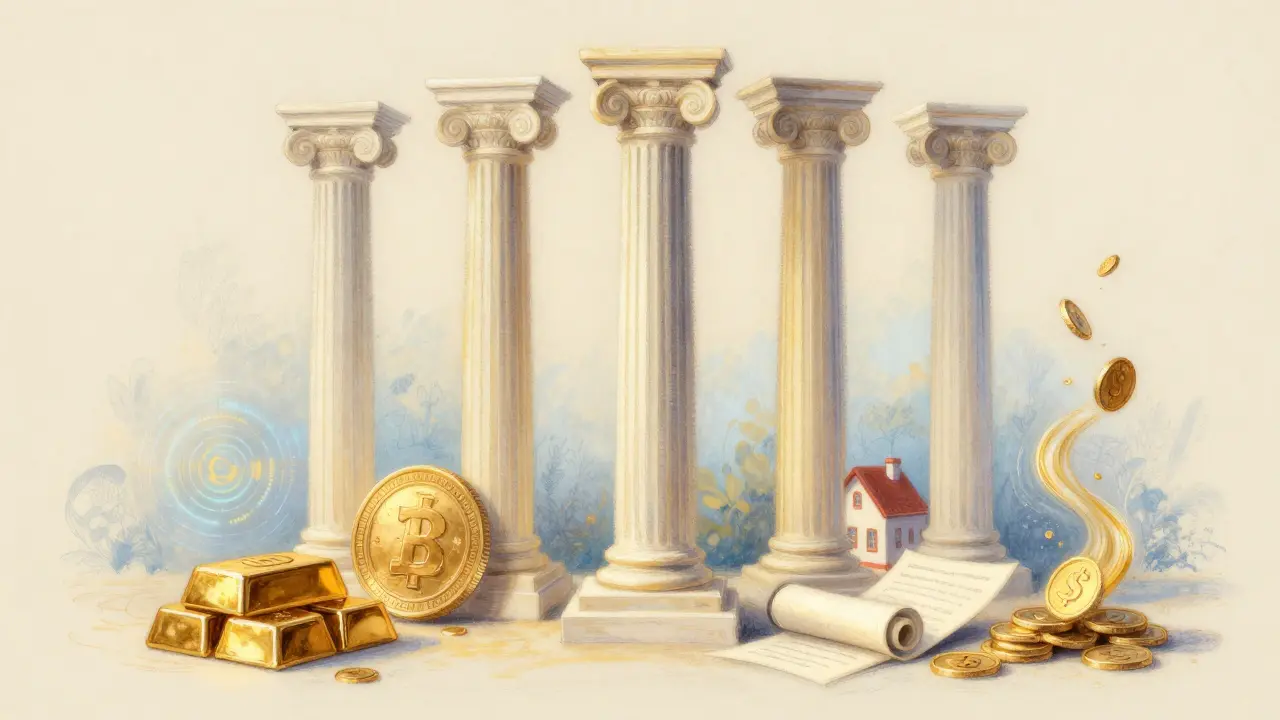
Imagine a cryptocurrency that isn't just based on hype or a fancy algorithm, but is actually tied to things you can touch, like gold or real estate. That is the core pitch behind Five Pillars Token is a deflationary, asset-backed cryptocurrency token built on the Binance Smart Chain (BSC) designed to blend decentralized finance with real-world value. Also known as 5PT, it aims to move away from the "pure speculation" model that plagues so many new coins by anchoring its value in five distinct asset classes.
But here is the catch: in the world of crypto, a promise of "asset backing" is only as good as the proof provided. While the project claims to be a game-changer for sustainable rewards, the actual data from tracking platforms is often contradictory. If you are looking into this coin, you need to understand how its unique burn mechanism works and where the potential risks lie before putting your money on the line.
The Five Pillars of Value
Most tokens derive value from demand and scarcity. 5PT attempts to add a layer of stability by integrating with five specific asset categories. According to the project's framework, these "pillars" are meant to provide a tangible floor for the token's value:
- Precious Metals: Integration with physical assets like gold or silver.
- Digital Currencies: Diversification across other established crypto assets.
- Real Estate: Connecting token value to property markets.
- Equity Participation: Stakes in business ventures.
- Transaction Fee-Based Ventures: Revenue generated from active business operations.
By spreading its backing across these areas, the project hopes to create a hedge against the extreme volatility typical of the Five Pillars Token ecosystem. However, it is worth noting that verifiable proof of ownership for these assets is not readily available in public audits, which is a critical point for any cautious investor.
How the Deflationary Staking Model Works
The most striking feature of 5PT is its approach to staking. In a typical staking setup, you lock your coins and earn more coins as a reward. 5PT does things differently. It uses a permanent burn mechanism to fight inflation.
When users stake their tokens in the 5PT ecosystem, 100% of those staked tokens are permanently removed from circulation. This is a bold move designed to shrink the total supply over time, theoretically pushing the price up as the remaining tokens become rarer. This process is handled by Smart Contracts is self-executing contracts with the terms of the agreement directly written into lines of code, which ensures that the burn happens automatically without human interference.
To make this more attractive, the project offers nine progressive staking pools. The more you engage and the longer you stay, the more you can potentially benefit from the referral-based network multipliers. It is essentially a race to see how much of the supply can be burned while rewarding the most loyal community members.
Technical Specifications and Network
If you are looking to trade or hold this coin, you need to know its technical DNA. 5PT is a BEP-20 Token is a token standard on the BNB Smart Chain that allows for the creation of smart contracts and easy integration with the Binance ecosystem. This means it is compatible with most BSC-supported wallets like Trust Wallet or MetaMask.
| Attribute | Details |
|---|---|
| Blockchain Network | Binance Smart Chain (BSC) |
| Token Standard | BEP-20 |
| Contract Address | 0xe6cae4094352a670c3eb0fcbda17c898b71c7f2a |
| Staking Model | 100% Permanent Burn |
| Audit Status | Claimed Triple-Audited |
The project claims that its core logic is immutable, meaning once the contract is deployed, the rules cannot be changed by a central authority. This is intended to prevent "rug pulls" or sudden changes in reward structures. Additionally, the project states that its liquidity is permanently locked, which is a standard security measure to prevent developers from draining the funds.
The Reality Check: Market Data and Red Flags
While the whitepaper sounds promising, the actual market data tells a more complicated story. If you check different tracking sites, you will see wildly different numbers. For example, as of late 2023, some platforms reported a 24-hour price drop of nearly 6%, while others showed a slight increase. This usually happens when a coin has low liquidity-meaning there aren't enough buyers and sellers to keep the price stable.
Another major red flag is the inconsistency in market cap and circulating supply. Some trackers list the circulating supply as zero, while others place it outside the top 2,000 coins. When data is this fragmented, it suggests that the token hasn't yet achieved wide adoption or a standardized reporting method across major exchanges.
Furthermore, the "triple-audited" claim is a bit vague. In the crypto world, an audit is only valuable if the auditing firm is reputable (like CertiK or Hacken) and the report is public. Without a link to a verified report, "triple-audited" is just a marketing term. If you're considering a large investment, this lack of transparency is something you cannot ignore.

Roadmap and Future Potential
The team behind 5PT isn't just stopping at a staking token. Their roadmap includes several features that could potentially move the coin from a speculative asset to a functional tool. They are planning the rollout of crypto debit cards, which would allow users to spend their rewards in the real world. They also want to launch a decentralized marketplace and a community-driven lottery system.
Whether these features ever materialize is the big question. Many projects announce ambitious roadmaps to attract investors but fail to execute. The success of 5PT depends entirely on whether they can actually integrate the real-world assets they claim to have. If they can prove the gold and real estate backing, they could carve out a niche in the asset-backed token market, which is projected to grow significantly by 2030.
How to Approach 5PT as an Investor
If you are tempted by the high rewards of the staking pools, you should treat 5PT as a high-risk, high-reward play. It is not a "safe" haven like Bitcoin or a stablecoin. Because of the low trading volume, getting in is easy, but getting out of a large position without crashing the price can be difficult.
A smart way to handle this is to only invest what you are completely comfortable losing. Focus on the utility: do you believe in the asset-backed model? Are you okay with the fact that staked tokens are burned and gone forever? If the answer is yes, the deflationary pressure could work in your favor. If you are looking for a stable investment, this is likely not the right fit.
What exactly is the "burn" in 5PT staking?
In Five Pillars Token, staking isn't just about locking coins to earn interest. When you stake 5PT, those tokens are permanently destroyed (burned). This reduces the total number of coins in existence, which is intended to increase the value of the remaining coins over time due to scarcity.
Is 5PT safe to invest in?
Like all low-cap tokens on the Binance Smart Chain, 5PT carries significant risk. While the project claims to be triple-audited and have locked liquidity, there is a lack of public, verifiable data regarding its team and the actual ownership of the real-world assets it claims to be backed by. Always do your own research and avoid investing more than you can afford to lose.
Which blockchain does 5PT use?
Five Pillars Token operates on the Binance Smart Chain (BSC) as a BEP-20 token. This makes it compatible with any wallet that supports the BSC network, such as MetaMask or Trust Wallet.
What are the "Five Pillars" the token is backed by?
The token claims to be anchored by five asset classes: precious metals (like gold), other digital currencies, real estate properties, equity participation in businesses, and ventures that generate transaction fees.
Where can I trade 5PT?
Since it is a BEP-20 token, it can typically be traded on decentralized exchanges (DEXs) that support the Binance Smart Chain, such as PancakeSwap, using its contract address: 0xe6cae4094352a670c3eb0fcbda17c898b71c7f2a.




Oh, how quaint. Another BSC token promising the moon and the stars based on 'pillars' that conveniently lack any verifiable documentation. I'm sure the anoymous developers are just forgetting to upload the deeds to their imaginary real estate empire.
Actually guys this is totaly the next big thing!! 🚀 The burn mechanism is genius because it makes supply drop fast and price go moon 📈 just do your research and dont be scared of the volatility lol!! 💎🙌
Asset-backed tokens offer a fascinating bridge between old and new wealth. The key here is transparency.
look at the liquidity ratios its a joke honestly if you actually analyze the order books on pancakeswap you see the spread is massive which means you cant exit any decent position without nuking the price floor and the triple audit thing is a complete fabrication since no reputable firm is listed in the whitepaper just marketing buzzwords to lure in retail traders who dont know how to read a contract
i feel you on the liquidity point... it's always a gamble with these low caps. the phillosophy of burning tokens to create scarcity is cool but if nobody actually wants the token then scarcity of something worthless is still worthless lol. just my two cents
I agree that the risk is high, but for someone just starting out, using a small amount to learn how BEP-20 staking works could be a useful exercise. Just treat it as a tuition fee for learning the ropes of DeFi!
Triple-audited? Right. 🙄 Probably audited by the dev's dog and two friends in a basement. The whole 'real estate' thing is just a front for a massive pump and dump scheme to fund some yacht in the Caymans 🏝️👁️
Let's try to keep the conversation positive! 😊 Even if there are risks, the idea of tying crypto to gold is really interesting. I hope they provide the proof soon! ✨
it just seems like a lot of noise and very little proof
It is utterly pedestrian to expect a project of this nature to provide an immediate audit to the masses. However, the lack of professionalism in the market data reporting is an absolute disgrace to the industry. One simply cannot invest in such chaos.
Typical western skepticism!! 🙄 This is how real innovation happens in the east. The pillars are strong and those who dont understand the vision are just too blind to see the future of finance. Most of you just want safe bets but real wealth comes from risk and national pride in new tech!!
I've been spending a lot of time thinking about the nature of value and whether we even need physical assets to back our digital dreams anymore, because in a way, the community's shared belief is the only real pillar that has ever truly mattered in the history of currency, though I suppose the practical side of wanting a gold-backed hedge is a very human response to the terrifying volatility of the current market cycle and it makes sense why people are drawn to this.
Omg can you imagine if the 'real estate' is actually just a parking lot in the middle of nowhere? 😂 That would be such a plot twist! I'm honestly just here for the drama of the crash!
Just stay safe guys. Only put in what you can lose.
If anyone is confused about the BEP-20 part, just remember to use a wallet that supports BSC or your funds will be stuck. It's a common mistake for beginners and it's a nightmare to fix.
I believe we should give the developers the benefit of the doubt while remaining cautious. It is always encouraging to see new attempts at stabilizing the ecosystem, and a structured approach to risk management will serve every investor well in the long run.