

What is Kujira (KUJI) crypto coin? Explained

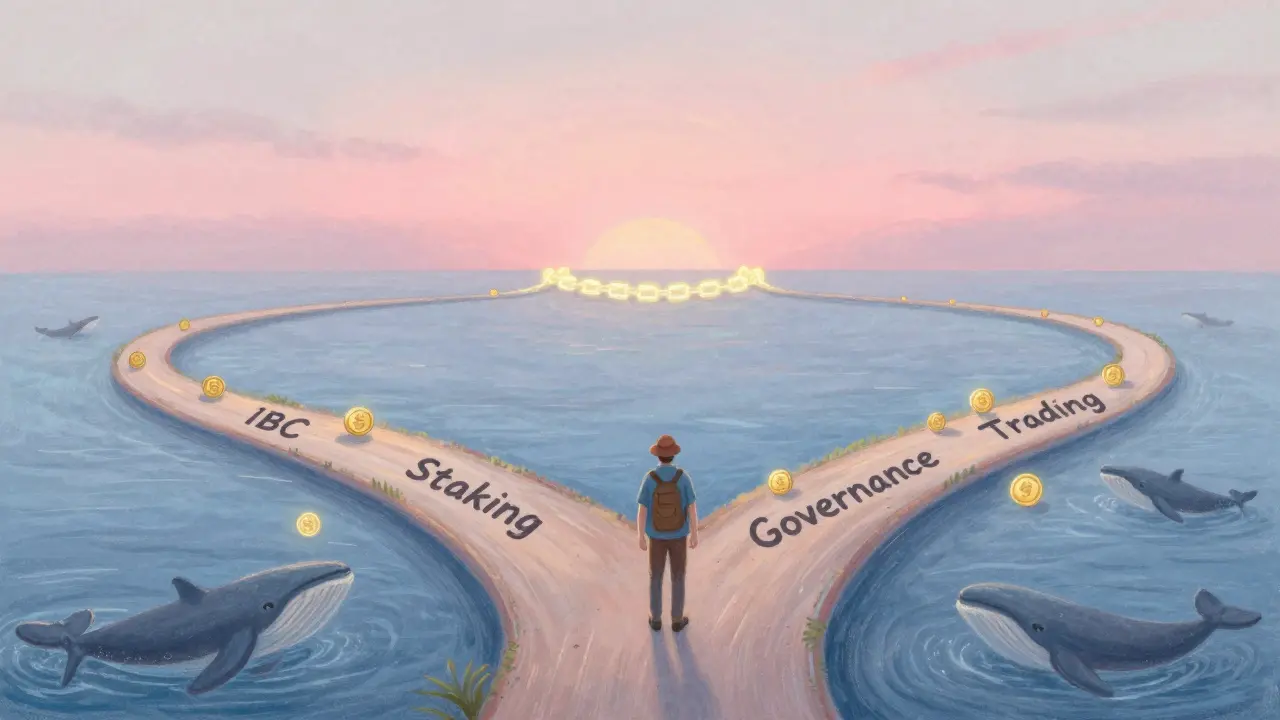
Kujira (KUJI) isn’t just another crypto coin. It’s a full-fledged Layer 1 blockchain built to make decentralized finance (DeFi) accessible to everyone - not just the big players. The name comes from the Japanese word for "whale," and its whole mission is simple: KUJI wants to turn everyday users into crypto whales. That means giving regular people the same tools, rewards, and control that institutional investors usually have.
How Kujira Started
Kujira didn’t start on its own chain. It began as an app on the Terra network, one of the biggest DeFi ecosystems before its collapse in May 2022. When Terra failed, the Kujira team didn’t shut down. Instead, they moved everything to a brand-new blockchain they built from scratch using the Cosmos SDK. By May 2022, Kujira launched its own independent network, cutting ties with Terra and becoming its own standalone system. This move wasn’t just a backup plan - it was a reset. They took what worked from Terra, fixed the flaws, and rebuilt with better security and governance.What Makes Kujira Different?
Most blockchains either let anyone launch apps (which can lead to scams) or tightly control what gets built (which kills innovation). Kujira found a middle ground. It uses a semi-permissioned governance model. That means anyone can propose a new DeFi app to run on Kujira, but the community votes on whether it gets approved. No centralized team makes the call. No anonymous devs can sneak in a shady contract. If the community doesn’t trust it, it doesn’t launch. This keeps the ecosystem clean without stifling creativity.Another standout feature is the on-chain scheduler. Think of it like a smart calendar that automatically runs financial tasks - like interest payments, liquidations, or staking rewards - without needing someone to trigger them manually. This cuts down on delays, reduces gas fees, and makes everything run smoother than on older blockchains.
The KUJI Token: More Than Just a Coin
KUJI isn’t just a trading asset. It’s the lifeblood of the whole network. Here’s what it actually does:- Staking: You can lock up your KUJI to help secure the network. In return, you earn rewards - similar to interest in a savings account, but for blockchain security.
- Fees: Every transaction on Kujira - whether swapping tokens, borrowing, or auctioning collateral - must be paid in KUJI. That means as more people use the platform, demand for KUJI goes up.
- Governance: Holders vote on proposals. Should a new lending app be added? Should the fee structure change? The KUJI holders decide. One token = one vote.
- Trading: KUJI is listed on multiple exchanges, but the most active trading pair is KUJI/OSMO on Osmosis, where daily volume regularly hits over $100 million.
As of February 2026, the KUJI price hovers around $0.031, with a circulating supply of about 79.7 million tokens. Its market cap sits near $2.5 million. While that’s small compared to Bitcoin or Ethereum, it’s a solid base for a niche DeFi chain focused on utility, not hype.

The Four Core Apps of Kujira
Kujira doesn’t just offer one tool. It’s a full DeFi suite built around four main apps:- FIN: A swap and trading platform that lets you exchange tokens across chains with low fees. It’s like Uniswap, but optimized for Cosmos.
- BLUE: A lending and borrowing app. Deposit your crypto, borrow stablecoins, or lend your assets to earn interest - all without a bank.
- ORCA: This one’s unique. It handles liquidations in a smarter way. When someone’s loan gets undercollateralized, ORCA auctions off their assets in a transparent, fair auction. This prevents fire sales and keeps the system stable.
- Finder: A dashboard that shows you everything happening on Kujira - which apps are popular, where liquidity is flowing, and what governance votes are up. No more digging through 10 different websites.
These apps work together. You can stake KUJI on FIN, use the rewards to borrow on BLUE, and if you default, ORCA automatically auctions your collateral. Finder shows you all of it in real time.
Cross-Chain Power
Kujira doesn’t live in a bubble. It’s built on the Cosmos ecosystem and uses the Inter-Blockchain Communication (IBC) protocol. That means you can move assets directly from Kujira to chains like Cosmos Hub, Osmosis, or even Terra 2.0 - no bridges, no wrapped tokens, no extra risk. This interoperability is a huge advantage. If you’re using DeFi on multiple chains, Kujira lets you manage everything in one place.Who Is Kujira For?
It’s not just for experts. If you’re new to DeFi, Kujira’s apps are designed to be intuitive. Finder gives you clear data. FIN has simple swap screens. BLUE explains loan terms in plain language. But it’s also powerful enough for pros. The on-chain scheduler, semi-permissioned governance, and IBC connectivity make it a favorite among developers building serious DeFi products.Some users use Kujira to earn yield. Others use it to hedge against market swings with stablecoin loans. A few even use ORCA’s auction system to buy discounted assets during market dips. There’s no single "right" way to use it - which is exactly the point.
Challenges and Risks
Kujira isn’t risk-free. Like all DeFi projects:- Smart contracts can have bugs - even if they’re audited.
- Market crashes can trigger mass liquidations, straining ORCA’s auction system.
- Regulators might target DeFi platforms in the coming years.
- If user growth stalls, KUJI demand could drop, affecting staking rewards and fees.
But Kujira’s team has shown they adapt fast. They’ve responded to every major DeFi crisis since 2022 with updates, fixes, and new tools. Their roadmap includes adding support for Ethereum-based assets and integrating with more Layer 2 networks.
Where to Buy KUJI
The most liquid place to trade KUJI is on Osmosis, where the KUJI/OSMO pair dominates. You can also find it on KuCoin, Gate.io, and Bitrue. Most users buy KUJI with OSMO, ATOM, or USDC. If you’re new, start with Osmosis - it’s built for Cosmos tokens and gives you direct access to Kujira’s ecosystem.Final Thoughts
Kujira (KUJI) is one of the few DeFi projects that actually delivers on its promise. It’s not trying to be Bitcoin. It’s not chasing meme coin hype. It’s a focused, community-run blockchain that gives real tools to real people. If you’ve ever felt like DeFi is only for the rich or the tech-savvy, Kujira is designed to change that. Its token isn’t just a currency - it’s a vote, a stake, and a key to a more open financial system.What is KUJI used for?
KUJI is the native token of the Kujira blockchain and serves four main purposes: staking to secure the network, paying transaction fees, voting on governance proposals, and trading on exchanges. It’s the glue that holds the entire Kujira DeFi ecosystem together.
Is Kujira built on Ethereum?
No, Kujira is not built on Ethereum. It’s a Layer 1 blockchain built on the Cosmos SDK and uses the Inter-Blockchain Communication (IBC) protocol to connect with other Cosmos-based chains like Osmosis and Cosmos Hub. This gives it faster transactions and lower fees than Ethereum-based DeFi platforms.
Can I stake KUJI?
Yes, you can stake KUJI directly through Kujira’s wallet or compatible wallets like Keplr. By staking, you help validate transactions on the network and earn rewards in KUJI. The annual percentage yield (APY) typically ranges between 8% and 15%, depending on network activity and validator performance.
How is Kujira different from Terra 2.0?
Kujira and Terra 2.0 are separate projects. Kujira started as an app on the original Terra chain but moved to its own blockchain after Terra’s collapse. Unlike Terra 2.0, which focuses on stablecoins and algorithmic money, Kujira is a full DeFi ecosystem with lending, swapping, auctions, and governance - all built on Cosmos. Kujira doesn’t issue its own stablecoin and avoids the risks tied to algorithmic stablecoin models.
Is Kujira safe to use?
Kujira’s core smart contracts have been audited by reputable firms like CertiK and Hacken. The semi-permissioned governance model reduces the risk of malicious apps being added. However, like all DeFi platforms, there’s always some risk - including smart contract bugs, market volatility, and liquidity gaps. Never invest more than you can afford to lose.





Kujira's whole vibe is like that one friend who shows up to the party with a fully stocked fridge and zero ego. No hype, no flash - just solid tools that actually work. FIN swaps are smooth, BLUE is stupid simple, and ORCA’s auction system? Chef’s kiss. 🤌
I started with just 50 KUJI to stake and now I’m hooked. The APY’s solid, the interface doesn’t make me want to cry, and Finder shows me everything without me having to open 7 tabs. 🌱✨
I didn’t think I’d care about on-chain schedulers but now I can’t unsee how elegant they are. It’s like having a personal assistant who never sleeps and never asks for a raise.
The semi-permissioned governance model is a paradigm shift in DeFi infrastructure. It introduces a non-centralized, permissionless yet curated composability layer that mitigates MEV and front-running vectors while preserving protocol sovereignty.
They say it’s not Terra 2.0 but let’s be real - it’s just Terra with better PR. Wait till the next bear market hits and see how fast ORCA collapses.
Kujira’s not just a blockchain - it’s a middle finger to the DeFi bros who think you need a PhD in Solidity to earn 10%. I staked my KUJI, borrowed USDC, and bought a damn Tesla with it. No bank. No permission. Just code and guts.
i read this whole thing and still dont know if kujira is good or not lol. i just know i like the name. whale energy. 🐋
This is the kind of project that makes me believe in crypto again. No rug pulls, no empty whitepapers, no ‘community-driven’ buzzwords hiding a dev wallet full of 20M tokens. Kujira’s got bones. Real ones.
If you’re new to DeFi, start here. FIN’s UI is cleaner than my mom’s kitchen after she’s done cooking. BLUE explains loans like you’re 15. ORCA’s auctions are fair. And Finder? It’s like Google Maps for your crypto life.
you think this is safe? bro the whole cosmos chain is just one big phishing farm. they dont even know who controls the validators. kujira? more like kujira-ruined-my-eth-portfolio
I’ve seen this movie before. Another ‘community-driven’ chain built on Cosmos. By the time retail investors wake up, the whales will have already dumped. KUJI at $0.03? Cute. It’ll be $0.005 by Q3.
The philosophical underpinnings of Kujira’s governance model are commendable. It represents a non-hierarchical, epistemic democracy where token-weighted consensus replaces centralized authority. However, one must question whether such a system can withstand the pressures of asymmetric information and coordinated manipulation.
LMAO this is just another ‘we’re not Terra’ project. You think ORCA won’t melt down during a 30% dump? Wake up. This is a meme with a whitepaper. KUJI is a lottery ticket.
So Kujira’s built on Cosmos, uses IBC, has a scheduler, semi-permissioned governance, four apps, and zero stablecoin? That’s not a DeFi platform - it’s a thesis. And honestly? I’m here for it.
I just used FIN to swap KUJI for OSMO, then staked it on BLUE. Took 90 seconds. No gas wars. No confusing menus. This is what DeFi should feel like.
I’ve watched this space for years. Every ‘community-driven’ chain dies. Every ‘innovative’ feature gets copied. Every ‘clean’ ecosystem gets flooded with spam tokens. Kujira? It’s just the next graveyard.
I’ve been staking KUJI since launch. APY’s been steady, the devs actually respond to feedback, and ORCA saved me last bear market. If you’re scared of DeFi, try this first. It’s the nicest place in the whole crypto jungle. 🌿❤️