

Bear Market Bottom: How to Recognize It in Crypto and Blockchain Markets
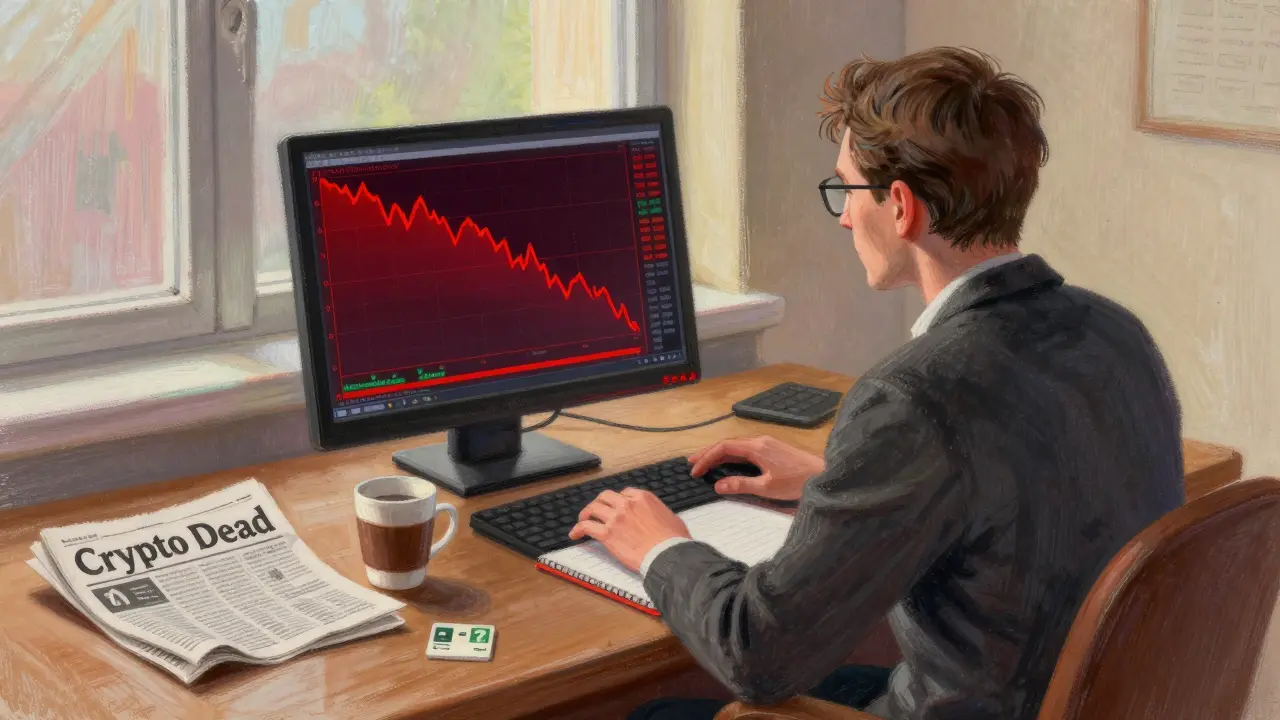
When the market crashes, everyone panics. Prices drop. Social media explodes with fear. You check your portfolio and wonder: Is this the bottom? Or is it just getting worse? In crypto and blockchain markets, where volatility is the norm, recognizing a true bear market bottom isn’t about luck-it’s about spotting patterns. And yes, it’s harder than it sounds. But you don’t need to predict the future. You just need to recognize when the conditions line up.
What a Bear Market Bottom Really Means
A bear market bottom isn’t just the lowest price you’ve seen. It’s the moment when selling pressure dries up and buyers-real ones, not just bots-start stepping in. In traditional markets, a bear market is defined as a drop of 20% or more from recent highs. In crypto? It’s often worse. Bitcoin has dropped over 80% in past bear cycles. Ethereum? Same story. The key isn’t the percentage. It’s the behavior behind the drop. Most people think the bottom is when prices stop falling. That’s wrong. The bottom is when people stop selling out of fear. When the last person who was holding onto their coins finally gives up and sells. That’s when the real shift begins.Sign #1: Earnings and On-Chain Activity Start to Stabilize
In stocks, analysts watch corporate earnings. In crypto, you watch on-chain data. Look at Bitcoin’s transaction volume. Look at the number of active addresses. Look at how much ETH is being staked or transferred. If these numbers keep falling for months, the market is still in decline. But when they stop dropping-and even start creeping up-you’re getting a signal. Take the 2022-2023 bear market. Bitcoin’s daily active addresses fell below 500,000. Then, in late 2023, they hovered around 650,000 for three straight months. No big spike. Just steady stability. That’s not a rally. But it’s not a collapse either. It’s a sign that the network isn’t dying. And that’s the first clue a bottom might be near.Sign #2: The Yield Curve and Interest Rates Are Turning
You might think this doesn’t apply to crypto. But it does. Crypto doesn’t exist in a vacuum. When central banks raise rates to fight inflation, money leaves risky assets like Bitcoin and Ethereum. When rates start to fall-or even just stop rising-that’s a huge shift. In early 2024, the U.S. Federal Reserve signaled it was done hiking. By mid-2025, markets started pricing in rate cuts. That’s when institutional money began creeping back into crypto. Why? Because holding cash became less attractive. Bonds didn’t pay enough. And crypto, even at low prices, looked like a better bet. Look at the 10-year Treasury yield. If it’s falling while the Fed funds rate is still high, that’s an inverted yield curve. It’s a warning sign for recession. But when the curve starts to flatten-or better yet, normalizes-that’s when recovery often begins. In crypto, this shift usually shows up 3-6 months later.
Sign #3: Sentiment Is at Rock Bottom
Here’s the ugly truth: when everyone is done with crypto, that’s when you should start paying attention. In 2022, Twitter was full of memes about Bitcoin hitting $10,000. In 2023, it was full of people saying, "Crypto is dead." Reddit threads were filled with posts like, "I’m done. Sold everything. Never again." YouTube channels that used to post daily price analysis went quiet. Podcasts stopped talking about crypto. That’s not just bad news. That’s a contrarian signal. When even die-hard believers stop talking about it, when no one wants to hear about blockchain anymore-that’s when the crowd has given up. And history shows: when the crowd gives up, the smart money starts buying. There’s a tool called the Crypto Fear & Greed Index. When it hits 10 or 15, you’re in extreme fear territory. That’s not a reason to sell. That’s a reason to look. Because in the last three major bear markets, the bottom always happened when the index was below 20.Sign #4: Valuations Are Attractive Again
In 2021, Bitcoin’s price-to-earnings ratio (if you could even calculate it) was absurd. People were paying $100,000 for every dollar of network value. Now? Look at Bitcoin’s Market Value to Realized Value (MVRV) ratio. It’s below 1.0. That means the average holder is underwater. That’s rare. Same with Ethereum. Its price-to-staked-ETH ratio hit 1.8 in 2025. That’s the lowest since 2019. When the price of ETH drops below the cost to stake it, you know miners and long-term holders aren’t selling. They’re holding. And that’s a sign of strength. Don’t chase cheap coins. But if you’ve been waiting for a chance to buy Bitcoin at 60% off its all-time high? That’s not speculation. That’s valuation-based investing.Sign #5: Volume Spikes on Small Price Gains
Technical analysis gets a bad rap in crypto. But one thing it does well: spot volume shifts. A bear market bottom often looks like this: price drops 5% one day. Then it bounces back 2%. Volume spikes. Not a little. A lot. That’s not retail traders. That’s institutions. That’s whales. That’s people with deep pockets buying because they believe the worst is over. Look at Bitcoin’s volume on March 2025. It was 10x higher than the 30-day average on a 3% price gain. That’s not random. That’s accumulation. And accumulation before a rally is the classic pattern.
Sign #6: Multiple Markets Show the Same Pattern
One market moving? Could be noise. But if Bitcoin, Ethereum, Solana, and even DeFi tokens all show stabilization at the same time? That’s convergence. In 2018, Bitcoin bottomed in December. But Ethereum didn’t bottom until February 2019. Then, DeFi tokens like UNI and AAVE didn’t start recovering until mid-2020. That’s not a coincidence. Different assets have different cycles. But when they all stop falling together? That’s the real bottom forming. In 2025, we saw Bitcoin, Ethereum, and Polygon all hit multi-month lows within weeks of each other. Then, all three started making higher lows. That’s the kind of multi-asset confirmation that separates a bounce from a real reversal.What Doesn’t Work
Don’t wait for a 100% rally to confirm the bottom. By then, you’ve missed it. Don’t rely on a single indicator. No one tool tells you the truth. Not the RSI. Not the moving average. Not Elon Musk’s tweet. And don’t think you need to time it perfectly. You don’t. You just need to know when the conditions are right to start buying-gradually. Dollar-cost averaging into a market that’s showing stabilization, rising on-chain activity, and falling fear? That’s how you win.History Doesn’t Repeat. It Rhymes.
Since 2009, crypto has had four major bear markets. Each one felt endless. Each one had people saying, "This time it’s different." And each time, the bottom came. Not because someone predicted it. But because the signals lined up. The bottom isn’t a single event. It’s a process. It’s when fear fades. When volume returns. When value reappears. When the last person sells-and the first smart buyer steps in. You won’t know it happened until after it’s over. But if you’re watching the right things, you’ll know when it’s getting close.Can you predict exactly when a bear market bottom will happen?
No. Not even the best analysts or hedge funds can predict the exact date. Markets are too complex. But you can identify the conditions that make a bottom likely. Look for convergence: falling fear, stable on-chain activity, improving volume, and valuation recovery. When multiple signals align, the odds shift in your favor.
Should I buy crypto right at the bottom?
You don’t need to buy at the absolute bottom. In fact, trying to do that often leads to losses. Instead, start buying in stages. When you see stabilization in price, rising volume on small gains, and falling fear, begin allocating small amounts. Spread your purchases over 3-6 months. That’s how professionals do it.
How long do bear market bottoms usually take to form?
In crypto, it can take 3 to 12 months. Non-recessionary bear markets (like in 2016) bottomed in under 6 months. Recession-driven ones (like 2018 and 2022) took 9-18 months. The key is patience. Don’t rush. Let the market show you the signs instead of forcing a call.
What’s the best indicator for crypto bear market bottoms?
There’s no single best indicator. But the most reliable combo is: 1) Crypto Fear & Greed Index below 20, 2) On-chain transaction volume stabilizing or rising, 3) Bitcoin’s MVRV ratio below 1.0, and 4) Volume spiking on small price increases. When three or more of these happen together, you’re in the zone.
Do altcoins bottom at the same time as Bitcoin?
Usually not. Bitcoin leads. Altcoins follow. In past cycles, Bitcoin started recovering 6-12 months before most altcoins. So if Bitcoin is showing signs of a bottom but your altcoins are still falling, don’t panic. Wait. The altcoin season typically kicks in after Bitcoin has gained 30-50% from its low.







I remember sitting there in late 2022 thinking I'd never touch crypto again. Then I started checking on-chain data just out of habit. Noticed addresses holding steady. Didn't jump in. Just watched. A few months later, I bought a little. Not because I knew it was the bottom. But because the fear had stopped being loud. Now I'm glad I waited. No regrets.
The notion that a bottom is defined by the last seller is a romanticized fiction. Markets are not psychological dramas. They are liquidity events shaped by macro capital flows and institutional order flow. You're mistaking correlation for causation.
This is so true!!! The moment you stop screaming about crypto dying... that's when the real magic begins!!! I've been watching Bitcoin's MVRV like a hawk!!! When it dipped below 1.0, I felt it in my bones!!! It's not about timing!!! It's about sensing the shift!!! The market whispers before it shouts!!!
I love this breakdown 🙌 Especially the part about volume spiking on small gains. That’s when I started buying small amounts last cycle. Didn’t go all in. Just dipped a toe. Now I’m glad I did. Patience pays.
i just wanna say i read this whole thing and its sooo true!! i sold all my eth in 2022 and regretted it every day!! then i saw the onchain data start to creep up and i bought back in slowly!! its not about being right its about being consistent!! 🤝🙌
I'm from the Philippines. We don't have banks that work. Crypto saved my family. When prices crashed, I kept buying. My mom said I was crazy. But I saw people still sending money through it. That's when I knew: it's not dead. It's just resting.
The entire premise of this article is fundamentally flawed. You're anthropomorphizing market behavior. There is no 'last seller.' There are only margin calls, liquidations, and algorithmic rebalancing. Sentiment indices are meaningless noise. Real data is in futures funding rates and open interest shifts. You're reading tea leaves and calling it analysis.
I've been in this game since 2017. I've seen three bear markets. The pattern never changes. The panic always peaks when the news is worst. The real buying happens when no one's talking about it. I don't watch price. I watch wallet activity. If the number of addresses sending more than 1 BTC is stable? That's your signal. Not the Fear & Greed Index. Not Elon. Just quiet, consistent movement.
It is of paramount importance to recognize that the formation of a bear market bottom constitutes a multi-factorial convergence of macroeconomic, on-chain, and behavioral indicators. One must not rely upon anecdotal sentiment or single-variable metrics. Rather, a holistic, statistically rigorous framework must be employed. The stabilization of transaction volume, coupled with a normalized yield curve and a reduction in the MVRV ratio, collectively suggest a transitionary phase. Furthermore, the temporal lag between institutional capital reallocation and retail sentiment recovery must be carefully accounted for. One cannot expect immediate price appreciation upon the observation of stabilization; rather, one must engage in disciplined, incremental accumulation over a 6- to 12-month horizon. This is not speculation. This is prudent, evidence-based portfolio management.
I've been waiting for this. Everyone's talking about 'signs' like it's astrology. The only thing that matters is volume on small rallies. That's institutional accumulation. No one else has that kind of cash to move markets on a 3% bounce. If you're not watching volume spikes, you're not watching the market. You're watching memes.
I’ve been in crypto since 2015. I’ve seen this movie. The bottom isn’t a moment. It’s a silence. The moment the noise stops. The forums go quiet. The influencers disappear. The news stops. That’s when you start. Not because you’re smart. Because you’re patient.
I'm sorry, but this article is so... amateurish. You're using terms like 'smart money' like it's a magic spell. Who even defines that? The top 0.1% of wallets? The whales? The institutions? There's no consensus. And you're treating sentiment indices like gospel. Please. The entire framework is built on confirmation bias. I've seen this exact 'pattern' fail three times before. It's not a signal. It's a trap.
This made me feel so much better. I was so scared I sold my Bitcoin at $28k. Then I saw this. I started buying again last month. Just a little bit every week. It’s not about being rich. It’s about not giving up. You’re not alone. We’re all just trying to figure it out.
I didn't believe this until I saw the volume spike on March 12th. 10x normal volume on a 3% up day? That's not retail. That's banks. That's hedge funds. I bought my first 0.1 BTC that day. Not because I knew it was the bottom. But because I knew someone with way more money than me did.
Stop pretending this is science. You're just describing patterns that worked in hindsight. What if the next cycle doesn't follow? What if the Fed keeps rates high? What if the US dollar strengthens? You're giving people false confidence. This isn't investing. It's superstition.
Y’all are overthinking this. The bottom is when your ex texts you out of nowhere saying ‘I miss crypto.’ That’s it. That’s the signal. If you’re still holding, you’re already winning. If you sold? You’re probably still crying into your ramen. Welcome to the club. Now go buy a little. Just a little. We’re all broke here.
What if the MVRV ratio stays below 1.0 for 18 months? What if volume never spikes? What if Bitcoin just... stagnates? You’re treating historical patterns like laws. But crypto isn’t a pendulum. It’s a chaotic system. You can’t predict it. You can only prepare. And prepare differently this time.