

Understanding Different Hash Algorithms Used in Cryptocurrencies
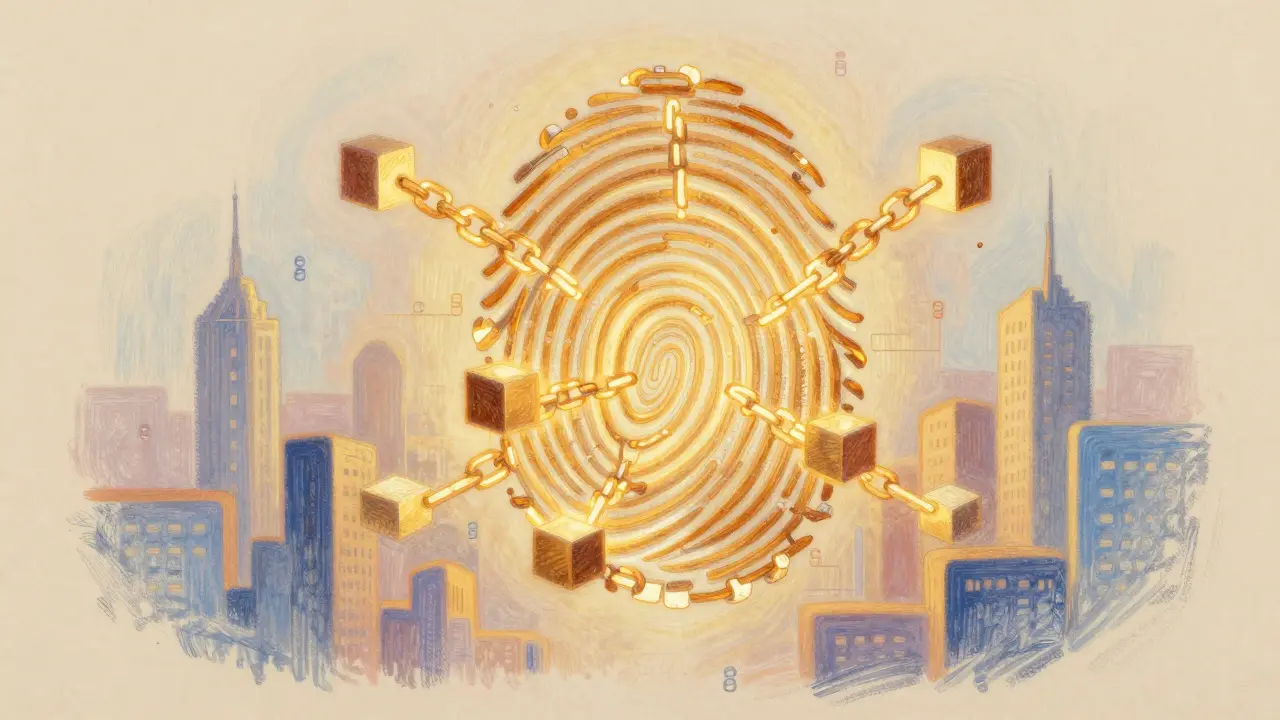
Security isn't magic, and every single cryptocurrency you hold relies on a digital fingerprint to keep your assets safe. When people talk about hash algorithms, they aren't discussing abstract math-they're looking at the lock and key system that powers the entire blockchain economy. If you've ever wondered why Bitcoin behaves differently from Ethereum or Litecoin, the answer lies buried in the code that processes transactions behind the scenes. These mathematical functions determine everything from how fast a network moves to whether a hacker can steal your funds.
We are living in March 2026, and despite years of debate, the choices made over a decade ago still define which coins are fast, which are private, and which require massive industrial farms to secure. Understanding these differences helps you make smarter decisions when investing or building on top of these networks.
The Foundation: What Actually Is a Hash Function?
At its core, a cryptographic hash function is a mathematical tool that takes any size of input-like a transaction record-and spits out a fixed-length string of characters called a hash. Think of it like a food processor. You can put in a whole apple, a carrot, or a bag of flour, but the machine outputs pureed mush of the same consistency every time. The difference is, with cryptography, you can't reverse the process. If someone sees the hash, they cannot recreate the original input.
This property creates a chain of trust. When Block A is linked to Block B via their hashes, anyone tampering with Block A changes its hash instantly, breaking the link. Without this mechanism, a distributed ledger like Bitcoin would fall apart immediately.
SHA-256: The Old Guard of Digital Gold
You have almost certainly heard of SHA-256. It stands for Secure Hash Algorithm 256-bit. Developed by the NSA and standardized by NIST, this was Satoshi Nakamoto’s choice back in 2009. Even today, it secures roughly 45% of the total cryptocurrency market capitalization.
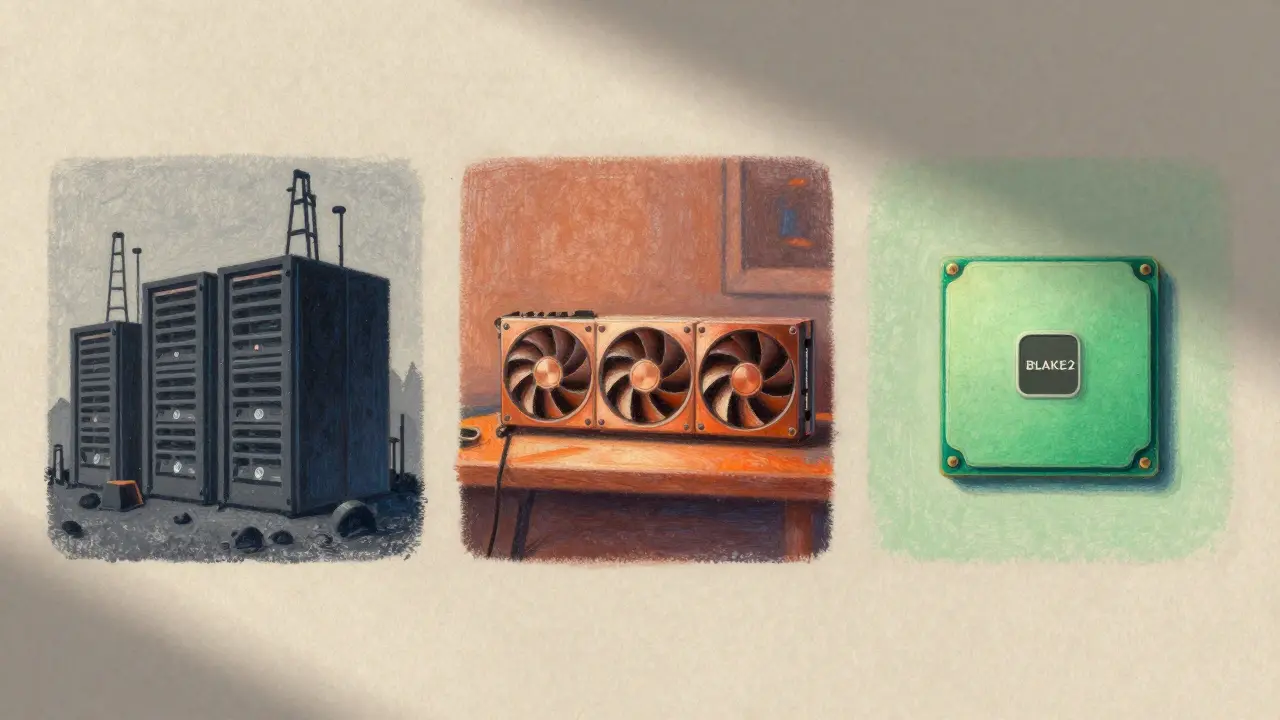
Why does Bitcoin stick with it? It’s battle-tested. While newer options exist, SHA-256 offers extreme security against collisions where two different inputs produce the same output. However, it comes with a major catch: efficiency. Because SHA-256 requires minimal memory to compute, specialized hardware known as ASIC Miners (Application-Specific Integrated Circuits) can calculate billions of hashes per second.
In 2023, a Bitmain Antminer S19 XP Hydro could churn out over 300 terahashes per second. This creates centralization risks because only large industrial facilities can compete profitably. Energy consumption is also high; data from the Cambridge Bitcoin Electricity Consumption Index indicates SHA-256-based chains consume around 950 kilowatt-hours per 1,000 transactions. For a store-of-value asset like Bitcoin, this stability and security often outweigh the environmental cost in the eyes of holders.
Keccak-256 and the Ethereum Ecosystem
When Vitalik Buterin launched Ethereum, he didn't choose SHA-256. Instead, he selected Keccak-256. This algorithm is part of the SHA-3 family, selected by NIST in 2012 after a five-year global competition involving dozens of submissions.
What makes Keccak special? It uses a "sponge construction" method. Unlike the Merkle-Damgård structure used by older algorithms, a sponge absorbs data and squeezes it out. This provides unique resistance to length extension attacks, which are vital for preventing specific types of cryptographic exploits in smart contract environments.
It is important to clarify a common misconception: Ethereum uses Keccak-256, not the standard NIST SHA3-256. They differ slightly in padding rules. This intentional incompatibility prevents cross-chain hash collision attacks, giving the network an extra layer of safety. Recent analysis suggests Ethereum may transition to a standardized SHA-3 variant in the coming years, potentially by late 2026, to maintain compliance with global digital identity regulations like the EU's eIDAS 2.0.
Scrypt: Fighting the Giants
Not everyone wants ASICs dominating their network. When Charlie Lee created Litecoin in 2011, his goal was to prevent the same centralization seen in Bitcoin. He implemented Scrypt, a memory-hard algorithm designed to punish those without enough RAM.
To mine Scrypt efficiently, your machine needs to access large amounts of random-access memory quickly. Historically, this allowed regular users with powerful GPUs (graphics cards) to mine alongside big players. Scrypt requires significantly more memory bandwidth than SHA-256. While ASICs eventually targeted Scrypt too, changing the landscape around 2014, the design philosophy remains relevant for privacy-focused networks that want to resist concentrated mining power.
This approach changed how we view Proof-of-Work security. It proved that requiring memory access, not just raw calculation speed, could level the playing field-at least for a while. Developers looking for ASIC-resistance in 2026 often revisit Scrypt derivatives to ensure network decentralization.
BLAKE2: The High-Speed Option
If you prioritize speed above almost anything else, look at BLAKE2b. Created by a team including Jean-Philippe Aumasson, this algorithm beats SHA-256 hands down on performance. Benchmarks from 2023 show BLAKE2 processing at 1,200 megabytes per second, compared to SHA-256's 600 megabytes per second on similar Intel processors.
Which coin actually uses this? Nano. Since Nano aims to provide fee-less, instant payments, it cannot afford slow verification times. Using BLAKE2 allows Nano nodes to confirm transactions within fractions of a second. Energy-wise, this is massive news. BLAKE2-based networks consume approximately 0.05 kWh per 1,000 transactions, drastically lower than Bitcoin’s 950 kWh.
The trade-off? It lacks the historical reputation of SHA-256. While cryptographers haven’t found practical ways to break it, developers often prefer the "known quantity" of older standards for long-term value storage.
Equihash: The Privacy Standard
Zcash utilizes a different beast entirely: Equihash. This algorithm was born from a need to balance anonymity with security. It relies heavily on finding specific solutions in vast computational trees, demanding significant memory (around 140MB per instance).
The theory was that this would be too hard for efficient ASICs to build, keeping mining decentralized among GPU owners. Reality check: By late 2022, Innosilicon released the Z15 miner capable of 1,500 sol/s, effectively ending the era of GPU-friendly Equihash mining. However, Equihash remains critical for Zcash because it supports zero-knowledge proofs essential for the network's privacy features. The algorithm ensures that verifying transactions doesn't compromise the confidentiality of the data inside.
| Algorithm | Primary Coin | Hash Output Size | Average Processing Time | Key Characteristic |
|---|---|---|---|---|
| SHA-256 | Bitcoin | 256-bit | 600-800 nanoseconds | Maximum Security |
| Keccak-256 | Ethereum | 256-bit | 1,000 nanoseconds | Sponge Construction |
| Scrypt | Litecoin | 256-bit | Memory Hard | GPU Friendly |
| BLAKE2b | Nano | 256-bit | 400 nanoseconds | Highest Speed |
| Equihash | Zcash | Variable | 5,000+ nanoseconds | Privacy Focused |
The 2026 Quantum Concern
By March 2026, the conversation shifted heavily toward quantum computing. Google demonstrated a 70-qubit processor in 2023, and timelines for practical quantum threats are accelerating. Bruce Schneier noted in 2022 that harvesting attacks could compromise blockchains within a decade.
This puts older algorithms under scrutiny. SHA-256 remains secure against classical computers, but its theoretical resistance drops with quantum capabilities. SHA-3 offers better theoretical resistance due to its structure, leading to recommendations from Dr. Ari Juels to transition protocols sooner rather than later. While we aren't facing immediate collapse, forward-thinking projects in 2026 are designing systems with "algorithm agility," ensuring they can swap their hashing engine before a supercomputer breaks the current standard.
Choosing the Right Tool for Your Project
If you are developing a new cryptocurrency or token in 2026, you cannot just copy-paste code. You need to align the algorithm with your goals. Are you building a settlement layer? Stick with the security reputation of SHA-256 or SHA-3. Are you building a fast payment rail? Look at BLAKE2. Do you need privacy guarantees? Equihash is your starting point.
Implementation is rarely plug-and-play. Developer communities report that RIPEMD-160, often combined with SHA-256 in Bitcoin address generation, causes bottlenecks due to slower speeds. Meanwhile, libraries like OpenSSL dominate SHA-256 support, whereas newer algorithms sometimes lack robust documentation. Always verify that the library you use executes in constant time to avoid timing attacks that could leak secret keys during computation.
Which hash algorithm is the most secure today?
While multiple algorithms offer strong security, SHA-3 (specifically Keccak-256) is generally considered to have superior theoretical properties against emerging quantum threats compared to older SHA-2 variants. However, SHA-256 remains extremely secure for current classical hardware contexts due to its decades of validation.
Can I switch my Bitcoin wallet to use SHA-3 instead of SHA-256?
No, you cannot unilaterally change the consensus algorithm of the Bitcoin network. Every node in the network agrees on the rules. Switching the hash function would require a hard fork and agreement from all participants, which has never occurred for Bitcoin.
Why does Nano use BLAKE2 instead of SHA-256?
Nano prioritizes instant transaction confirmation and ultra-low energy consumption. BLAKE2 offers significantly faster processing speeds and higher throughput than SHA-256, making it ideal for high-volume payment systems where latency matters.
Are ASIC miners bad for cryptocurrency health?
Opinions vary. ASICs concentrate mining power, potentially threatening decentralization if owned by few entities. However, they also provide immense security through high hash rates that prevent double-spending attacks. Some networks intentionally use memory-hard algorithms like Equihash to mitigate ASIC dominance.
Will quantum computers break crypto in 2026?
Not necessarily. Current projections suggest practical quantum attacks on SHA-256 are likely 10-15 years away. However, organizations are already testing post-quantum cryptographic suites to prepare for eventual migration, ensuring longevity of digital assets.







These differences matter for long term holders who want safety.
quantum computers are coming for our hashes soon and i am worried about it we have seen progress on 70 qubit machines already and that feels scary for the industry bitcoin relies on sha-256 which might break sooner than people think developers say they are planning updates but history shows blockchain changes are hard nobody likes forks when consensus splits everyone loses trust value drops when investors panic about security risks we need to see more work on post quantum signatures before it is too late maybe the transition will happen smoothly this time around hopefully engineers have tested these new algorithms thoroughly enough to prevent disasters during the switch phase migration paths seem vague right now in most docs we should demand more transparency from core teams regarding timeline expectations for such a major change nobody wants a replay attack scenario to ruin their life savings stored on ledger networks security must remain absolute priority over speed
Love this update 🌟 so true about quantum threats 😱
The mathematical foundation requires rigorous analysis rather than hype surrounding newer standards older methods offer stability that newer protocols lack
Security trumps speed every time.
I totally agree with the points raised here about the memory hardness factor being crucial for decentralization goals.
Huge fan of Zcash privacy features 🔒🔑 Equihash is underrated imo 💯🚀
Everyone acts like Equihash is magic while ignoring how easily ASICs broke it once again reality check please
Nice breakdown of BLAKE2 performance stats
The philosophy behind choosing hash functions reveals the intent of the network designers more than raw numbers alone
Crypto-zombies still cling to SHA-256 despite clear entropy issues visible in recent chain analysis studies
There is always room for innovation in the space so let us keep building better systems together
We should support projects testing new algorithms before rolling them out mainnet wide for maximum safety
You cannot ignore the energy costs associated with SHA-256 chains moving forward this is becoming unsustainable
I tinkering with scrypt setups on my gpu rig lately and it runs warm
This is absolutely devastating for small miners who cannot afford the newest hardware required for optimal speeds
Technical specifications define boundaries we must respect during implementation phases
Simple choices often lead to better outcomes for adoption rates
Waiting for the dust to settle before making moves on these networks seems prudent given the volatility involved