

Food Safety Traceability with Blockchain: How It Stops Contamination in Seconds
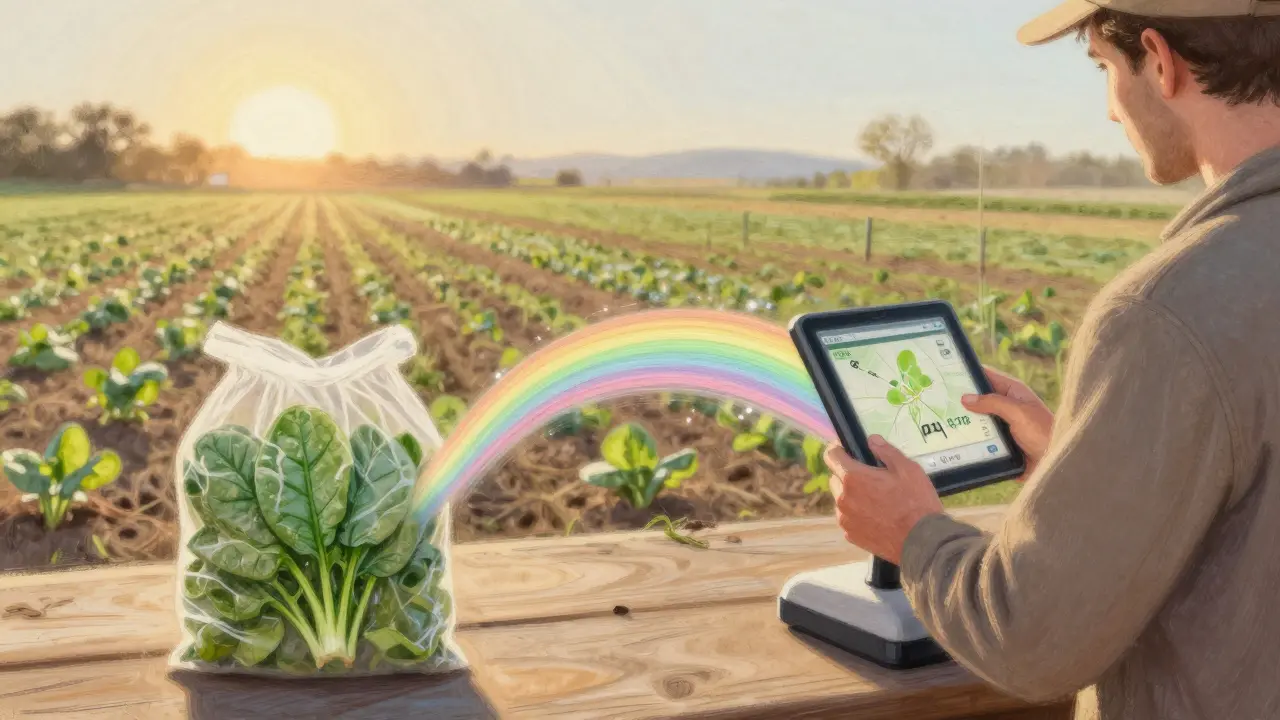
When a bag of spinach is linked to an outbreak of E. coli, every second counts. Traditional systems take days - sometimes weeks - to trace where it came from. But with blockchain, that same bag can be traced back to the exact farm, field, and harvest date in under two seconds. This isn’t science fiction. It’s happening right now in grocery stores, warehouses, and farms around the world.
Why Food Traceability Has Always Been Broken
For decades, food safety relied on paper logs, spreadsheets, and barcode scanners. If a shipment of lettuce turned toxic, companies had to call up suppliers, dig through invoices, and cross-reference batch numbers by hand. In 2018, a single outbreak of E. coli in romaine lettuce cost the U.S. lettuce industry over $550 million. Why? Because it took 11 days to trace the source. By then, millions of pounds of safe produce had been thrown away out of fear. The problem wasn’t laziness - it was fragmentation. One farm used one system. A transporter used another. A retailer used a third. None of them talked to each other. Data got lost. Records got corrupted. And when something went wrong, nobody could answer: Where did this come from?How Blockchain Fixes the Chain
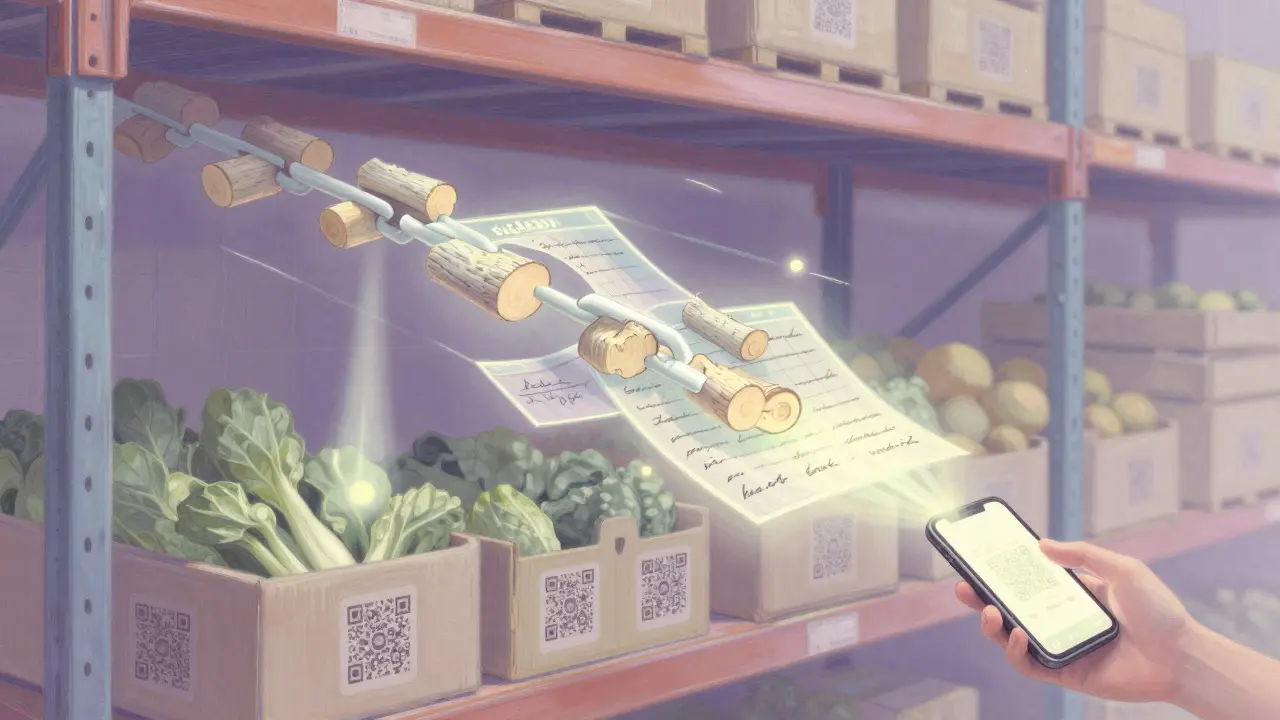
Blockchain isn’t just a fancy word for a database. It’s a shared, tamper-proof ledger that every trusted party in the supply chain can write to - but no one can erase. Think of it like a digital notebook that gets copied across hundreds of computers. Every time a product changes hands - from soil to shelf - a new block is added with verified details: date, time, location, temperature, batch ID, and even who handled it. These blocks are chained together using cryptography. If someone tries to change one entry - say, faking a temperature log - every other copy of the ledger instantly flags the inconsistency. It’s impossible to hack without being caught. The magic? You don’t need to trust any single company. You trust the system.What Data Gets Recorded?
It’s not just "this lettuce came from California." Blockchain captures granular, standardized data using global standards like GS1. Here’s what’s tracked:- GTIN-14 (Global Trade Item Number) - unique ID for every product
- Lot and batch codes
- Harvest date and location (GPS coordinates)
- Processing facility and time
- Temperature logs during transport
- Shipping manifests and delivery receipts
- Quality inspection results
Real-World Proof: Walmart and IBM Food Trust
In 2017, Walmart made a bold move. They told every leafy green supplier: "If you want to sell to us, you must use blockchain." They partnered with IBM to launch the IBM Food Trust a blockchain-based platform that enables secure, transparent tracking of food products across global supply chains. Within a year, they tested it with mangoes, spinach, and baby food. Before blockchain: tracing a single mango back to its farm took 7 days. After blockchain: it took 2.2 seconds. They didn’t just track one product. They traced over 25 items from five suppliers - all at once. A consumer could scan a QR code on a salad bowl and see exactly which farm grew the lettuce, which truck carried it, and what temperature it was kept at during transit. No guesswork. No red tape. By 2019, Albertsons, Carrefour, Nestlé, and Dole joined. Today, the IBM Food Trust network includes over 100 companies worldwide. It’s not a pilot anymore. It’s the new standard.How It Saves Lives - And Money
Imagine a shipment of contaminated ground beef hits shelves in three states. Under old systems, the entire product line gets recalled. Maybe even all beef from that region. Millions of pounds of perfectly safe meat get tossed. Farms lose income. Stores lose sales. Consumers lose trust. With blockchain? You pinpoint the exact batch. Maybe only 300 pounds are affected. You pull just those. The rest stay on shelves. No panic. No waste. No financial carnage. A 2023 study by the World Economic Forum found that blockchain traceability reduces food waste by up to 30% in high-risk categories like fresh produce and dairy. Why? Because recalls become surgical, not shotgun. It also helps farmers. Small growers who use blockchain can prove their organic or sustainable claims with data - not just labels. Buyers pay more for verified quality. Fairer prices. Stronger supply chains.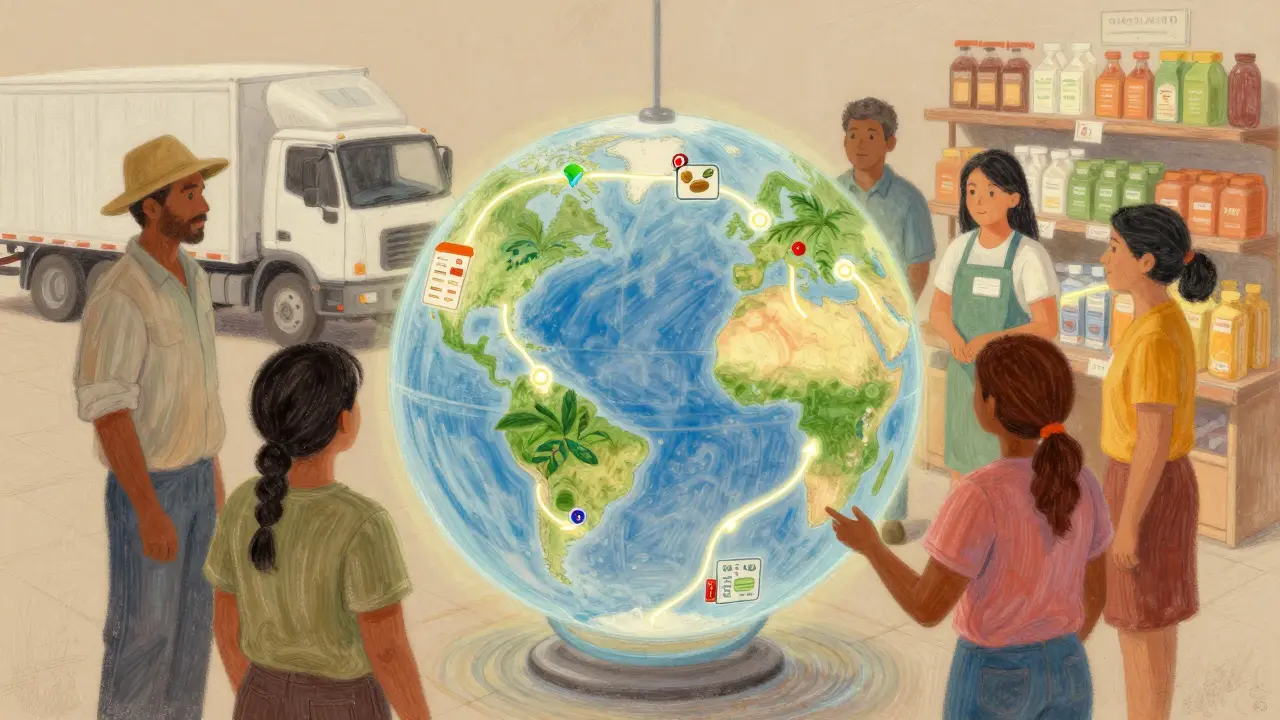
Who’s Using This Today?
You’re probably buying food tracked by blockchain right now - even if you don’t know it.- Walmart: Requires blockchain for all leafy greens, pork, and baby food in the U.S. and China.
- Albertsons: Tracks produce, meat, and seafood using IBM Food Trust.
- Carrefour: Lets customers scan QR codes on eggs and chicken to see their journey.
- Nestlé: Uses blockchain to trace coffee beans from farms in Colombia to your cup.
- Dole: Tracks bananas from Central American farms to U.S. stores.
- Tyson Foods: Monitors chicken from hatchery to packaging.
It’s Not Perfect - But It’s Getting Better
Some suppliers still resist. Setting up scanners, training staff, and connecting to a blockchain network takes time and money. Not every farm has reliable internet. Some still rely on handwritten logs. But the trend is clear: regulation is catching up. The U.S. FDA’s Food Traceability Rule (effective January 2026) now requires detailed electronic records for 16 high-risk foods - including leafy greens, tomatoes, sprouts, and melons. Blockchain isn’t mandatory, but it’s the only system that meets the standard cleanly. And consumers? They’re asking for it. A 2025 survey showed 71% of shoppers in North America and Europe would pay more for food they could trace back to its source. Transparency isn’t a perk anymore - it’s a demand.What’s Next?
The next wave is automation. Sensors on pallets that auto-record temperature. Drones that scan crop health. AI that predicts contamination risks before they happen. Blockchain will be the backbone - the trusted record keeper - tying it all together. In five years, you won’t just scan a QR code to see where your food came from. You’ll see its entire story: rainfall levels, soil health, labor conditions, carbon footprint. And you’ll know it’s real - because blockchain won’t let it be faked. This isn’t about technology for technology’s sake. It’s about trust. Trust that your food is safe. Trust that the farmer got paid fairly. Trust that the system won’t fail when it matters most. The old way of tracing food was broken. Blockchain didn’t just fix it - it rewrote the rules.How does blockchain improve food safety compared to traditional methods?
Traditional methods rely on paper records or disconnected digital systems, making it slow and error-prone to trace food back to its source - often taking days or weeks. Blockchain creates a single, shared, tamper-proof digital ledger where every step of the supply chain is recorded in real time. This means contamination can be traced to its origin in seconds, not days, allowing for precise recalls and preventing widespread illness.
Is blockchain food traceability only used by big companies?
No. While big retailers like Walmart and Carrefour led the way, the technology is now accessible to small farms and cooperatives. Low-cost mobile apps and cloud-based blockchain platforms let even small growers record and share data. In places like Kenya and Colombia, smallholder farmers are using blockchain to prove quality and get better prices.
What happens if a supplier doesn’t use blockchain?
Many major retailers now require blockchain compliance for high-risk products like leafy greens and meat. Suppliers who don’t adopt it risk losing contracts. In the U.S., the FDA’s new Food Traceability Rule (2026) makes electronic records mandatory for 16 food types - blockchain is the most reliable way to meet this standard. Without it, suppliers face delays, fines, or exclusion from key markets.
Can blockchain prevent food fraud?
Yes. Fraud often happens when labels lie - like selling cheaper fish as premium tuna, or passing off non-organic produce as organic. Blockchain records are immutable and verified at each step. If a product claims to be from a specific farm, the system shows the actual harvest date, location, and handler. Any mismatch instantly raises a red flag.
Does blockchain track organic or sustainable claims?
Absolutely. Blockchain doesn’t just track location - it records certifications, inspection reports, and compliance documents. A bag of organic spinach can show not just where it was grown, but which certifier approved it, when, and under what standards. This cuts down on greenwashing and gives consumers real proof.
Is blockchain expensive to implement?
Initial setup costs exist - scanners, software, training - but they’re falling fast. Platforms like IBM Food Trust offer subscription models that scale with size. For many suppliers, the savings from reduced waste, faster recalls, and premium pricing more than cover the cost. A 2025 study showed an average ROI of 2.3x within 18 months.
Can consumers access blockchain food data?
Yes. Many products now come with QR codes or NFC tags. Scan it with your phone, and you’ll see the full journey: farm name, harvest date, transport details, and inspection results. Some apps even show environmental impact metrics like water use or carbon emissions.
What’s the biggest challenge to widespread adoption?
The biggest hurdle isn’t tech - it’s coordination. Different suppliers use different systems. Getting everyone to agree on data standards, entry points, and access rules takes time. But with global standards like GS1 and growing regulatory pressure, adoption is accelerating. The technology is ready. The industry is catching up.


This is just another Silicon Valley fantasy. Real farmers don't have smartphones. This blockchain nonsense is just a way for big corps to control the food supply. We don't need tech. We need trust. And we don't trust corporations. Period. 🤬
The technical implementation is sound, but the real challenge lies in interoperability across heterogeneous systems. Standardization via GS1 is critical; without it, fragmented data silos persist even within blockchain architectures. A well-structured ontology is non-negotiable for scalability.
I love this. My cousin works at a small farm in Iowa and they just started using this system. She says it’s changed everything - no more guessing if the lettuce was chilled properly. And customers are way more confident now. Small wins add up 😊
Interesting. I’ve seen QR codes on produce but never thought about what’s behind them. Wonder how many people actually scan them. Probably not many. Still, the fact that the data exists is a win.
The ethical implications of this technology are profound. When consumers can verify the provenance of their food, it fosters accountability not only in supply chains but also in labor practices and environmental stewardship. This is not merely logistical - it is moral infrastructure.
so like… uhhh… i scanned a bag of spinach last week and it showed the farm was in cali but the truck was from texas? wtf? i thought this was supposed to be foolproof. maybe the system just needs more time to work out the kinks lol
THIS IS THE FUTURE. WE’RE NOT JUST TRACKING LETTUCE - WE’RE RESTORING TRUST IN A WORLD THAT’S BEEN LYING TO US FOR DECADES. SCANNING A QR CODE AND SEEING THE WHOLE STORY? THAT’S NOT TECHNOLOGY. THAT’S A REVOLUTION. 🙌
I’ve been following this since Walmart first rolled it out. The drop in recall costs alone is insane. One grocery chain saved $12M in the first year just by not throwing away safe product. This isn’t hype - it’s ROI with a conscience.
Blockchain is overrated. You think a ledger stops contamination? The real issue is hygiene at processing plants. No amount of digital tracking fixes bad sanitation. Also why do we need GPS on a bag of kale? It’s not a satellite phone
I work in logistics. The biggest win here is temperature logs. One time, a shipment of dairy got delayed and no one knew until it was too late. With blockchain, that’s flagged the moment the temp drops. Prevents so much waste. Simple. Effective.
This is one of those rare tech wins where everyone benefits - farmers, retailers, consumers. Even the middlemen. No one’s getting screwed. That’s kinda beautiful in a world where tech usually just helps the rich get richer.
I tried to scan my avocado’s QR code and it said it was grown in Mexico but the farm name was misspelled lol. still better than nothing though! maybe next time it’ll be perfect 😅
Imagine if every product had this. Your coffee, your jeans, your laptop. Knowing where things come from isn’t a luxury - it’s a right. This is the first step. Let’s make it universal. 💪
i think this is great but what about the small farms that cant afford the sensors or the wifi? are they just left out? i mean the tech is cool but if it only helps the big guys then its kinda just another way to gatekeep
Ah yes, the blockchain solution. The only thing more overhyped than this is NFTs. You’re telling me we need a decentralized immutable ledger to track lettuce? We used to use paper. It worked fine. Now we’re all just performing digital yoga for corporate PR.
This is disgusting. You’re turning food into a surveillance product. Who authorized this? Who owns the data? What if someone hacks the blockchain? What if the government uses it to track your eating habits? This isn’t progress - it’s dystopia.
The integration of blockchain with IoT-enabled sensors, coupled with GS1-compliant data standards, enables real-time, end-to-end visibility across the supply chain. This paradigm shift reduces non-value-added activities, enhances compliance, and mitigates systemic risk through cryptographic immutability.
You think this is revolutionary? I’ve seen farmers in Kerala using WhatsApp to send harvest pics with timestamps. That’s traceability. This blockchain thing is just corporate overengineering. Let people use what works. Not every problem needs a blockchain