

State Bank of Vietnam Crypto Policy: New Rules and Regulations for 2026

For years, Vietnam was a paradox: one of the world's most active crypto-trading populations operating in a legal gray zone. The State Bank of Vietnam is the central bank of the Socialist Republic of Vietnam, responsible for managing monetary policy and overseeing the banking system finally broke that cycle in 2025. Instead of a blanket ban, the government pivoted to a highly controlled, regulated acceptance of digital assets. But if you think this means a free-for-all, think again. The new rules are some of the strictest in Southeast Asia, designed to keep the government in the driver's seat while tapping into the massive retail interest in blockchain.
| Feature | Current Status / Value |
|---|---|
| Legal Status | Legalized as "Virtual Assets" (since June 2025) |
| Payment Use | Prohibited (Cannot be used for payments) |
| Exchange Capital Req. | 10 Trillion VND (~$379 Million) |
| Trading Currency | Vietnamese Dong (VND) only |
| Regulatory Framework | Resolution No. 05/2025/NQ-CP |
The Big Shift: From Prohibition to "Virtual Assets"
The real turning point happened in June 2025 with the introduction of the Law on Digital Technology Industry. This legislation fundamentally changed how the state views coins and tokens. Rather than ignoring them or calling them illegal, the government officially categorized Bitcoin is a decentralized digital currency without a central authority that serves as a store of value (BTC) and Ethereum is a blockchain platform that enables the creation of smart contracts and decentralized applications (ETH) as "virtual assets."
Now, here is the catch: while you can own and transfer these assets, you still can't buy a coffee with them. The State Bank of Vietnam continues to prohibit using cryptocurrency as a legal means of payment. This is a strategic move to protect the Vietnamese dong and ensure the central bank keeps total control over monetary policy. In short, crypto is now treated as a piece of property-like land or gold-that you can invest in, inherit, or sell, but not as a replacement for the national currency.
Decoding Resolution No. 05/2025/NQ-CP
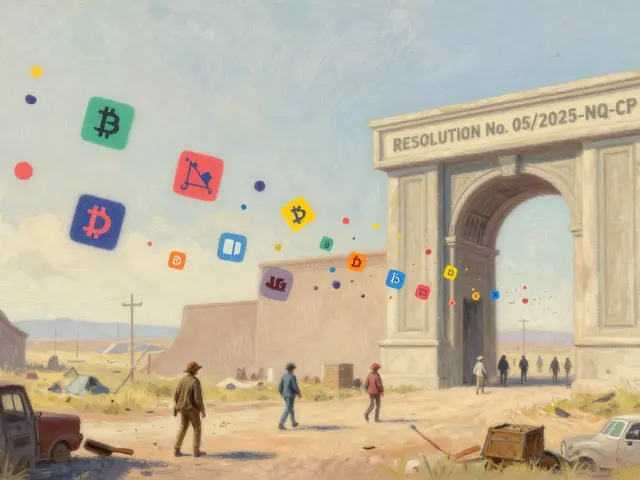
If the Law on Digital Technology Industry provided the "what," then Resolution No. 05/2025/NQ-CP is the specific regulatory decree issued on September 9, 2025, that defines the licensing and operational rules for crypto exchanges in Vietnam provides the "how." This resolution is the backbone of the current five-year pilot program launched in late 2025.
The framework is very specific about what counts as a digital asset. It defines them as assets authenticated through encryption during their creation and transfer. However, it draws a hard line: securities and fiat currencies in digital form are not included in this category. This means the government isn't giving a free pass to unregulated stablecoins that claim to be "money." Under this pilot, only Vietnamese companies are allowed to issue virtual assets, and those assets must be backed by real-world assets, not just promised fiat.
The High Bar for Crypto Exchanges
The State Bank of Vietnam isn't looking for a thousand small startups to run the show. They want a handful of massive, stable players. To get a license to operate a crypto exchange, the requirements are intentionally daunting. A company must have a minimum capital of 10 trillion Vietnamese dong. For context, that's roughly $379 million USD.
It's not just about the money; it's about who provides it. The capital must come from at least two entities, which have to be from a specific pool: commercial banks, insurance providers, securities companies, fund managers, or tech firms. Furthermore, these shareholders must prove they've been profitable for at least two consecutive years. This ensures that only the "big fish" with proven track records can enter the legal market. Starting in 2026, these licensed platforms are required to list trading pairs exclusively in Vietnamese dong, further tying the digital asset market to the local economy.
NDAChain and the National Blockchain Strategy
Beyond just regulating exchanges, Vietnam is building its own infrastructure. In July 2025, the government rolled out NDAChain is a national permissioned blockchain network designed for the tokenization of government-approved assets and data security. Unlike the public nature of Bitcoin, NDAChain is a permissioned system. This means the government controls who joins and what they can do.
The goal here is virtual assets tokenization. The state plans to use this network to tokenize bonds and carbon credits, making them easier to trade while keeping a perfect digital audit trail. By creating a state-sanctioned blockchain, Vietnam is attempting to capture the efficiency of distributed ledger technology without giving up the oversight that a central bank requires. It’s essentially a "walled garden" approach to blockchain innovation.
Comparing Vietnam to the Rest of Southeast Asia
When you look at the region, Vietnam is playing a very different game than its neighbors. Singapore, for instance, has a much more open and flexible structure for stablecoins and institutional crypto growth. The Philippines has also been relatively welcoming to the industry. Vietnam, by contrast, is restrictive.
This high barrier to entry might slow down institutional growth. Why would a global giant move its headquarters to Hanoi if it has to lock up 10 trillion VND in capital? However, the retail side of things tells a different story. According to the 2025 Chainalysis Global Crypto Adoption Index, Vietnam ranks fourth globally. More than 20% of the tech-savvy population already owns digital assets. This creates a weird tension: a government that is incredibly cautious, but a population that is incredibly bullish. Most of this activity still happens via peer-to-peer (P2P) markets on platforms like Binance, as the official licensed exchanges are still in their infancy.
The Road Ahead: Challenges and Realities
Despite all the fancy laws and resolutions, the actual implementation has been slow. As of October 2025, almost no firms had actually submitted formal applications for the exchange licenses. The capital requirements are simply too high for most, and the compliance burden is heavy. Many banks are still "exploring" the pilot program, but few have jumped in head-first.
Deputy Governor Pham Thanh Ha has tied this crypto push to broader economic goals, including a target of 20% credit growth for 2025. The idea is that by regulating digital assets, the state can attract foreign investment and create new tax revenue streams. They even envision a future where insurance companies and pension funds use Bitcoin as a hedge or investment vehicle within the legal framework.
For the average person in Vietnam, the most important takeaway is legal clarity. For the first time, crypto is recognized as legal property. You can now legally own, transfer, and inherit your digital assets without fear that the government views the act of owning a private key as a crime. The pilot program will likely run for five years, and the State Bank will adjust the dials based on how much volatility they can stomach.
Is cryptocurrency legal in Vietnam in 2026?
Yes, cryptocurrencies are legalized as "virtual assets" under the Law on Digital Technology Industry (June 2025). You can legally own and trade them as property, but you cannot use them as a means of payment for goods or services.
What is Resolution No. 05/2025/NQ-CP?
It is the regulatory decree that established the licensing regime for crypto exchanges in Vietnam. It defines digital assets, sets capital requirements for exchanges, and outlines the five-year pilot program for digital asset usage.
How much capital is needed to start a crypto exchange in Vietnam?
Companies must have a minimum capital of 10 trillion Vietnamese dong (approximately $379 million), sourced from at least two qualified entities such as commercial banks or insurance providers.
What is NDAChain?
NDAChain is a national permissioned blockchain network launched by the Vietnamese government in July 2025. It is used for the tokenization of bonds and carbon credits and to enhance government data security.
Can foreign investors trade crypto in Vietnam?
Foreign investors must access the Vietnamese crypto market through Crypto Asset Service Providers (CASPs) that have been approved by the Ministry of Finance.
Are stablecoins allowed in Vietnam?
The government maintains strategic restrictions on fiat-backed stablecoins. While retail P2P trading of stablecoins continues informally, they are generally excluded from the official "virtual asset" issuance rules to protect monetary stability.





Basically just another way for the state to control everything while pretending to innovate
The capital requirement is an obvious mechanism for institutional gatekeeping. By mandating a 10 trillion VND threshold, they are effectively ensuring that the asymmetric information advantage remains with the state-aligned financial oligarchy, thereby neutralizing any disruptive potential of decentralized finance within their borders. It's a textbook case of regulatory capture via prohibitive entry costs.
wow that capital req is insane!! like how is any normal company gonna afford that many dong lol
It's definitely a steep climb for the little guys, but maybe it'll lead to more stable platforms for everyone 🚀 hope it works out for the retail traders! 💎
true true.. maybe they just want to avoid the big crashes we saw before. its a safe way to start i guess
Absolutely pathetic. This isn't "regulation," it's a stranglehold. The British system might have its flaws, but this level of bureaucratic absurdity is frankly embarrassing. Only a government terrified of its own people would set a bar this high just to keep the keys to the kingdom for themselves.
It is common for emerging markets to take a cautious approach to protect their local currency from volatility.
WAKE UP PEOPLE!!! This NDAChain thing is just a digital leash!!! They want to track every single move you make and call it "security"!!! It's a total power grab by the elites to ensure we can't escape their crumbling system!!! Why do you think they banned using it for coffee??? BECAUSE THEY CAN'T TAX THE AIR YOU BREATHE YET!!! Absolute madness!!!
Look at all these people acting like this is a tragedy. It's funny how the 'crypto-revolutionaries' only like decentralization when it's a gamble and not when it's actually functional. This is just the state cleaning up the mess left by a bunch of hype-beasts who thought they'd be millionaires by trading dog-themed coins. Real utility requires a framework, even if that framework is built by people who don't know what a private key is.
just seems like a way to keep people safe
Absolute game changer! This clarity is exactly what the market needs to explode! Let's gooo!
Oh sure, because the Vietnamese government is just so well-known for its "freedom" and "openness." I'm sure this pilot program will be a complete success and not just a way to fund their fancy new offices with the 10 trillion VND they're demanding. So inspiring really.
10 trillion VND is just a joke 🤣 they don't want exchanges they want a piggy bank 💸
Omg I can't believe people are actually okay with this!!! Like imagine not being able to use your own money to buy a coffee?? That's just so wild to me!! 😱 I mean I get the safety thing but it's just... ugh!
It's okay to feel frustrated by the rules, but maybe we can look at this as a first step toward a more stable future for everyone involved.
The focus on VND trading pairs is a prudent move to maintain monetary sovereignty.
my heart actually breaks for the small traders who just want a chance in this world
This is a very helpful summary of the new laws. It is great that the government is providing a legal way to own these assets. It will help many people feel more secure about their investments. I think the high capital requirements are just to make sure only the most reliable companies can operate. This should protect users from scams. It's a positive step for the industry in the long run. Everyone should read the full Resolution 05 to be sure. It's better to be safe than sorry. I'm glad there is finally some clarity. This will likely attract more institutional interest over time. Let's hope the pilot program is successful. It's an interesting experiment in governance. I'm sure the State Bank will make adjustments as they learn more. Good luck to all the investors in Vietnam.
I've seen a lot of this in other markets too. The a mount of red tape is crazy but it's usually how they start. Most of the retail guys will just keep using Binance anyway cuz it's way easier than waiting for a gov-approved app that takes 5 years to launch.
The use of a permissioned blockchain for tokenizing carbon credits is a high-utility use case that could actually drive real GDP growth via ESG-compliant frameworks.
The legal recognition of virtual assets as property is a commendable advancement in regulatory clarity.
So exciting to see this evolving!
im just so tired of these rules always changing... why cant things just be simple for once 😩