

What is Frax USD (FRXUSD) Crypto Coin? Fully Backed Stablecoin Explained
Frax USD, or FRXUSD, isn't just another crypto coin. It's a stablecoin built to behave like digital cash - but with a twist. While most stablecoins like USDC or USDT try to hold their $1 value by sitting on bank deposits, FRXUSD backs every single token with actual U.S. Treasury securities. Think of it as owning a slice of the U.S. government’s debt, but in a form you can send across blockchain networks instantly. Launched on January 2, 2025, it’s one of the newest players in the stablecoin space - and it’s already catching attention from institutional investors.
How FRXUSD Works: Backed by Treasuries, Not Bank Accounts
Most stablecoins claim to be $1-backed, but what they’re really backed by matters. USDT and USDC mostly hold commercial paper and cash in bank accounts - assets that can be risky if banks face stress. FRXUSD takes a different path. Every FRXUSD token you hold is directly backed by tokenized U.S. Treasury instruments. That means the reserves aren’t sitting in a bank. They’re held in funds like BlackRock’s BUIDL, Superstate’s USTB/USCC, and Circle’s USDC, all of which invest in short-term government debt, cash, and repurchase agreements. These are the same assets that hedge funds and pension plans use - but now, they’re accessible on-chain.
Here’s the key: if you own 1 FRXUSD, you own the right to redeem it for $1 worth of these assets. That’s not a promise. It’s a contract enforced by code and regulated custodians. Unlike algorithmic stablecoins like the original FRAX, which rely on complex supply adjustments to maintain price, FRXUSD has a 1:1 reserve ratio. No guessing. No floating collateral. Just pure backing.
The Dual-Token System: FRXUSD and sfrxUSD
FRXUSD doesn’t work alone. It’s part of a pair with sfrxUSD, its yield-bearing sibling. Here’s how it works: when you mint FRXUSD by depositing approved collateral, you can choose to convert it into sfrxUSD. The sfrxUSD token earns interest automatically - generated from the returns on the U.S. Treasury assets backing the system. This isn’t staking. It’s not lending. It’s built right into the protocol. You’re earning yield simply by holding a version of the same asset.
This dual-token setup is smart. If you just want to send $1 to a friend or pay for a DeFi service, use FRXUSD. If you want to earn a steady return without selling your crypto, convert some to sfrxUSD. The two are interchangeable, and the protocol keeps them in balance. This system avoids the common problem of stablecoins offering yield through risky lending pools. With FRXUSD, the yield comes from government bonds - the safest assets in the world.
Layer 2 Bridging: Why FRXUSD Isn’t Just on Ethereum
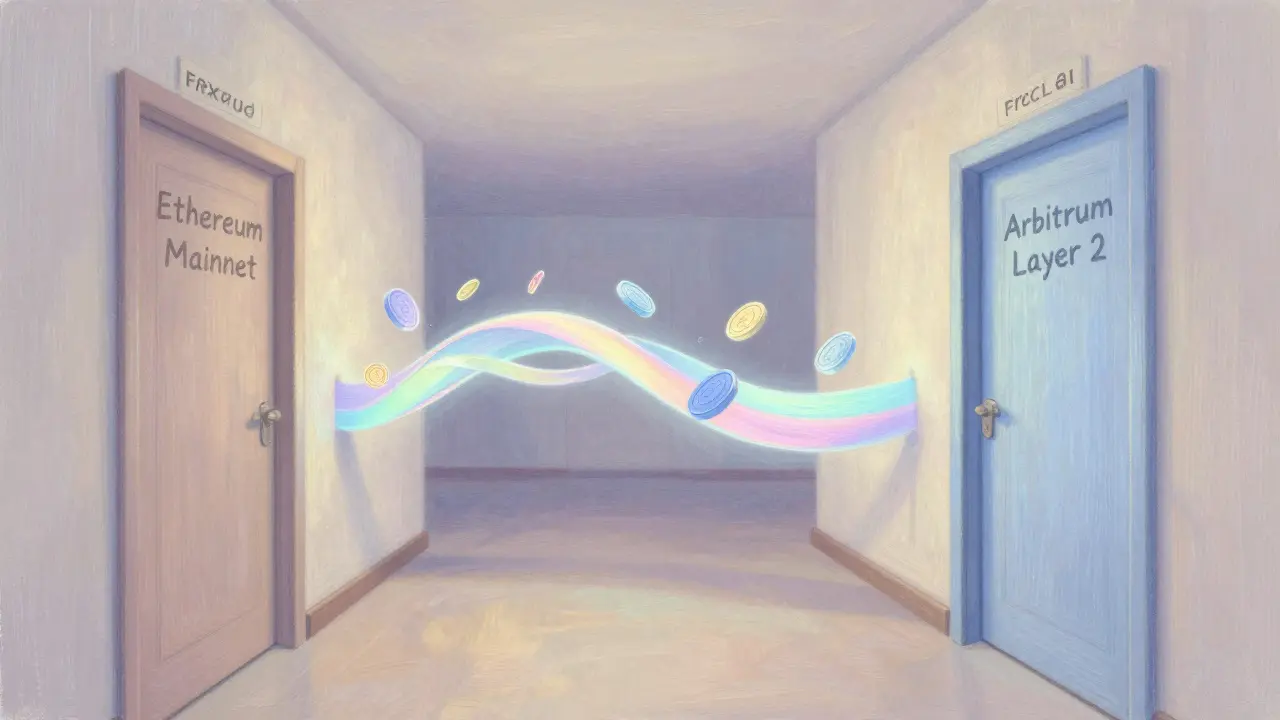
You might see FRXUSD listed on exchanges or wallets and wonder why it’s not on Bitcoin or Solana. That’s because FRXUSD was designed to work on Ethereum - but not the mainnet. The "L2 Standard Bridged" version lets you use FRXUSD on Layer 2 networks like Arbitrum, Optimism, or Base. Here’s the trick: your original FRXUSD tokens are locked on Ethereum mainnet. In return, an equivalent amount is minted on the Layer 2 chain. This gives you the speed and low fees of Layer 2 without losing the security and full backing of Ethereum.
It’s like having a digital dollar that moves fast on a highway, but still has the same value and backing as cash in a vault. This makes FRXUSD ideal for DeFi users who want to trade, lend, or provide liquidity without paying $50 in gas fees every time they swap tokens.
Market Data and Adoption: Niche, But Growing Fast
As of early March 2026, FRXUSD has a market cap of around $117.5 million and a circulating supply of 117.5 million tokens. That’s tiny compared to USDC’s $33.8 billion or USDT’s $118.2 billion. But size isn’t the whole story. FRXUSD is designed for a different audience: institutions and serious DeFi users who care about transparency and safety.
It’s not on Coinbase or Binance as a direct trading pair. You won’t find it at your local crypto ATM. But it’s live on Curve Finance, where over $7 million in liquidity is locked in FRXUSD pools. That’s a lot for a new stablecoin. It’s also being integrated into Crypto.com’s custody platform, meaning large investors can now hold FRXUSD securely - something that wasn’t possible before late 2025.
On-chain data shows about 8,300 unique wallets hold FRXUSD. Most of them are institutional or professional DeFi users. Retail adoption is still low - but that’s by design. The redemption process requires KYC/AML checks handled by Frax Inc, a regulated public-benefit corporation. You can’t just mint FRXUSD from your phone. You need to verify your identity. That’s a barrier for casual users - but a feature for those who want regulatory compliance.
How FRXUSD Compares to USDC and USDT
| Feature | FRXUSD | USDC | USDT |
|---|---|---|---|
| Backing Type | Tokenized U.S. Treasuries (BUIDL, AUSD, etc.) | Cash & Cash Equivalents (60% in treasuries as of Sept 2025) | Commercial paper, loans, deposits |
| Transparency | On-chain, audited daily | Monthly attestations | Irregular audits, limited disclosure |
| Redemption | Fiat redemption via regulated custodians | Only via Circle-approved partners | No direct fiat redemption |
| Liquidity (Curve Finance) | $7M+ | $500M+ | $300M+ |
| Regulatory Status | Classified as payment stablecoin by SEC (July 2025) | Complies with U.S. financial regulations | Under regulatory scrutiny |
FRXUSD doesn’t compete on volume. It competes on quality. If you care about knowing exactly where your money is held - and that it’s backed by assets the U.S. government owes - then FRXUSD is the cleanest option. USDC is close, but even Circle’s own reports show only 60% of its reserves are in treasuries. The rest is in commercial paper and other short-term debt. FRXUSD? Nearly all of it is in U.S. Treasury instruments.
Real User Experiences: Smooth, But Limited
Users who’ve tried FRXUSD say the peg holds steady. During the March 2025 market crash, when USDT dipped to $0.985, FRXUSD stayed at $1.0001. That’s a big deal for traders who rely on stable value.
But the experience isn’t perfect. One Reddit user, DeFiInvestor87, successfully redeemed 50,000 FRXUSD for U.S. dollars in two business days. Another user, CryptoCurious2025, got frustrated trying to swap FRXUSD directly for USDC. There’s no simple pool. You often need to go through FRAX or sUSDS first - adding steps and fees. That’s the trade-off: you get safety and transparency, but not convenience.
Frax’s Discord has over 12,500 members, and the community is active. But support response times average 4-6 hours. The documentation on GitHub is rated 4/5 - detailed, but not beginner-friendly. If you’re new to DeFi, this isn’t the place to start. But if you’ve used Uniswap, Curve, or Aave before? You’ll adapt fast.
What’s Next for FRXUSD?
The roadmap is clear. Frax Inc is working on direct redemption paths to USDC and ETH. They’re adding more regulated custodians and expanding to additional Layer 2 networks. By Q2 2026, they aim to cut the number of steps needed to convert FRXUSD into other assets.
Industry analysts think FRXUSD could grow to $3.7 billion by 2027 - not by replacing USDC, but by becoming the go-to stablecoin for institutional DeFi. Think hedge funds, asset managers, and treasury teams moving into crypto. For them, FRXUSD isn’t a gamble. It’s a bridge between traditional finance and blockchain.
Who Should Use FRXUSD?
- Yes: DeFi power users who want transparent, Treasury-backed collateral. Institutions looking for secure digital cash. Investors tired of opaque stablecoin reserves.
- No: Casual traders who want to buy crypto with a credit card. People who need instant swaps to USDC. Anyone who doesn’t want to go through KYC.
FRXUSD isn’t for everyone. But for those who care about where their money is held - and want to use crypto without sacrificing safety - it’s one of the most honest options on the market.
Is FRXUSD the same as FRAX?
No. FRAX is the original algorithmic stablecoin from Frax Finance, which uses a mix of collateral and algorithmic supply adjustments to stay pegged to $1. FRXUSD is its fully collateralized successor, backed 1:1 by U.S. Treasury assets. FRAX is still active, but FRXUSD was designed to replace it as the primary stablecoin for institutional use.
Can I redeem FRXUSD for real U.S. dollars?
Yes - but only through Frax Inc’s regulated portal. You need to complete KYC/AML verification, which takes 1-3 business days. Once approved, you can redeem FRXUSD for U.S. dollars via bank transfer. This is a major advantage over USDT, which doesn’t offer direct redemption at all.
Is FRXUSD safe from hacks or smart contract failures?
The smart contracts have been audited by multiple firms, including Chaos Labs and OpenZeppelin. But the real safety comes from the collateral: U.S. Treasuries are held by regulated custodians like BlackRock and Superstate. Even if the Frax protocol fails, the assets backing FRXUSD are held separately and can be recovered. This is why experts call it "bank-grade" in a crypto context.
Why does FRXUSD have lower liquidity than USDC?
Because it’s new and targeted. USDC has been around since 2018 and is listed on every major exchange. FRXUSD launched in January 2025 and is still focused on DeFi and institutional users. It doesn’t need massive liquidity to function - it just needs enough for arbitrage to keep the peg stable. That’s already happening, with trades up to $6 million showing minimal slippage.
Does FRXUSD earn interest?
Not directly. But if you convert FRXUSD to sfrxUSD, you automatically earn yield from the U.S. Treasury assets backing the system. This yield is distributed daily and compounds automatically. You don’t need to lock up funds or join a lending pool. It’s built into the token.


This is way too much effort for something that should just be digital cash.
Honestly? I'm just here for the yield. sfrxUSD is the real MVP. I've been holding it since February and my wallet's been quietly growing while I slept. No need to chase DeFi yields that smell like a Ponzi. Just let the Treasuries do the work.
Let me break this down for the amateurs. FRXUSD isn't a stablecoin-it's a Treasury ETF wrapped in a smart contract. The fact that it's tokenized via BlackRock's BUIDL means institutional capital is already flowing in. The liquidity on Curve is a red flag for retail, honestly. It's not meant for you. It's meant for hedge funds that need on-chain exposure without touching USDC's murky reserve disclosures.
If safety is the goal, then yes, this is the cleanest path. But let's not pretend it's revolutionary. We've had Treasury-backed digital assets since 2020. What's new is the regulatory alignment. That's the real innovation.
The fact that redemption requires KYC undermines the entire ethos of decentralization. If you need a government-verified identity to use a crypto asset, then you're not using crypto-you're using a bank with better UX.
I appreciate the clarity here, but I think we're missing the bigger picture. FRXUSD isn't competing with USDC or USDT-it's competing with the entire legacy financial infrastructure. Imagine a world where pension funds allocate 5% of their reserves to tokenized Treasuries on-chain. That’s not speculation. That’s happening. The liquidity may be small now, but the underlying asset class is the most liquid in human history. This isn’t about volume. It’s about trust architecture.
I've been using FRXUSD on Arbitrum for swaps and the gas savings are insane. No more $40 fees to move $500. And the peg? Rock solid. Even during the Fed rate panic last month, it never blinked. USDT dipped, FRXUSD didn't. That's the kind of reliability you can't buy.
I love this so much 😍😍😍 I just converted 10k FRXUSD to sfrxUSD and my yield is already 4.2% APY! No locking, no risk, just pure US gov bonds on my phone 🤯 I’m telling all my friends. This is the future!
Let’s be clear: the U.S. Treasury is not a safe asset. It is a liability of a government that prints money to pay its debts. Tokenizing that liability doesn’t make it safer-it makes it more accessible to global actors who have no stake in American sovereignty. This is financial colonialism dressed in blockchain aesthetics. The moment the Fed loses control of monetary policy, these "backed" tokens will collapse faster than any algorithmic stablecoin ever did.
You people are delusional. FRXUSD is just another crypto scam with a fancy whitepaper. They're using "Treasury-backed" as a buzzword to lure in gullible investors. Meanwhile, the real money is still in USDT-because at least Tether has actual liquidity. This FRXUSD thing is a glorified demo. It’s not even on Binance. That says everything.
It’s like they took the soul of money-clean, quiet, dependable-and gave it a blockchain glow-up. No flash. No noise. Just pure, unadulterated trust. I didn’t think crypto could feel this… peaceful. Like finding a quiet library in the middle of a riot.
The structural superiority of FRXUSD over USDC cannot be overstated. While Circle’s attestations are monthly and rely on third-party verification, FRXUSD’s on-chain reserves are verifiable in real time via Ethereum block explorers. Furthermore, the inclusion of regulated custodians such as Superstate ensures that the underlying assets are segregated from operational risk. This is not merely an improvement-it is a paradigm shift in monetary design.
You're all missing the point. This is a Trojan horse. The SEC classified it as a payment stablecoin in July 2025? That’s not regulation-it’s pre-emptive control. They’re building a digital dollar infrastructure under the guise of decentralization. The moment they mandate all stablecoins to use this model, you’ll be forced into a system where your transactions are monitored, your identity is locked in, and your freedom to transact is revoked. This isn’t innovation. It’s surveillance with a better UI.
In India, we have long understood that stability in currency is not a technical achievement but a political one. FRXUSD’s success hinges not on its smart contracts, but on the enduring credibility of the United States federal government. Should that credibility falter-whether through inflation, debt default, or geopolitical collapse-the entire system unravels. A stablecoin backed by gold would be more resilient. At least gold does not require a central bank to function.
If you're new to DeFi and you're reading this, just start with FRXUSD on Base. It's the easiest on-ramp. No need to overthink it. Swap USDC for it, convert half to sfrxUSD, and let it sit. You'll thank me in six months. You're not losing anything-you're gaining yield without risk. That's rare in crypto.
I’ve been watching this space for years. FRXUSD is the first stablecoin that doesn’t feel like a compromise. USDC? Too centralized. USDT? Too shady. FRAX? Too volatile. This? It’s the closest we’ve come to a truly honest digital dollar. I’m not bullish on crypto. I’m bullish on this. It’s not a coin. It’s a promise kept.
The assertion that FRXUSD offers superior transparency compared to USDC is factually incorrect. USDC’s monthly attestations are performed by Grant Thornton, a globally recognized audit firm, with full disclosure of asset composition. FRXUSD’s on-chain verification, while technically elegant, lacks third-party validation of custodial holdings. The reliance on BlackRock and Superstate as custodians introduces counterparty risk that is not adequately disclosed in the documentation. This is not a superior product-it is a more opaque one.
They say it’s backed by Treasuries. But what if the tokenization process is a front? What if the real assets are being leveraged in off-chain repo markets? What if the auditors are paid by Frax Inc? What if the "regulated custodians" are just shell entities? You think this is secure? It’s all a facade. The Fed’s printing press is still running. And they’re using this to funnel liquidity into private hands. I’ve seen the patterns. This isn’t finance. It’s a controlled demolition.
I tried it. It works. But the interface is clunky. You need to go through three different wallets just to swap it. And don’t get me started on the KYC. Took three days. Meanwhile, I could’ve bought USDT on Robinhood in 60 seconds. It’s nice tech, but it’s not for normal people. And honestly? I don’t trust BlackRock. They helped crash 2008. Why should I trust them with my money now?