
What is Vara Network (VARA)? A Beginner’s Guide to the Web3 Platform
Have you ever tried to build an app on a blockchain and felt like you were fighting against the system? You’re not alone. Most existing blockchains are slow, expensive, and incredibly hard to code for. That’s exactly the problem Vara Network aims to solve. It isn’t just another coin; it’s a specialized platform designed to make decentralized applications (dApps) run as smoothly as your favorite website.
If you’ve heard about the VARA token and wondered if it’s worth your attention, you need to understand what makes this network different from Ethereum or Solana. The short answer? Vara brings familiar web technologies into the blockchain world, making it faster, cheaper, and easier for developers to build without sacrificing security.
The Core Idea: Bridging Web2 and Web3
To get Vara Network, you first have to understand its roots. It is built on the Gear Protocol, which started development in 2021. Think of Gear as the engine room, and Vara as the car that drives on the road. Vara launched in September 2023 as the first standalone network in the Gear ecosystem.
The big innovation here is how Vara handles data. Traditional blockchains process transactions one by one, which creates traffic jams. Vara uses parallel data processing. Imagine having ten checkout lanes at a grocery store open instead of just one. This allows multiple tasks to happen at the same time, drastically increasing speed and scalability.
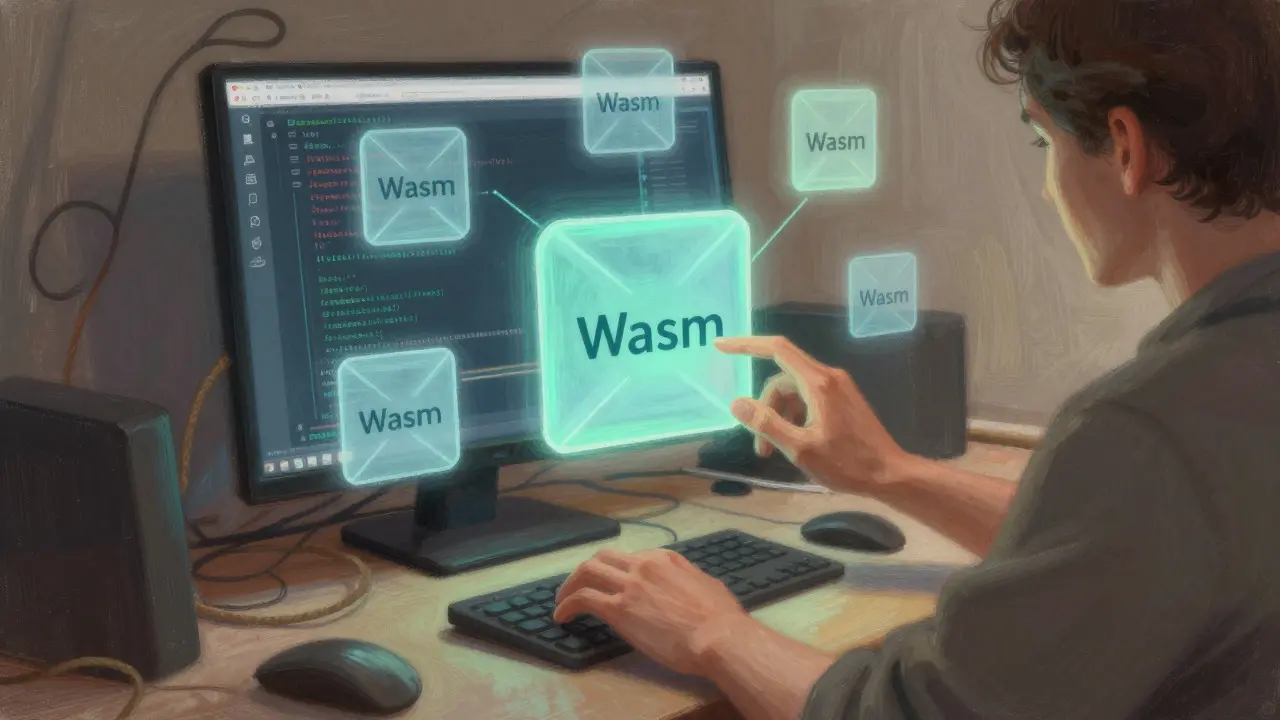
But speed means nothing if developers can’t use it. Vara relies on WebAssembly (often shortened to Wasm). If you’re a developer, you know Wasm is the standard for running high-performance code in modern browsers. By using Wasm as its virtual machine, Vara lets programmers write code in languages they already know-like Rust or C++-instead of learning obscure, blockchain-specific languages. This lowers the barrier to entry significantly.
How Does Vara Actually Work?
Under the hood, Vara Network operates on three distinct architectural pillars that set it apart from other Layer-1 blockchains:
- The Actor Model: In traditional programming, actors are independent units that communicate via messages. Vara applies this to smart contracts. Instead of complex state changes, programs send secure messages to each other. This reduces errors and makes interactions more predictable.
- Persistent Memory with Smart Virtualization: Data availability is a huge issue in crypto. Vara isolates memory access, ensuring that data remains secure and available when needed. It’s like giving every app its own private, unbreakable safe rather than sharing a crowded locker room.
- Gasless Transactions: This is a game-changer for user experience. On networks like Ethereum, users pay “gas fees” for every action. Vara enables gasless transactions, meaning end-users don’t need to hold crypto just to interact with an app. This removes a major friction point for mainstream adoption.
Additionally, Vara supports signless transactions and asynchronous processing. Developers can schedule tasks to run in the background without constant user input. This is crucial for building complex dApps that require automation, such as supply chain tracking or identity verification systems.
VARA Tokenomics: Supply and Utility
Every blockchain needs a native token to secure the network and incentivize participants. For Vara, that’s the VARA token. But what do you actually do with it?
First, let’s look at the numbers. The total supply of VARA is capped at 10 billion tokens. As of our latest data, approximately 4.43 billion VARA are in circulation. This means there is still significant inflation potential as the remaining tokens are released over time, which is common for new projects but something investors should watch closely.
The primary utility of VARA falls into two categories:
- Staking and Security: Vara uses a Proof-of-Stake (PoS) consensus mechanism. You can become a validator by providing computing resources to secure the network, or a nominator by staking your VARA tokens to back validators. In return, you earn rewards. This is how the network stays decentralized and secure.
- Ecosystem Participation: While many transactions are gasless for end-users, developers and validators may use VARA for network operations, governance votes, and accessing premium features within the IDE portal.
It’s important to note that because Vara focuses on removing transaction costs for users, the demand for VARA will likely come more from staking and speculation rather than daily micro-transactions like on some other chains.
Developer Experience: The IDEA Portal
One of Vara’s strongest selling points is its accessibility for coders. The platform offers the IDEA Portal. This is a browser-based integrated development environment. You don’t need to install heavy software or configure complex local nodes. You can write, compile, test, and deploy smart contracts directly in your browser.
This streamlined approach has attracted a growing community. Vara boasts nearly 200,000 community members and hundreds of active ambassadors. Developer feedback highlights that migrating existing Web2 projects to Vara is surprisingly straightforward due to the Wasm compatibility. If you’ve built a web app before, the transition to Vara feels less like starting from scratch and more like upgrading your infrastructure.
Market Performance and Price History
Let’s talk numbers, because that’s often why people click on articles like this. Vara Network launched in late 2023 with significant hype, quickly hitting an all-time high of around $0.1953. However, like many new assets, it faced volatility. By the end of 2023, the price settled closer to $0.07.
In early 2024, during a broader market bull run, VARA saw another spike, reaching approximately $0.1398 in March. Since then, it has experienced a correction, trading in a lower range. Recent data shows the token hovering between $0.018 and $0.019, with a market capitalization of roughly $12 million. This places it firmly in the small-cap category, which implies higher risk but also higher potential reward compared to established giants like Bitcoin or Ethereum.
| Metric | Value |
|---|---|
| Total Supply | 10 Billion VARA |
| Circulating Supply | ~4.43 Billion VARA |
| Consensus Mechanism | Proof-of-Stake (PoS) |
| Virtual Machine | WebAssembly (Wasm) |
| Launch Date | September 2023 |
Experts remain divided on long-term price predictions. Some analysts project a recovery toward $0.12-$0.14 by 2030, citing the platform’s unique tech stack. Others caution that the competitive Layer-1 space is brutal, and Vara needs to prove it can retain developers against well-funded rivals. Always do your own research before investing.

Why Choose Vara Over Other Blockchains?
You might be asking, “Why not just use Ethereum or Solana?” Here’s where Vara finds its niche:
- Compared to Ethereum: Ethereum is secure but slow and expensive. Vara is faster and offers gasless transactions for users, making it better for consumer-facing apps where friction kills conversion rates.
- Compared to Solana: Solana is fast but requires developers to learn Rust specifically for its runtime. Vara uses Wasm, which is compatible with many more languages and easier for traditional web developers to adopt.
- Privacy Features: Vara integrates zero-knowledge proofs (ZKPs) natively. This allows for private transactions and identity verification without revealing sensitive data-a feature that is often an afterthought on other chains.
Vara positions itself as a “wasm-native hub.” It’s not trying to be everything to everyone. It’s targeting developers who want to build scalable, private, and user-friendly dApps without the headache of legacy blockchain limitations.
Risks and Considerations
No investment is without risk. Vara is still a young project. Its ecosystem is smaller than competitors’, meaning fewer dApps are currently live. If developers don’t migrate to Vara, the token’s utility could stagnate. Additionally, the high percentage of tokens yet to enter circulation means future sell pressure could impact the price.
Regulatory uncertainty also looms over all cryptocurrencies. While Vara’s focus on enterprise-grade privacy and ZKPs might appeal to businesses, it could also attract regulatory scrutiny depending on how governments define digital assets in the coming years.
Is Vara Network a good investment in 2026?
Whether VARA is a good investment depends on your risk tolerance. It is a high-risk, high-reward asset due to its small market cap and early-stage ecosystem. If you believe in the potential of WebAssembly-based blockchains and gasless transactions, it could offer significant upside. However, always diversify and never invest more than you can afford to lose.
What is the difference between Vara and Gear Protocol?
Gear Protocol is the underlying technology and framework developed since 2021. Vara Network is the first public, standalone blockchain built using Gear. Think of Gear as the engine design and Vara as the first car model produced from that design. Vara utilizes Gear’s actor model and parallel processing capabilities.
Can I use Vara for DeFi applications?
Yes, absolutely. Vara’s support for parallel processing and low-latency transactions makes it suitable for Decentralized Finance (DeFi) apps. The gasless transaction feature is particularly beneficial for DeFi users who perform frequent swaps or yield farming actions, as it removes the need to pay gas fees for every interaction.
How do I stake VARA tokens?
You can stake VARA by becoming a nominator. This involves locking up your tokens to support validators who secure the network. You’ll need a compatible wallet that supports Polkadot/Substrate ecosystems, as Vara is built on Substrate. Once connected to the Vara staking interface, you can select validators and delegate your tokens to earn rewards.
Is Vara Network secure?
Vara employs several security measures, including Proof-of-Stake consensus, persistent memory isolation, and zero-knowledge proofs for privacy. The actor model also enhances security by limiting how programs interact, reducing the attack surface for bugs. However, as with any smart contract platform, individual dApps built on Vara must also be audited to ensure their specific code is secure.