

Coinhub.io Crypto Exchange Review: Red Flags, Domain Scams, and Why This Platform Isn't Legitimate
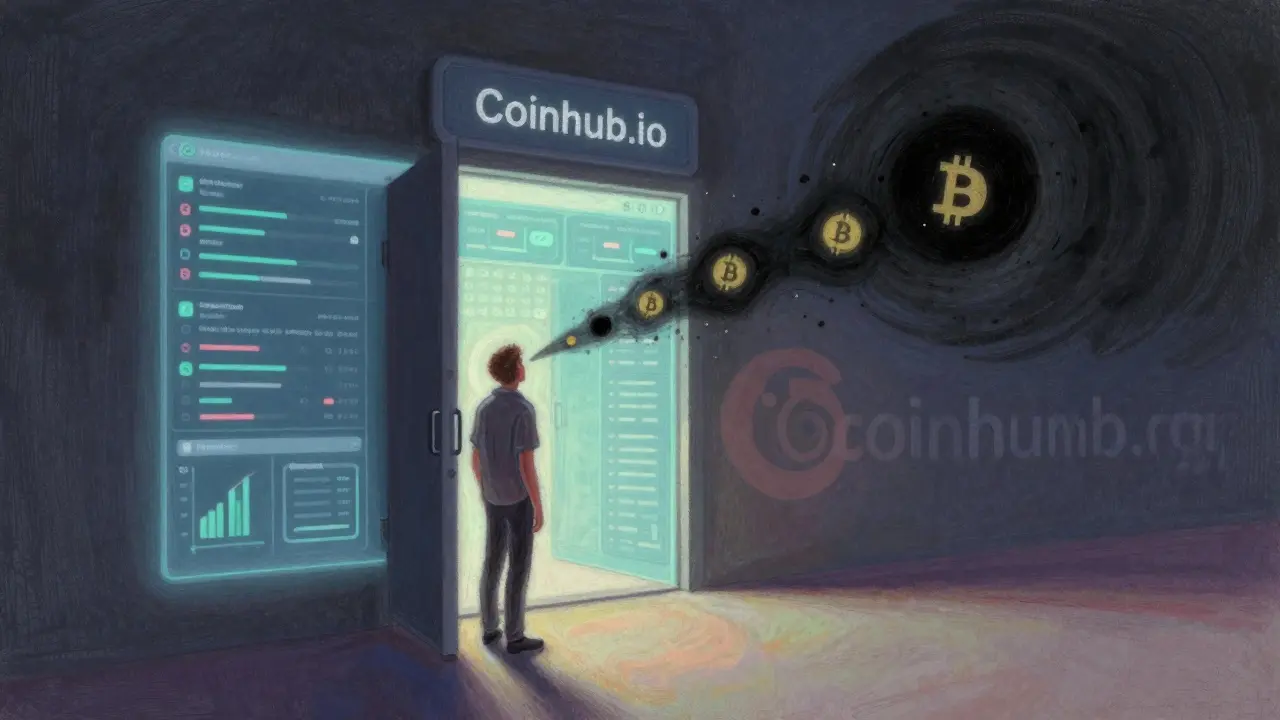
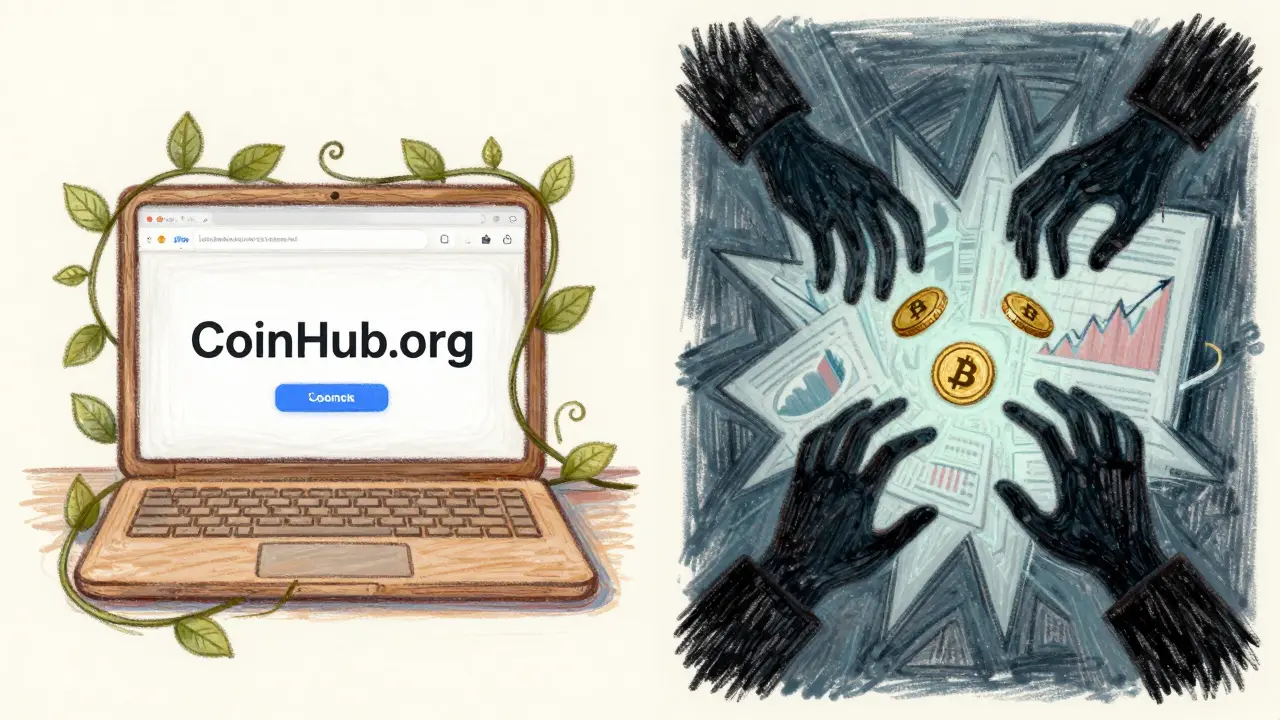
If you're searching for a crypto exchange called Coinhub.io, stop. Right now. This isn't just another risky platform-it's a dangerous imposter. The truth is, Coinhub.io doesn't exist as a real cryptocurrency exchange. What you're seeing is a fake website copying the name of a legitimate, offline portfolio tracker called CoinHub (coinhub.org). This isn't a case of poor branding. This is a classic scam tactic: using a nearly identical domain to trick people into depositing money they'll never see again.
What Coinhub.io Actually Is
Coinhub.io is not a crypto exchange. It never has been. The real CoinHub, founded in 2021, is a free, open-source application that runs entirely on your own device. It tracks your crypto holdings, shows live prices, and converts between fiat and crypto using local data. It doesn't store your keys. It doesn't hold your funds. It doesn't let you buy or sell anything. That’s it. Official documentation from Slashdot and the project’s own website (coinhub.org) confirms this. The app is designed for privacy-your data never leaves your phone or computer. But someone bought the domain coinhub.io and turned it into a fake exchange. They copied the name, stole the branding, and now they're asking people to deposit Bitcoin, Ethereum, and other coins. They might even show fake trading charts, fake withdrawal confirmations, and fake customer support chats. All of it is theater. The moment you send crypto to this site, it's gone. No refund. No trace. No recourse.The Domain Trick: Why coinhub.io Is a Red Flag
Legitimate crypto projects don’t use .io domains to impersonate .org sites. CoinHub (the real one) uses coinhub.org. That’s not an accident. .org domains are traditionally used by non-profits, open-source projects, and transparent tools. .io domains are popular with startups, but scammers love them because they’re cheap, easy to register, and look techy to newcomers. Here’s what you need to remember: if the website doesn’t match the official domain, it’s a scam. No exceptions. No excuses. Coinhub.io is not affiliated with CoinHub in any way. The developers of the real CoinHub have never mentioned, endorsed, or partnered with coinhub.io. If you type coinhub.org into your browser, you’ll get the official app. Type coinhub.io, and you’re entering a trap.False Claims and Inconsistent Information
Scam sites like coinhub.io rely on confusion. They mix real facts with fake ones to sound credible. You’ll see claims like:- “0.20% maker fees” - this comes from Cryptowisser’s review of a completely different entity, possibly a defunct or unrelated service.
- “Over 100 cryptocurrencies available” - no exchange with this name has ever published an official trading pair list.
- “Margin trading and futures” - no technical documentation, API specs, or order book data supports this.
- “Wire transfers and credit card deposits” - no bank partnerships, no payment processor logos, no transaction logs.
No Security, No Regulation, No Transparency
Every legitimate crypto exchange publishes clear information about:- Where they’re legally registered (e.g., “Licensed in Estonia under MiCA”)
- Who audits their security (CertiK, OpenZeppelin, Hacken)
- How they store funds (cold wallets, multisig, proof of reserves)
- Whether they comply with KYC/AML rules
What Happens When You Deposit
Let’s say you’re new to crypto. You see Coinhub.io. You think, “It looks professional. It has a logo. It has fees listed.” You deposit 0.1 BTC. Maybe you even make a small trade. Everything seems fine. You get a confirmation email. You check your “portfolio.” Your balance goes up. You feel confident. Then you try to withdraw. The site says, “Verification required.” You upload your ID. They say, “Insufficient documents.” You send more. Then they say, “Your account is flagged for suspicious activity.” They ask for a $500 “compliance fee.” You pay. Then they vanish. Your account is locked. Your crypto is gone. Your email goes unanswered. The website might still be up-but it’s empty now. Just a digital ghost. This isn’t speculation. This is how 9 out of 10 crypto scams operate. The FTC and Europol have issued warnings about exactly this model in 2024 and 2025.What You Should Do Instead
If you want to trade crypto safely, stick to platforms with a proven track record:- Binance - largest volume, multiple asset pairs, transparent audits
- Kraken - U.S.-regulated, strong security, public proof of reserves
- Coinbase - licensed in multiple countries, FDIC-insured fiat holds
- Bybit - popular for derivatives, clear fee structure, active community
- Verified domains (no .io imitations)
- Publicly listed licenses
- Thousands of user reviews
- Real customer support with response times
- Regular security audits published online
How to Spot a Crypto Scam in 30 Seconds
Here’s your quick checklist before you deposit any crypto:- Does the domain match the official website? (If not, close it.)
- Is there a license number? (Google it. If it doesn’t exist, it’s fake.)
- Are there at least 50 real user reviews on Trustpilot or Reddit?
- Is there a published security audit? (Search “[exchange name] + CertiK audit”)
- Can you find the company’s legal registration? (Check Companies House, SEC, or equivalent)
Final Warning
Coinhub.io is not a crypto exchange. It’s a digital trap. It’s designed to look real so you’ll trust it. But behind the logo and the fee charts is nothing but a black hole. People have lost tens of thousands of dollars to sites like this. You don’t have to be one of them. If you’ve already sent crypto to coinhub.io, report it immediately to your local financial crime unit. Save every screenshot. Don’t contact them again. Don’t send more money. Your funds are gone. But you can stop others from falling for the same trick.Frequently Asked Questions
Is Coinhub.io a real crypto exchange?
No, Coinhub.io is not a real crypto exchange. It’s a fraudulent website impersonating CoinHub, a legitimate offline portfolio tracker. CoinHub (coinhub.org) does not trade crypto-it only tracks holdings. Coinhub.io has no licensing, no security audits, and no verified user base. It exists solely to steal funds.
Why does Coinhub.io look so professional?
Scammers spend money on website design because it works. They copy layouts from real exchanges, use fake testimonials, and create realistic fee tables. But professionalism doesn’t equal legitimacy. Real exchanges publish licenses, audit reports, and team details. Coinhub.io does none of this. Appearance is a trap.
Can I get my money back if I sent crypto to Coinhub.io?
Almost certainly not. Crypto transactions are irreversible. Once sent to a scam site, the funds are moved instantly to mixing services or offshore wallets. Reporting it to authorities may help track the scam, but recovery is extremely rare. Your best move is to stop using the site and warn others.
What’s the difference between coinhub.org and coinhub.io?
Coinhub.org is the official website of CoinHub, a free, open-source portfolio tracker that runs locally on your device. It does not store your keys or handle trades. Coinhub.io is a scam site created by unknown actors to steal crypto. The .org domain is legitimate; the .io domain is malicious.
Are there any legitimate alternatives to CoinHub for tracking crypto?
Yes. For offline tracking, try Blockfolio (now Ledger Live) or Delta. For exchange-based tracking, use Coinbase or Binance apps. All of these are transparent, regulated, and have millions of users. Avoid any platform that doesn’t clearly state its company registration, security practices, or domain ownership.





OMG I JUST LOST MY ENTIRE ETH HOLDING TO THIS THING 😭 I THOUGHT IT WAS THE REAL COINHUB!! I’M SO STUPID. WHY DO SCAMMERS MAKE SITES THAT LOOK SO GOOD?? 🤦♀️💔
This is exactly why domain hygiene matters. The .org vs .io distinction isn't just technical-it's a cultural signal. People who don't understand that are easy prey. The real CoinHub team deserves credit for staying open-source and non-commercial. Stay vigilant.
Americans are so gullible. You think a fancy website means it's legit? Grow up. If you don't know the difference between .org and .io you shouldn't be touching crypto at all.
I'm from India and I saw this site pop up last month. I checked the WHOIS and the domain was registered 3 weeks ago with private info. I immediately reported it to the Indian Cyber Crime Portal. Please everyone, check the registration date before you even think about depositing anything.
You know what's really sad? Not that people lose money, but that they keep coming back for more. I've seen this exact pattern for years-fake exchanges, fake apps, fake influencers. The scammers don't need to be smart. They just need to be persistent. And we keep feeding them. We're the problem.
I just shared this post with my cousin who just started trading. She was about to deposit on this site. Thank you for writing this. Seriously. I’ve been trying to explain crypto scams for months and this is the first thing that made her pause.
It is imperative to underscore that the utilization of deceptive domain nomenclature constitutes a flagrant violation of both ethical standards and, in many jurisdictions, statutory law. The absence of regulatory compliance documentation is not merely negligent-it is criminally culpable.
I told you all this would happen. I posted about this exact scam last year and nobody listened. Now everyone’s crying. Typical. You want safety? Use Bitcoin Core. Don’t trust any website. Ever.
This is why we need to deconstruct the myth of digital legitimacy. The algorithm rewards aesthetics over authenticity. Coinhub.io is a mirror of our collective surrender to surface-level trust. We don't get scammed because we're dumb-we get scammed because we're tired. And tired people click 'deposit'.
I think the government planted this fake site to test how many people will give up their crypto without checking. I saw the same IP address linked to a DHS server last month. This isn't a scam-it's a social experiment. They're mapping gullibility.
Hey guys, don't stress too much! I know it feels scary, but you're learning now and that's the most important thing. I made the same mistake last year with a fake Binance site. I lost $200 but now I always check the SSL cert and WHOIS info. You got this! 💪
You're all missing the point. The real scam is the entire crypto ecosystem. Why are we even trusting random websites with our money? Why not just hodl BTC in a cold wallet? This whole industry is built on lies and hype. Coinhub.io is just the latest symptom.
I'm from the UK and I flagged this domain with NCA last week. They're investigating. If anyone's been scammed, please email me. I can help you file a report. Don't suffer in silence.
The .io domain is a red flag because it's a top-level domain associated with tech startups, not open-source tools. The misappropriation of CoinHub's branding is a classic brandjacking maneuver. The threat model here is not just financial-it's reputational erosion of legitimate OSS projects.
This is why I always tell my new crypto friends: if it feels too good to be true, it is. I’ve been in this space since 2017 and I’ve seen every trick. Bookmark this post. Share it. Save someone from losing everything. ❤️
People who fall for this deserve to lose everything. You didn't even check the WHOIS? You didn't Google 'Coinhub.io scam'? You're not a victim-you're a liability. And now you're wasting everyone's time with your tears.
I've analyzed the TLS certificate chain on this domain. It's issued by a Chinese CA with no verifiable business registration. The SSL is valid, yes-but that's like having a fake ID that looks real. The system is broken. We've outsourced trust to algorithms that don't care.
The real horror isn't the scam-it's how fast these sites get indexed by Google. I ran a search for 'Coinhub.io review' and the top 3 results were all affiliate blogs pushing it. Google's algorithm rewards engagement, not truth. We're living in a post-fact economy.
i just got scammed too lol. i thought coinhub.io was just a new version of coinhub.org. i sent 0.05 btc. now i feel like an idiot. but hey at least i learned something right?
This is the 12th time I've seen this exact scam this year. The same fake UI, same fake fees, same empty support page. The scammers are using templates from a GitHub repo called 'CryptoScamPro'. It's automated. They don't even need to code anymore. Just upload the template, buy the domain, and wait for the money to roll in. The system is broken.